
Furnace Repair Vs Replacement When To Decide: 5 Essential Tips
Decide on furnace repair vs replacement when to decide with this guide covering lifespan, warning signs, and long-term value.
Perfect Climate Heating, Air & Plumbing

Is It Time to Repair or Replace Your Furnace? Here's How to Decide
Knowing furnace repair vs replacement when to decide can save you from spending money on a system that's already on its last legs — or from replacing a furnace that still has years of good service left. If your furnace is acting up this heating season in Evansville, IN or anywhere across our service area, the answer usually comes down to a few key factors: age, repair costs, safety, and efficiency.
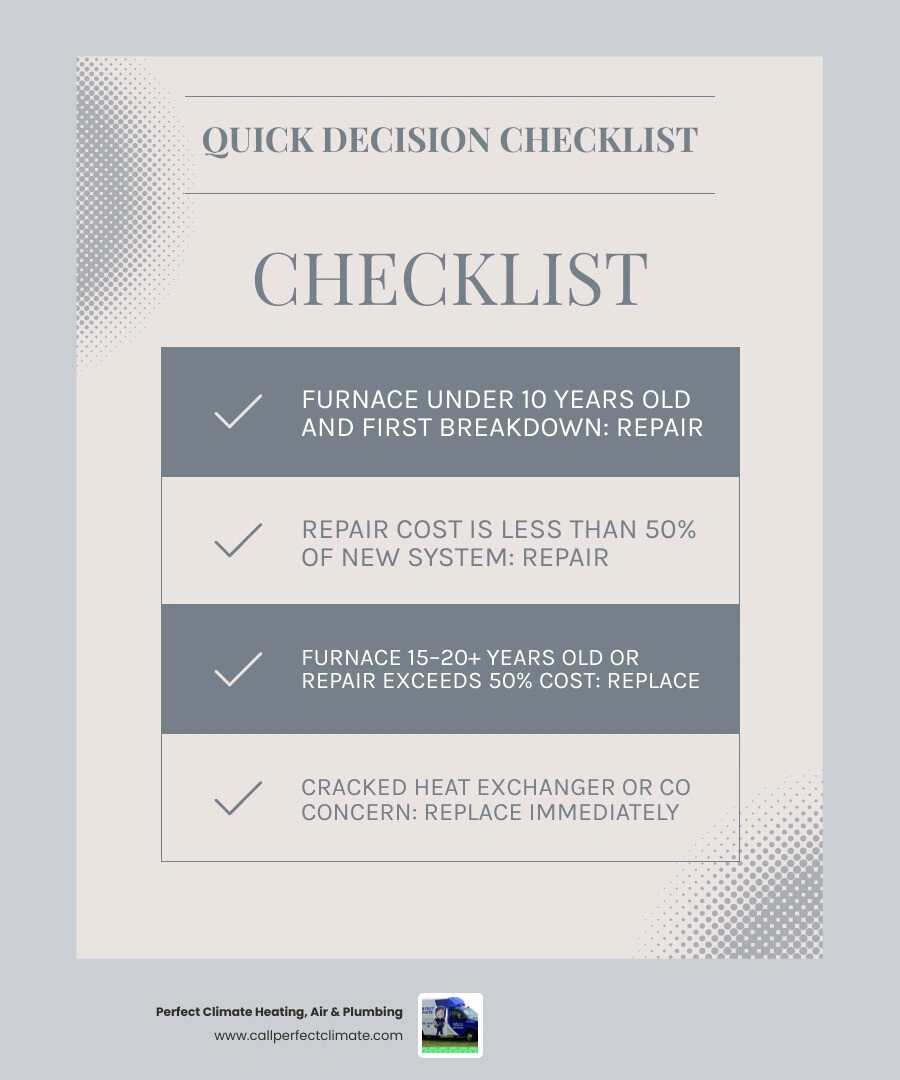
Here's a quick answer based on your situation:
| Situation | Recommended Action |
|---|---|
| Furnace is under 10 years old, first breakdown | Repair |
| Repair cost is less than 50% of a new system | Repair |
| Furnace is 15–20+ years old | Replace |
| Repair cost exceeds 50% of new system cost | Replace |
| Cracked heat exchanger or carbon monoxide concern | Replace immediately |
| Frequent breakdowns (2+ per season) | Replace |
| Rising energy bills despite normal usage | Evaluate for replacement |
| Still under manufacturer warranty | Repair |
Most gas furnaces last between 15 and 20 years with proper care. Once a furnace crosses that threshold — or starts demanding repeated repairs — the math almost always favors replacement. But age alone isn't the whole story. A 12-year-old furnace with a cracked heat exchanger is a safety emergency, while a 10-year-old unit with a failed ignitor is usually a straightforward fix.
The goal of this guide is simple: give you a clear, honest framework so you can make a confident decision without second-guessing yourself when the heat goes out on a cold January night.
Key Factors in Furnace Repair vs Replacement: When to Decide

Making the choice between repairing your current heating system and investing in a brand-new one is rarely a split-second decision. Instead, it requires looking at your heating system as a whole. We look at a furnace much like a physician looks at a patient: we evaluate its history, its current symptoms, and its overall structural integrity.
When you are caught in the middle of a cold winter night without heat, it is easy to make a hasty decision just to get the warm air flowing again. However, taking a step back to evaluate the system's reliability and operational lifespan will save you from throwing good money after bad. To help you navigate this complex choice, we have developed a comprehensive Ultimate Repair vs Replace HVAC Guide to walk you through every financial and technical consideration.
Evaluating Furnace Lifespan and Climate Impact
The operational lifespan of your heating system depends heavily on the fuel source it uses:
- Gas Furnaces: Typically last 15 to 20 years. Once they pass the 15-year mark, the probability of major component failures increases dramatically.
- Electric Furnaces: Can often last 20 to 30 years because they do not experience the intense thermal stress of combustion. However, they can be much more expensive to operate over time.
- Oil Systems: Generally have a lifespan of 15 to 20 years, though they require highly consistent maintenance to reach this age.
Here in Southern Indiana — from Evansville and Newburgh to Princeton and Mount Carmel, IL — our winters bring a mix of freezing temperatures, heavy ice, and high humidity. Because our weather can swing wildly, our furnaces work incredibly hard to maintain a stable indoor temperature. This constant cycling during our long heating seasons puts extra wear and tear on mechanical parts.
If your furnace is approaching the end of its typical lifespan, it is crucial to recognize the warning signs before a total breakdown occurs. You can read more about these timeline indicators in our guide on Furnace Replacement: Time Signs.
Applying the 50% Rule to Your Decision
One of the most reliable financial benchmarks in the HVAC industry is the 50% Rule. The rule is simple: if the cost of a single repair exceeds 50% of the cost of a brand-new heating system, replacement is almost always the smarter long-term investment.
For older systems, we also have to look at the frequency of repairs. If you are paying for minor repairs multiple times a year, those costs quickly add up to the price of a new, reliable unit. To help you weigh these upfront repair costs against the long-term value of a new installation, check out our detailed analysis on Should I Repair or Replace My HVAC System.
Critical Warning Signs That Require Immediate Attention
While some furnace issues merely cause minor inconveniences, others represent serious safety hazards to your household. Knowing which signs point to a simple repair and which ones demand an immediate system replacement can keep your family safe. For a deeper dive into these urgent indicators, see our guide on Furnace Replacement: Warning Signs.
Red Flags and Safety Concerns in Furnace Repair vs Replacement: When to Decide
There is one line we never cross when it comes to furnace repairs: safety. If a furnace poses a physical threat to your home or health, the debate between repair and replacement is instantly over.
- Cracked Heat Exchanger: The heat exchanger is the metal chamber that keeps toxic combustion gases separate from the clean air circulating through your home. If this metal cracks due to years of expanding and contracting, carbon monoxide can leak directly into your living spaces. Because a cracked heat exchanger is incredibly expensive to replace and carries fatal risks, finding a crack almost always means it is time for an immediate furnace replacement.
- Yellow or Flickering Pilot Flame: A healthy gas burner should always produce a steady, crisp blue flame. A yellow, dancing, or flickering flame indicates incomplete combustion, which means your furnace is producing carbon monoxide.
- Soot and Rust: Visible soot around the furnace burners or heavy rust on the flue pipe indicates that the system is no longer venting combustion gases safely.
- Carbon Monoxide Alarms: If your CO detector sounds, immediately evacuate your home, call emergency services, and do not turn your heating system back on until a professional has inspected it.
To learn how to spot these dangers early and understand how they are diagnosed, explore our article on Common Furnace Problems and Solutions.
Rising Energy Bills and Declining Efficiency
Have you noticed your monthly utility bills creeping up even though your heating habits haven't changed? As furnaces age, their mechanical components wear out, and their heat exchangers become coated with dust and scale. This forces the system to run longer and work harder to produce the same amount of heat.
This drop-off in performance is directly tied to the unit's AFUE (Annual Fuel Utilization Efficiency) rating. Older conventional furnaces might have been rated at 80% AFUE when they were new, meaning 20% of the fuel they burned was lost up the chimney. Over time, that efficiency drops even lower. Upgrading to a modern condensing furnace can instantly boost your efficiency to 96% AFUE or higher, saving you significant money on your monthly energy bills. If you want to see if your system is showing these efficiency-related warning signs, read our checklist on Furnace Replacement: Needs Signs.
Long-Term Value and Modern Benefits of Upgrading
While repairing an old furnace might seem like the easiest way to save money today, upgrading to a new system often provides far better long-term value. Modern heating technology has advanced significantly over the last decade, offering levels of comfort and efficiency that older systems simply cannot match. For more information on what a new system can do for your home, see our article on When to Consider Furnace Replacement.
Some of the standout benefits of modern furnaces include:
- Variable-Speed Blowers: Unlike older furnaces that are either 100% on or 100% off, variable-speed blowers run at lower, quieter speeds for longer periods. This eliminates hot and cold spots, keeps your home at a perfectly consistent temperature, and saves electricity.
- Smart Thermostat Compatibility: Modern systems integrate seamlessly with smart thermostats, allowing you to control your heating remotely, set custom schedules, and monitor your energy usage from your phone.
- Enhanced Warranties: A new furnace comes with a fresh manufacturer’s warranty, often covering major parts for 5 to 10 years and the heat exchanger for 20 years or even a lifetime. This gives you complete peace of mind and eliminates unexpected repair costs.
- Quieter Operation: Advanced cabinet insulation and combustion technology mean you will barely hear your new furnace running.
Homeownership Plans and Future Goals
Your long-term plans for your home should play a major role in your furnace repair vs replacement when to decide evaluation.
If you plan to stay in your home for many years, investing in a high-efficiency system makes perfect sense. You will fully recoup your investment through lower monthly utility bills, improved comfort, and years of worry-free operation.
On the other hand, if you plan to sell your home in the near future, you might think a quick repair is the best route. However, an ancient, unreliable furnace is a major red flag for home buyers and home inspectors. Installing a new, warrantied furnace can boost your home's property value, make your listing much more attractive, and prevent negotiations from stalling during the closing process. For a complete breakdown of these ownership factors, read Furnace Replacement: Key Considerations.
Professional HVAC Guidance for Furnace Repair vs Replacement: When to Decide
The best way to make an informed decision is to have a certified professional evaluate your system. A trained technician can perform a combustion analysis, inspect the heat exchanger with specialized cameras, and help you calculate whether a repair or a replacement makes the most sense for your budget.
Additionally, if you decide to replace your system, a professional must perform a proper load calculation (Manual J) to ensure your new furnace is perfectly sized for your home. An oversized or undersized furnace will short-cycle, wear out prematurely, and fail to keep you comfortable. For homeowners in the Evansville area, you can learn more about what to expect during a professional inspection in our Furnace Repair Evansville Complete Guide.
Frequently Asked Questions About Furnace Decisions
How long does a typical gas furnace last?
With regular preventative maintenance and professional tune-ups, a standard gas furnace typically lasts between 15 and 20 years. In areas with cold winters like Southern Indiana, systems that are not maintained may begin to fail closer to the 12-to-15-year mark.
What is the 50% rule for HVAC systems?
The 50% rule dictates that if the cost to repair your current furnace is more than half the cost of purchasing and installing a brand-new system, you should choose replacement. This is especially true for systems that are over 10 to 12 years old and out of warranty.
Can a cracked heat exchanger be repaired safely?
No. A cracked heat exchanger cannot be safely patched, welded, or repaired. Because a crack allows deadly carbon monoxide to leak into your home’s air stream, the heat exchanger must be entirely replaced. On older systems that are out of warranty, replacing the heat exchanger is rarely cost-effective, making a full furnace replacement the safest and smartest choice.
Conclusion
Deciding whether to repair or replace your furnace doesn't have to be a stressful guessing game. By focusing on the system's age, evaluating the safety of its components, and applying the 50% rule to repair costs, you can make a choice that protects both your family's comfort and your financial well-being.
At Perfect Climate Heating, Air & Plumbing, we are proud to serve our neighbors in Haubstadt, Evansville, Newburgh, Princeton, Boonville, and the surrounding communities. Whether you need a fast, reliable repair to get through a cold spell or want to explore your options for a high-efficiency upgrade, our experienced team is here to provide honest, professional guidance.
Schedule professional heating services today with the team at Perfect Climate Heating, Air & Plumbing, and let us help you keep your home cozy all winter long.
Need Help?
Contact us today to discuss your needs. Our team is ready to help.
About the Author
Perfect Climate Heating, Air & Plumbing
Recent Posts
- The Role of a PRV (Pressure Reducing Valve) in Protecting Your Plumbing
- Navigating Federal Tax Credits for High-Efficiency Heat Pump Upgrades
- Bypass vs. Fan-Powered Whole-House Humidifiers: A Design Choice for Evansville Homes
- Why Your Gas Furnace Short-Cycles When You First Turn It On in Autumn
- Upgrading Your Electrical Panel to Handle a New High-Efficiency HVAC System
Related Articles

The Role of a PRV (Pressure Reducing Valve) in Protecting Your Plumbing
Banging pipes and running toilets are often symptoms of high municipal water pressure. Discover how a pressure reducing valve acts as a shock absorber to save your fixtures from hidden damage.
Read Article
Navigating Federal Tax Credits for High-Efficiency Heat Pump Upgrades
Read Article
Bypass vs. Fan-Powered Whole-House Humidifiers: A Design Choice for Evansville Homes
Preparing your home for the dry winter ahead means choosing the right humidifier. Discover how your square footage and duct layout determine whether a bypass or fan-powered unit is the best fit.
Read Article
Why Your Gas Furnace Short-Cycles When You First Turn It On in Autumn
That frustrating three-minute shutdown cycle on the first chilly morning is usually a built-in safety response. Find out if it is a simple airflow issue or a dirty flame sensor.
Read Article
Upgrading Your Electrical Panel to Handle a New High-Efficiency HVAC System
Surprised by a quote to overhaul your breaker box before a heat pump installation? This electrical upgrade is a mandatory safety requirement to support modern heating systems.
Read Article
The Truth About Chemical Drain Cleaners and Your PVC Pipes
Liquid drain cleaners seem like a quick fix, but they trigger a violent chemical reaction inside your plumbing. See how this intense heat silently warps and melts residential PVC p-traps.
Read ArticleReady to Get Started?
Whether you need a repair, maintenance, or a new installation, our expert team is here to help.