How to Apply for Energy Rebates in Indiana: 2025 Easy Guide
Learn how to apply for energy rebates in Indiana with our step-by-step guide covering HOMES and HEAR programs, eligibility, and qualifying upgrades.
Perfect Climate Heating, Air & Plumbing

Overview of Indiana's Energy Rebate Programs
Knowing how to apply for energy rebates in indiana can put real money back in your pocket when you upgrade your home's heating, cooling, or insulation. Here's a quick overview of the process:
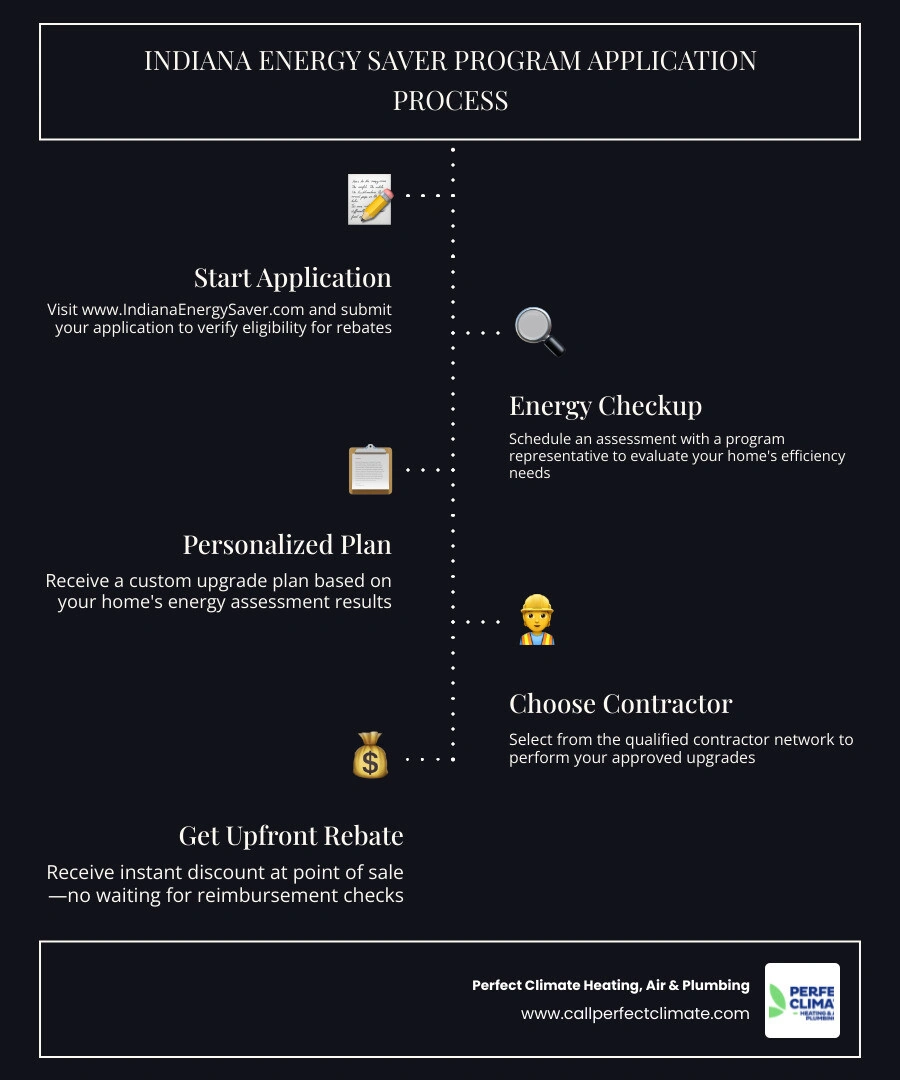
- Visit www.IndianaEnergySaver.com to start your application
- Submit your application through the online portal to verify eligibility
- Schedule an energy checkup with a program representative
- Receive a personalized plan outlining your recommended upgrades
- Work with a qualified contractor for installation — your rebate is applied as an upfront discount at the time of service
Indiana homeowners now have access to the Indiana Energy Saver Program, launched in May 2025 and backed by approximately $182 million in federal funding. The program combines two separate rebate offerings — the Home Efficiency Rebate (HOMES) and the Home Appliance Rebate (HEAR) — into a single, streamlined application. That means less paperwork and more savings for Hoosiers looking to cut energy costs and improve home comfort.
Whether you're a homeowner in Evansville, Haubstadt, or anywhere across Indiana, these rebates can significantly reduce what you pay out of pocket for qualifying HVAC upgrades, insulation, and more. And unlike many rebate programs, these discounts are applied upfront through a qualified contractor — no waiting for a check in the mail.
Relevant articles related to how to apply for energy rebates in indiana:
The launch of the Indiana Energy Saver Program by the Indiana Office of Energy Development (OED) represents a massive step forward for energy efficiency in our state. Backed by $182 million in federal formula funds, this initiative is specifically designed to help Hoosier families reduce their monthly utility bills while upgrading to high-efficiency equipment.
The program is split into two distinct, yet complementary pathways, depending on your goals and household income:
- Home Efficiency Rebates (HOMES): This pathway focuses on whole-home energy retrofits. To qualify, your upgrades must achieve a minimum of 20% modeled energy savings. It's a fantastic option for comprehensive projects like whole-house insulation, professional air sealing, and high-efficiency HVAC installations.
- Home Appliance Rebates (HEAR): Aimed at low- to moderate-income households, this pathway provides robust discounts on specific high-efficiency electric appliances, such as heat pump water heaters, space-heating heat pumps, and even necessary electrical panel or wiring upgrades.
By integrating both of these options into a single statewide application, the OED has made it easier than ever to secure funding. If you want to dive deeper into how these state programs can improve your heating and cooling systems, take a look at our detailed guide on Indiana Energy Rebates for HVAC Upgrades.
Step-by-Step Guide: How to Apply for Energy Rebates in Indiana

Navigating state programs can sometimes feel like trying to assemble flat-pack furniture without the instructions. Fortunately, applying for the Indiana Energy Saver Program is straightforward when you follow these core steps:
- Submit the Online Application: Head over to the official portal at www.IndianaEnergySaver.com. This user-friendly portal is where you will input your household details, verify your income or categorical eligibility, and officially request to participate in the program.
- Schedule Your Energy Checkup: Once your initial application is approved, you will be connected with a program representative to arrange an energy checkup. This assessment helps determine your home's current energy performance and identifies the most impactful upgrades.
- Get Your Personalized Plan: You'll receive a customized plan detailing the specific improvements that qualify for the program, along with estimated savings.
- Select an Approved Contractor: You must work with an installation professional from the program's registered network to ensure all safety, quality, and efficiency standards are met.
- Enjoy Upfront Savings: Because the program is designed to deliver point-of-sale discounts, your qualifying rebate is deducted directly from your contractor's invoice. You only pay the remaining balance!
Gathering Required Documentation to Apply for Energy Rebates in Indiana
To keep your application moving smoothly and avoid delays, it is best to gather your paperwork before you log into the portal. The state requires verification across several key areas:
- Proof of Ownership or Residency: If you are a homeowner, you can use property tax records, a recent mortgage statement, or home insurance documents. Renters can provide a lease agreement along with a utility bill to establish residency.
- Proof of Income: You have two options here. Option A (Categorical Eligibility) allows you to upload an official award or participation letter from another approved state or federal program with similar income limits (such as SNAP, LIHEAP, or Medicaid). Option B (Income Documentation) requires you to submit tax returns, W-2s, or recent pay stubs for all adult members of your household.
- Utility Usage History: You may need to provide up to 13 months of utility bills or sign a release allowing your utility provider to share usage data directly with the program.
Tip: For security, make sure to redact any sensitive information, like Social Security numbers, from your documents before uploading them. If your application is missing any details, the program will notify you, and you will have 30 calendar days to submit the missing paperwork before your application is closed.
Working with Contractors to Apply for Energy Rebates in Indiana
One of the best design choices of the Indiana Energy Saver Program is that you do not have to pay full price upfront and wait months for a check. Instead, rebates are delivered as immediate point-of-sale discounts.
To make this possible, you must work with a licensed professional who is enrolled in the program's Qualified Contractor Network. These contractors are vetted to ensure they possess the necessary licensing, liability insurance, and technical training to install modern high-efficiency equipment properly.
When you choose a qualified professional to perform a Modern Heat Pump System Upgrade, they will handle the technical calculations, verify that the equipment meets all efficiency thresholds, and apply the rebate discount directly to your final bill.
Qualifying Upgrades and Stacking Incentives
Whether you are looking to replace an aging air conditioner or completely overhaul your home's thermal boundary, a wide range of upgrades qualify for these programs:
- Whole-Home Energy Efficiency (HOMES): Covers insulation, comprehensive air sealing, and high-efficiency HVAC equipment that achieves at least 20% modeled energy savings.
- Electric Appliances and Equipment (HEAR): Includes heat pump water heaters (rebates up to $1,750), space-heating and cooling heat pumps (rebates up to $8,000), and electrical upgrades like panels or rewiring.
But the savings don't stop with state-level programs. Homeowners in Southwestern Indiana can often stack these state rebates with local utility incentives and federal tax credits.
Local utility providers like CenterPoint Energy (serving Evansville, Newburgh, and surrounding areas) offer rebates on high-efficiency natural gas furnaces, smart thermostats, and AC tune-ups. Other major providers like NIPSCO, Duke Energy, and AES Indiana, along with local REMC cooperatives, have their own unique residential energy efficiency programs.
When planning your system upgrades, it is highly beneficial to understand how different systems compare and how proper installation affects performance. Explore our guide on Standard Efficiency vs High Efficiency HVAC Comparison to see which tier fits your goals, and learn How Proper HVAC Sizing Affects Comfort and Efficiency to ensure your new system is perfectly calibrated for your home.
Additionally, you can explore further savings through Federal Tax Credits for Heat Pump Upgrades, review your Energy Efficient AC Installation Options, and discover modern Energy Efficient AC Solutions that keep your home perfectly comfortable all year long.
Frequently Asked Questions about Indiana Energy Rebates
Who is eligible for the HEAR and HOMES programs?
The HOMES program is open to all Indiana homeowners, regardless of income. However, the rebate amounts are tiered, meaning low-income households (earning under 80% of the Area Median Income) are eligible for much higher rebate percentages, sometimes covering up to 100% of the project costs up to program caps.
The HEAR program is exclusively reserved for low- to moderate-income households earning less than 150% of the Area Median Income (AMI). Both programs are open to single-family homeowners, renters (with landlord approval), and multifamily building owners. New construction properties are not eligible for these rebates; the programs are strictly designed for retrofitting existing homes.
Can I get a retroactive rebate for past HVAC work?
Yes, but only under very specific conditions. Retroactive rebates are only available through the HOMES program for qualifying energy efficiency retrofits completed between August 16, 2022, and May 14, 2025. You must be able to provide comprehensive documentation, including detailed contractor invoices, equipment specifications, and proof that the work met the strict 20% energy savings requirement.
The HEAR program does not allow retroactive rebates under federal Department of Energy guidelines. If you are currently debating whether to keep patching up an old system or invest in a new one, read our guide on Should I Repair or Replace My HVAC System, consult the Ultimate Repair vs Replace HVAC Guide, and learn Why HVAC Replacement Is a Smart Investment for your long-term comfort and savings.
How do I check my Area Median Income (AMI) for eligibility?
Because eligibility and rebate tiers are closely tied to your local Area Median Income, you will need to check the specific limits for your county and household size. You can easily find this information using the HUD AMI tool or the Pacific Northwest National Laboratory (PNNL) tables. These resources break down the exact income thresholds by county, ensuring you know exactly where your household stands before you apply.
Conclusion
Maximizing your home comfort while lowering your monthly utility bills has never been more accessible. With $182 million in funding available through the Indiana Energy Saver Program, there is no better time to upgrade your home's heating, cooling, and insulation.
At Perfect Climate Heating, Air & Plumbing, we are proud to serve our local communities across Southwestern Indiana — including Haubstadt, Evansville, Newburgh, Princeton, Boonville, Fort Branch, and nearby areas. Our experienced, friendly team is here to help you navigate the process, select qualifying high-efficiency systems, and perform professional installations that maximize your energy savings.
Ready to make your home more comfortable and energy-efficient? Contact us today to schedule a consultation, or visit our Perfect Climate Services page to learn more about how we can help you save.
Need Help?
Contact us today to discuss your needs. Our team is ready to help.
About the Author
Perfect Climate Heating, Air & Plumbing
Recent Posts
- Troubleshooting Mid-Fall Heating Odors Before Searching for AC Repair Near Me
- Why Does My Furnace Smell Like Burning? Fall HVAC Troubleshooting
- Why We Install Whole-Home Surge Protectors on Modern HVAC Equipment
- The Anatomy of a Frost-Free Sillcock and Why It Matters in Mount Carmel
- Why We Don't Recommend DIY Freon Recharging for Residential AC Units
Related Articles

Troubleshooting Mid-Fall Heating Odors Before Searching for AC Repair Near Me
Read Article
Why Does My Furnace Smell Like Burning? Fall HVAC Troubleshooting
Read Article
Why We Install Whole-Home Surge Protectors on Modern HVAC Equipment
Modern variable-speed furnaces are essentially large computers. Leaving them vulnerable to grid fluctuations can destroy a brand-new circuit board in seconds during a minor storm.
Read Article
The Anatomy of a Frost-Free Sillcock and Why It Matters in Mount Carmel
Standard outdoor spigots trap water against exterior walls, risking burst pipes during deep freezes. A frost-free fixture moves the shut-off valve safely inside your heated home.
Read Article
Why We Don't Recommend DIY Freon Recharging for Residential AC Units
A sudden late-season AC breakdown can make a quick DIY refrigerant kit tempting. Understand the mechanical dangers of overcharging before you accidentally ruin your compressor.
Read Article
Identifying the Source of Sewer Gas Smells in Your Basement Floor Drain
A sudden rotten egg odor in your basement is alarming, but the fix is often simple. We explain how dried p-traps let municipal gases inside and when you actually need to call a licensed plumber.
Read ArticleReady to Get Started?
Whether you need a repair, maintenance, or a new installation, our expert team is here to help.