
Tankless Water Heater Benefits for Your Home: Essential Guide
Discover tankless water heater benefits for your home including endless hot water, energy savings, and space-saving design.
Perfect Climate Heating, Air & Plumbing

Why Tankless Water Heater Benefits for Your Home Are Worth Knowing
The tankless water heater benefits for your home go well beyond just avoiding that dreaded mid-shower temperature drop. If you want the quick version, here are the core advantages:
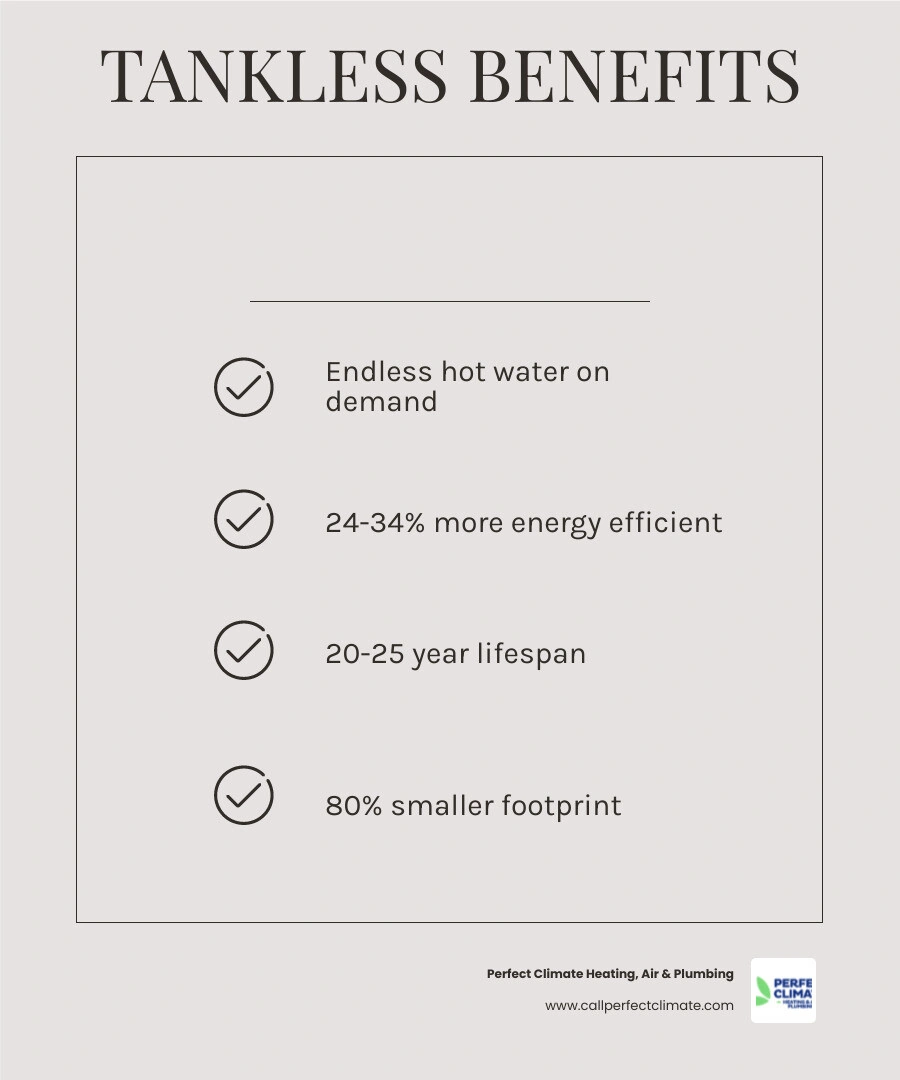
- Endless hot water - heats water on demand, so you never run out
- Energy savings - 24–34% more efficient than traditional tank models for average households
- Longer lifespan - lasts 20–25 years compared to 8–12 years for standard tanks
- Space savings - wall-mounted units take up roughly 80% less space than a traditional tank
- Lower flood risk - no stored water means no catastrophic tank leak or flood damage
- Reduced utility bills - most households save meaningfully each year on energy costs
Most homeowners only think about their water heater when something goes wrong — like standing in a shower that suddenly turns ice cold, or realizing the dishwasher and a simultaneous shower are too much for the tank to handle. A tankless system works differently. Instead of storing and continuously reheating a large tank of water, it heats water instantly as it flows through the unit. That single difference drives nearly every benefit on the list above.
Whether you're replacing an aging water heater or planning a home upgrade, understanding how tankless systems work — and whether one fits your household — can save you real money and real frustration over the long run.
Tankless water heater benefits for your home word guide:
- drain and sewer line maintenance tips
- how to protect your plumbing from freezing
- plumbing tips for midwest homeowners
What is a Tankless Water Heater and How Does It Work?
Unlike a traditional water heater that keeps 40 to 60 gallons of water hot 24 hours a day, a tankless water heater only heats water when you turn on a hot water tap. This is why they are often referred to as "on-demand" or "instantaneous" water heaters.
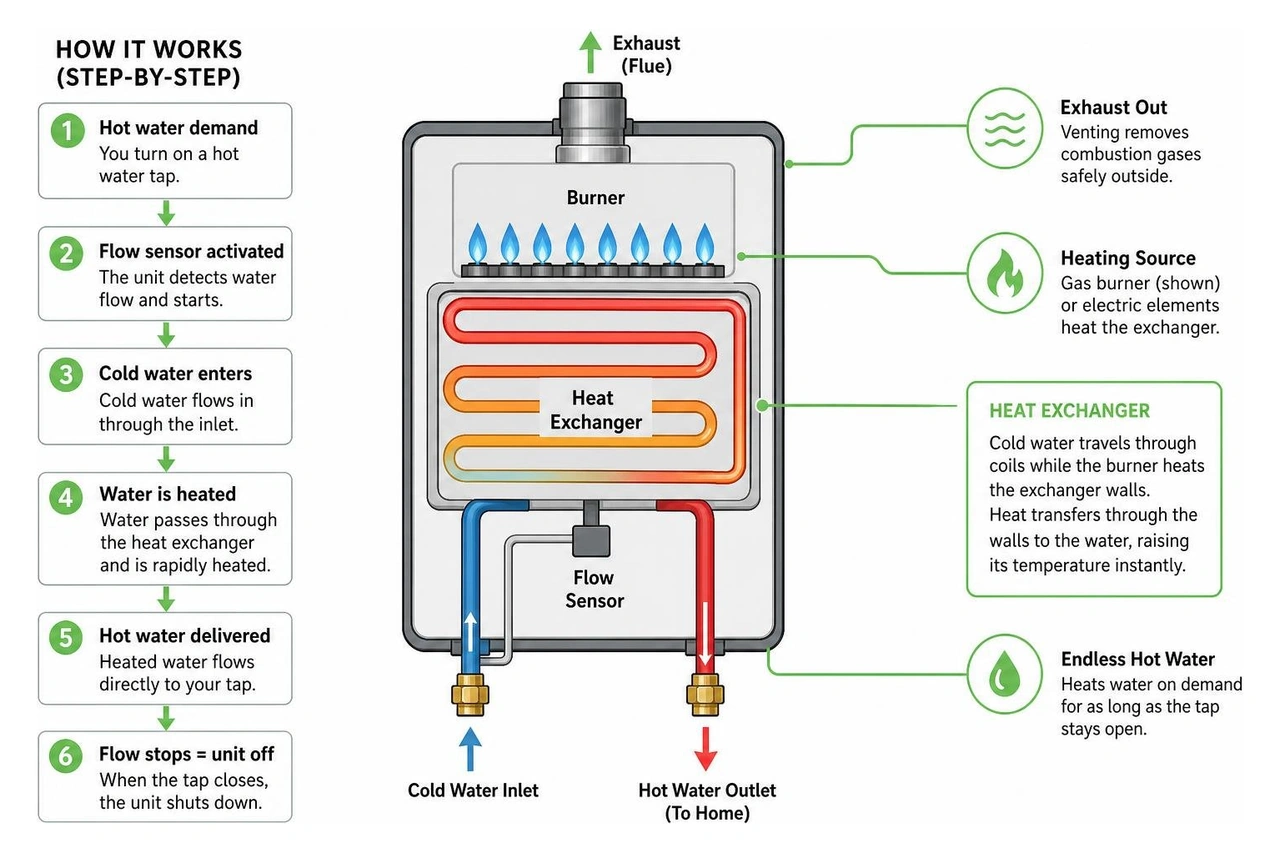
The magic happens the moment you open a hot water valve. A flow sensor inside the unit detects the movement of water and instantly activates the heating source. Cold water flows into the unit and travels through a high-efficiency heat exchanger. Depending on the model you choose, either powerful gas burners or heavy-duty electric elements rapidly transfer heat to the water as it passes through.
Once the water reaches your desired temperature, it flows directly to your shower, sink, or appliance. The rate at which this water is heated and delivered is measured in gallons per minute (GPM). Because there is no storage tank to deplete, the unit will continue heating water for as long as the tap remains open. If you are looking to install or upgrade a system in Southern Indiana, our team provides expert installation for a Tankless Water Heater Evansville IN to ensure your home has a reliable on-demand system.
Traditional Tanks vs. Tankless Water Heater Benefits for Your Home
To truly appreciate the tankless water heater benefits for your home, it helps to compare them side-by-side with traditional storage tank models. Standard heaters act like a thermal battery. They work slowly to heat up a large volume of water and then spend energy keeping it hot all day and night, even when you are sleeping or at work. Tankless systems, by contrast, act like a pass-through processor—running only when active.
| Feature | Traditional Tank Water Heater | Tankless Water Heater |
|---|---|---|
| Water Storage | Stores 40 to 80 gallons | 0 gallons (Heats on demand) |
| Physical Size | Approx. 60" tall x 24" wide | Approx. 28" tall x 20" wide x 10" deep |
| Energy Waste | High standby energy loss | No standby energy loss |
| Lifespan | 8 to 12 years | 20 to 25 years (with maintenance) |
| Water Damage Risk | High (catastrophic tank rupture risk) | Extremely low (no stored water volume) |
| Hot Water Supply | Limited to tank capacity | Endless (within flow rate limits) |
This comparison highlights why so many homeowners are making the switch. Traditional tanks are bulky, prone to gradual interior corrosion, and represent a continuous energy drain. If you live in Southern Indiana, upgrading to a modern system with a Tankless Water Heater Newburgh IN can help you reclaim valuable square footage and eliminate the risk of a catastrophic tank failure.
Key Tankless Water Heater Benefits for Your Home
Choosing a tankless water heater brings several immediate improvements to your daily routine and your home's physical layout. The most obvious benefit is the steady, uninterrupted flow of hot water. If you have a large family, you no longer have to negotiate shower schedules or worry about being the last person in line for the morning rush.

Another substantial benefit is the compact physical footprint. Traditional tanks are massive cylinders that often dominate utility closets, basements, or garage corners. A tankless unit is small enough to be wall-mounted in tight spaces, such as a pantry, a small closet, or even a utility room. By mounting the unit on the wall, you open up valuable floor space for storage or other home uses.
For households in our local service areas, installing a Tankless Water Heater Princeton IN is an excellent way to modernize your utility spaces while securing a dependable, continuous hot water supply.
Energy Efficiency and Lower Utility Bills
The primary driver behind the long-term financial savings of a tankless system is the elimination of standby energy loss. Traditional tank heaters cycle on and off throughout the day to keep their stored water at a set temperature, wasting energy when no one is home. Tankless systems only consume energy when a faucet is turned on.
According to the U.S. Department of Energy:
- For homes using 41 gallons or less of hot water daily, tankless water heaters are 24% to 34% more energy-efficient than conventional storage tank heaters.
- In larger households using around 86 gallons per day, tankless units still provide an 8% to 14% energy efficiency advantage.
- Overall, a tankless water heater can conserve 27% to 50% more energy than a traditional model when installed at individual hot water outlets.
These efficiency gains translate directly into lower monthly utility bills. The average household can save hundreds of dollars every year by making the switch. Typically, families save between $100 and $200 annually with a gas tankless system, or $50 to $100 annually with an electric model. Many high-efficiency condensing gas models carry Energy Star certification, making them eligible for federal tax credits and local utility rebates. If you are located in Knox County, upgrading to a Tankless Water Heater Vincennes IN can help you start keeping more money in your pocket every month.
Extended Lifespan and Long-Term Reliability
A water heater is a major home investment, which is why equipment longevity is a critical factor. Traditional storage tank water heaters typically only last from 8 to 12 years. Over time, the constant exposure to standing water causes the steel tank to corrode, eventually leading to structural failure and leaks.
Tankless water heaters, on the other hand, last five to 10 years longer than tank water heaters. With proper maintenance, a high-quality tankless system offers 20 to 25 years of reliable use. Because they do not store water, they are far less susceptible to the rust and corrosion that dooms standard tanks.
Furthermore, tankless systems are designed with replaceable components. If a single part like a heating element, flow sensor, or control board wears out, it can usually be replaced individually without needing to scrap the entire unit. This modular design makes them incredibly durable over the long haul. For homeowners in Gibson County, investing in a Tankless Water Heater Haubstadt IN ensures a long-term plumbing solution that will serve your home reliably for decades.
Important Considerations Before Switching to Tankless
While the benefits are impressive, switching to a tankless water heater is not a simple plug-and-play swap. It requires careful planning and a clear understanding of your household's hot water usage patterns. Because a tankless system heats water dynamically, its performance is limited by its maximum flow rate capacity.
When multiple hot water fixtures run at the same time—such as a washing machine, a dishwasher, and a shower—the total demand can sometimes exceed the unit's ability to heat the incoming cold water. Additionally, geographic location plays a role. In cold climates, the temperature of the incoming groundwater drops significantly during the winter months. This means the water heater has to work much harder to raise the water to a comfortable temperature, which can reduce the effective flow rate of the unit.
Before making the transition, it is highly recommended to have a professional plumber assess your home's plumbing layout and gas or electrical infrastructure. For residents in Wabash County, our team can evaluate your needs and install a Tankless Water Heater Mount Carmel IL that is perfectly sized for your home's peak demand.
Sizing, Fuel Types, and Tankless Water Heater Benefits for Your Home
Selecting the right tankless water heater involves choosing between gas and electric models and calculating your home's peak Gallons Per Minute (GPM) requirement.
- Gas Tankless Heaters: Typically offer higher flow rates, ranging from 5 to 10 GPM. They are ideal for larger households with multiple bathrooms. However, they require proper venting (often Category III stainless steel or specialized PVC) and may require upgrading your gas line to a larger diameter to handle the high BTU demand of the burners.
- Electric Tankless Heaters: Usually deliver between 2 to 5 GPM, which is suitable for smaller homes, apartments, or point-of-use applications. They require no venting, but they have substantial electrical demands. A whole-home electric unit may require multiple dedicated double-pole breakers, which might necessitate upgrading your home's main electrical panel.
Calculating your peak demand is straightforward: add up the GPM of all fixtures you expect to run simultaneously. For example, a standard shower head uses about 2.0 to 2.5 GPM, while a dishwasher uses roughly 1.0 to 1.5 GPM. If you plan to run both at once, you will need a unit capable of delivering at least 4.0 GPM at your local winter groundwater temperature. If you are in Richland County, we can help you navigate these calculations and select a Tankless Water Heater Olney IL that perfectly balances efficiency and performance.
Maintenance and Water Quality Factors
To keep your tankless water heater running efficiently for its full 20-to-25-year lifespan, regular maintenance is essential. The primary threat to a tankless unit's heat exchanger is mineral scale buildup. When hard water is heated, dissolved calcium and magnesium precipitate out of the water and cling to the hot surfaces inside the heat exchanger. Over time, this scale acts as an insulating barrier, forcing the unit to run hotter and work harder, which degrades efficiency and can cause premature component failure.
To prevent this, we recommend:
- Annual Flushing: Flush the unit once a year using a simple vinegar solution to dissolve and remove mineral scale.
- Water Softeners: If your home has highly hard water, installing a water softener or water conditioning system is highly recommended to protect your plumbing and appliances.
- Regular Filter Cleaning: Clean the unit’s inline water filter every six months to keep debris from restricting water flow.
With regular care, a tankless system will continue to operate at peak efficiency. If you are in Lawrence County, you can count on us to handle your routine maintenance or install a Tankless Water Heater Lawrenceville IL equipped with scale-reduction technology. We also serve surrounding areas with dedicated plumbing care, including Tankless Water Heater Owensville IN, Tankless Water Heater Elberfeld IN, Tankless Water Heater West Salem IL, Tankless Water Heater Hazleton IN, and Tankless Water Heater Oakland City IN.
Frequently Asked Questions About Tankless Water Heaters
Do tankless water heaters provide an endless supply of hot water?
Yes, a tankless water heater can provide a continuous, endless supply of hot water for a single fixture because it heats the water as it flows. However, this "endless" supply is subject to the unit's maximum flow rate capacity. If you try to run multiple high-demand hot water fixtures at the exact same time, the unit may struggle to keep up, leading to a drop in water pressure or temperature. Proper sizing by a professional is key to enjoying unlimited hot water without interruptions.
How long do tankless water heaters typically last compared to tank models?
Tankless water heaters typically last between 20 and 25 years with proper maintenance, which is roughly double the lifespan of traditional tank models (which usually last only 8 to 12 years). Because tankless systems do not hold water, they avoid the constant rust and corrosion that eventually ruins storage tanks.
What maintenance is required for a tankless water heater?
The most important maintenance task is an annual flush using a non-toxic descaling solution (like food-grade white vinegar) to clear out calcium and mineral buildup from the heat exchanger. This is especially critical in hard water areas. Additionally, you should periodically clean the inline screen filter to ensure optimal water flow.
Conclusion
Upgrading to a tankless water heater is one of the smartest investments you can make for your home's comfort, safety, and energy efficiency. By eliminating standby energy losses, freeing up valuable utility space, and providing a continuous supply of hot water, these modern systems deliver a superior daily experience while lowering your monthly utility bills. Plus, without a massive tank of standing water in your home, you virtually eliminate the risk of a catastrophic flood that can cause thousands of dollars in water damage.
At Perfect Climate Heating, Air & Plumbing, we are proud to be your trusted local experts for all your HVAC and plumbing needs. Located in Haubstadt, IN, and serving Evansville, Newburgh, Princeton, and the surrounding communities, our licensed plumbers have the training and experience to help you choose, install, and maintain the perfect tankless water heater for your unique household needs.
Ready to experience the comfort and savings of endless, on-demand hot water? Schedule plumbing services with Perfect Climate Heating, Air & Plumbing today to book an in-home assessment with our friendly, professional team!
Need Help?
Contact us today to discuss your needs. Our team is ready to help.
About the Author
Perfect Climate Heating, Air & Plumbing
Recent Posts
- Diagnosing a Banging Noise When Your Furnace Kicks On
- Is It Normal for My Furnace to Run Constantly on Colder October Nights?
- Navigating Evansville's Fall Leaves and Your Outdoor Heat Pump Unit
- HVAC Options Comparisons for Homeowners: Navigating Fall System Failures
- Why Does My Furnace Smell Like Burning? The 15-Minute Rule for Homeowners
Related Articles

Diagnosing a Banging Noise When Your Furnace Kicks On
That startling boom when you first turn on your heat this fall isn't just settling ductwork. It's a miniature gas explosion called delayed ignition that requires immediate action.
Read Article
Is It Normal for My Furnace to Run Constantly on Colder October Nights?
Hearing your furnace run non-stop during the first fall chill can feel like a major red flag. Find out how to tell if your system is running efficiently by design or struggling to keep up.
Read Article
Navigating Evansville's Fall Leaves and Your Outdoor Heat Pump Unit
That suffocating mat of wet autumn foliage packed against your condenser coil is a hidden hazard. Find out exactly where to draw the line between safe yard clearing and calling a pro.
Read Article
HVAC Options Comparisons for Homeowners: Navigating Fall System Failures
Read Article
Why Does My Furnace Smell Like Burning? The 15-Minute Rule for Homeowners
Read Article
October HVAC Maintenance: Identifying Freon Leaks vs. Furnace Startup Smells
Read ArticleReady to Get Started?
Whether you need a repair, maintenance, or a new installation, our expert team is here to help.