
HVAC Replacement Return on Investment: Smart Guide
Calculate HVAC replacement return on investment with our step-by-step guide covering efficiency ratings, tax credits, and payback periods.
Perfect Climate Heating, Air & Plumbing

Is HVAC Replacement Worth the Investment? Here's What You Need to Know
Understanding HVAC replacement return on investment is one of the smartest financial moves a homeowner can make before spending thousands on a new heating and cooling system. The short answer: yes, it typically pays off — and often in more ways than one.
Quick Answer: What ROI Can You Expect from HVAC Replacement?
- Energy savings: 20%–40% reduction in annual utility bills with a high-efficiency system
- Home resale value: A new HVAC system adds 5%–7% to your home's value on average
- Cost recovery at sale: Homeowners typically recoup 25%–50% of installation cost through increased home value
- Payback period: Most homeowners reach break-even within 5–10 years through energy savings alone
- Overall lifetime ROI: Can exceed 100% when combining utility savings, avoided repairs, and resale value gains
- Sale speed: Homes with new HVAC systems sell 10%–15% faster than comparable homes with aging equipment
If you're a homeowner in Evansville, Haubstadt, Newburgh, or anywhere across the Tri-State area, the decision to replace an aging system isn't just about comfort — it's a real financial calculation. An old, inefficient unit quietly drains money every month through high energy bills and creeping repair costs. At some point, keeping it running costs more than starting fresh.
This guide walks you through exactly how to calculate your personal HVAC return on investment — from energy savings and resale value to tax credits and the right time to stop repairing and start replacing.
Basic hvac replacement return on investment glossary:
Understanding HVAC Replacement Return on Investment
When evaluating home improvements, we often think of flashy kitchen remodels or bathroom upgrades. However, seasoned real estate appraisers and financial planners view HVAC upgrades as one of the most reliable "defensive" investments you can make. While a gourmet kitchen is subject to personal taste, every home buyer wants a reliable, energy-efficient heating and cooling system.
Calculating the true return on investment (ROI) of a new heating and cooling system involves looking at both immediate monthly savings and long-term equity gains. We use detailed financial modeling that balances the upfront net investment against lower utility bills, eliminated repair bills, and the projected boost in home appraisal value. This comprehensive view helps you see that a modern system isn't just an expense—it is an asset that immediately begins paying you back.
How a New System Boosts Home Resale Value
If you are planning to sell your home in the near future, you might wonder if future buyers will appreciate a brand-new heating and cooling system. The data is clear: a new HVAC system can increase your home's overall resale value by 5% to 7%. In competitive local real estate markets like Evansville and Newburgh, a certified, high-efficiency system acts as a major selling point.
Many buyers are already stretching their budgets to secure a mortgage. The last thing they want is to inherit a ticking financial time bomb in the form of a 15-year-old air conditioner or furnace. When buyers see a modern, worry-free system with an active manufacturer’s warranty, it changes their psychological approach to making an offer. Homes with newly updated HVAC systems sell roughly 10% to 15% faster because they eliminate a major point of negotiation and prevent buyers from demanding steep post-inspection concessions. For a detailed breakdown of how this equity translates to your bottom line, read our guide on How a New HVAC System Increases Home Value.
Long-Term Utility Savings and HVAC Replacement Return on Investment
While resale value is a fantastic benefit down the road, the immediate financial return of a new system comes from slashed monthly energy bills. Older systems—especially those built more than a decade ago—operate at significantly lower efficiency standards. Over time, wear and tear further degrades their performance, forcing them to run longer and consume more power to achieve the same indoor temperatures.
By upgrading to a modern, high-efficiency system, you can expect to reduce your heating and cooling costs by 20% to 40% annually. These operational savings accumulate month after month, effectively acting as a tax-free return on your initial investment. In our local climate, where summers are hot and humid and winters bring freezing temperatures, these monthly utility savings quickly add up to substantial annual sums. To explore how these utility savings build long-term wealth for your household, check out our article on Why HVAC Replacement is a Smart Investment.
Key Factors That Influence Your Financial Returns
Not all HVAC replacements yield the exact same ROI. Your actual financial returns depend on several interconnected variables unique to your property and location.
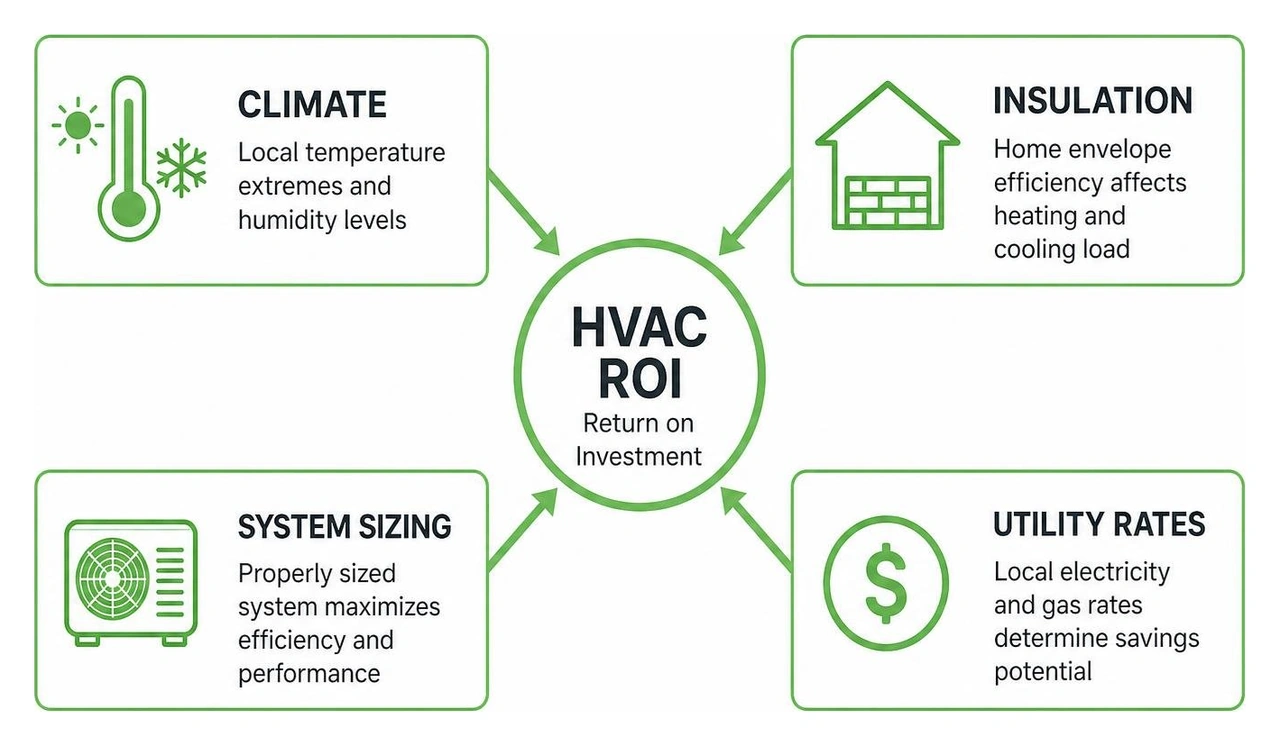
- Regional Climate: Homeowners in Southern Indiana and Southern Illinois experience dramatic seasonal shifts. Our bitter winters require robust heating, while our humid summers demand highly efficient cooling and moisture removal. This dual demand means high-efficiency systems are utilized year-round, leading to a faster payback period than in mild, single-season climates.
- The Building Envelope: Your HVAC system does not operate in a vacuum. The efficiency of your home's "envelope"—including attic insulation, wall insulation, and window seals—directly impacts how hard your heating and cooling equipment has to work.
- Local Utility Rates: The prices charged by your local electric and gas utilities serve as the multiplier for your energy savings. When utility rates rise, your high-efficiency system saves you even more money, acting as an excellent hedge against inflation.
Energy Efficiency Ratings: SEER2, AFUE, and HSPF2
To understand how much you can save, you need to understand the industry-standard efficiency metrics. Modern systems use updated testing standards (designated by the "2" in SEER2 and HSPF2) to reflect real-world operating conditions more accurately.
- SEER2 (Seasonal Energy Efficiency Ratio 2): This measures the cooling efficiency of air conditioners and heat pumps. The higher the number, the less electricity the system uses to cool your home. Upgrading from an old system to a modern high-efficiency unit can slash cooling costs dramatically.
- AFUE (Annual Fuel Utilization Efficiency): This applies to gas furnaces, representing the percentage of fuel converted directly into usable heat. Older furnaces often have AFUE ratings around 80% (meaning 20% of your fuel is wasted up the chimney), while high-efficiency condensing furnaces reach up to 95% to 98% AFUE.
- HSPF2 (Heating Seasonal Performance Factor 2): This measures the heating efficiency of electric heat pumps over a typical heating season.
| Equipment Type | Older Standard Rating | Modern High-Efficiency Rating | Estimated Annual Energy Savings |
|---|---|---|---|
| Central Air Conditioner | 10 SEER | 16 to 20+ SEER2 | 30% to 50% |
| Gas Furnace | 80% AFUE | 95% to 98% AFUE | 15% to 20% |
| Air Source Heat Pump | 6.8 HSPF | 8.5 to 10+ HSPF2 | 25% to 40% |
Choosing the right rating for your household requires balancing your upfront budget with your long-term savings goals. To find the perfect match for your home, explore our resources on Energy Efficient AC Solutions and learn more about the mathematics of efficiency in How Much Does a High Efficiency System Save.
Sizing, Installation Quality, and HVAC Replacement Return on Investment
One of the most critical mistakes a homeowner can make is assuming that a high-efficiency rating guarantees high-efficiency performance. In reality, up to 80% of a system's real-world efficiency and longevity comes down to the quality of the installation.
To maximize your hvac replacement return on investment, the system must be sized precisely for your home using an ACCA Manual J load calculation. This calculation factors in your home's square footage, insulation levels, window placement, and local climate.
If a system is oversized, it will "short-cycle," turning on and off rapidly. This wastes massive amounts of electricity, subjects components to extreme wear, and fails to properly dehumidify your home during muggy Indiana summers. Conversely, an undersized system will run constantly, struggling to maintain comfort while driving your utility bills through the roof. Proper sizing, airflow optimization, and professional duct connection are absolutely non-negotiable to protect your investment.
Leveraging Tax Credits, Rebates, and Incentives
You can significantly lower the net cost of your upgrade—and therefore shorten your payback period—by taking advantage of federal, state, and local incentives. Under the Inflation Reduction Act, homeowners can claim substantial federal tax credits for qualifying high-efficiency equipment.
For example, installing an energy-efficient heat pump can qualify you for a federal tax credit covering up to 30% of the project cost, up to a generous annual limit. Traditional high-efficiency central air conditioners and gas furnaces also qualify for valuable tax credits. When you combine these federal incentives with local utility rebates, the net cost of your system drops significantly, making high-efficiency upgrades much more accessible. To learn how to claim these valuable savings, read our guide on Federal Tax Credits for Heat Pump Upgrades.
How to Calculate Your Personal Payback Period
Calculating your custom payback period allows you to see exactly when your new system will transition from paying for itself to putting pure savings back into your pocket.
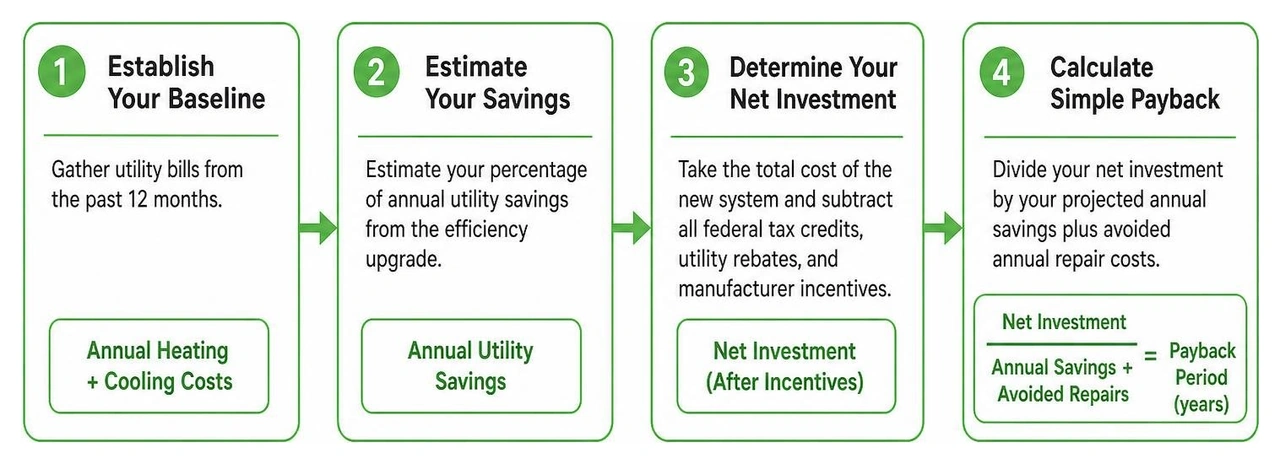
- Establish Your Baseline: Gather your utility bills from the past 12 months to calculate your annual heating and cooling costs.
- Estimate Your Savings: Based on the efficiency upgrade (e.g., moving from an old furnace to a high-efficiency unit), estimate your percentage of annual utility savings.
- Determine Your Net Investment: Take the total cost of the new system and subtract all federal tax credits, utility rebates, and manufacturer incentives.
- Calculate Simple Payback: Divide your net investment by your projected annual utility savings plus your avoided annual repair costs.
Step-by-Step Payback Formula
Let's look at the simple payback formula in action:
$$text{Payback Period (Years)} = frac{text{Net System Cost}}{text{Annual Utility Savings} + text{Avoided Repair Costs}}$$
For example, if your net system cost (after rebates and tax credits) is balanced against significant annual utility savings and the elimination of frequent repairs on an old unit, your system will quickly pay for itself.
To make your calculation even more accurate, you can factor in energy price inflation. Historically, residential electricity and gas rates rise by 3% to 5% annually. This means your yearly savings will actually increase over time, making your real-world payback period even shorter than a simple calculation suggests.
Maximizing Returns with Smart Thermostats and Duct Sealing
To squeeze every drop of efficiency out of your new investment, you should look at your heating and cooling system as a whole-home ecosystem. Adding a smart thermostat and sealing your home's ductwork are two of the highest-ROI companion upgrades available.
A smart thermostat optimizes your system's run times based on your family's daily habits, automatically adjusting temperatures when you are asleep or away. This simple addition can reduce your heating and cooling bills by an extra 10% to 15% annually.
Meanwhile, duct sealing addresses a massive invisible source of energy waste. The typical home loses 20% to 30% of its conditioned air through leaks, gaps, and poor connections in the ductwork. Sealing these leaks ensures that the air you pay to heat or cool actually reaches your living spaces, maximizing both comfort and financial returns. To discover how these strategies keep your home comfortable while keeping bills low, see our article on How High Efficiency Systems Reduce Summer Costs.
When to Replace vs. Repair Your Heating and Cooling System
Deciding whether to sink more money into an aging system or invest in a replacement is a common dilemma. While repairs might seem cheaper in the short term, they can quickly turn into a cycle of throwing good money after bad.
As systems age past 10 to 15 years, their mechanical components wear down, and their operating efficiency drops. Frequent breakdowns during peak summer heatwaves or winter cold snaps are not just inconvenient—they are financially draining. Furthermore, old systems can pose serious safety risks, such as cracked heat exchangers that allow dangerous carbon monoxide to leak into your home.
The 50% Rule and the $5,000 Decision Formula
To take the emotion out of this decision, we recommend using two objective, numbers-driven rules of thumb:
- The 50% Rule: If a single repair quote exceeds 50% of the cost of a brand-new system, you should always opt for replacement.
- The $5,000 Decision Formula: Multiply the age of your system by the cost of the recommended repair. If the resulting "decision score" is over 5,000, replacement is the financially smarter choice.
For example, if your 12-year-old air conditioner needs a repair that costs more than a few hundred dollars, multiplying those numbers gives you a score well above the threshold, signaling that it is time to replace. Conversely, a minor repair on a relatively young system is a great candidate for a fix. For an in-depth look at these decision-making frameworks, consult our Ultimate Repair vs Replace HVAC Guide and explore Should I Repair or Replace My HVAC System.
The R-22 and R-410A Refrigerant Phase-Outs
Environmental regulations also play a massive role in the financial viability of repairing older air conditioners. The EPA has completely banned the production and import of R-22 refrigerant (commonly known as Freon). If your system was installed before 2010, it likely runs on R-22, making any refrigerant-related repairs incredibly expensive due to extremely limited supplies.
More recently, the industry began its transition away from R-410A (Puron) to newer, more environmentally friendly refrigerants like R-32 and R-454B. As R-410A production is phased down, the cost of servicing these systems will inevitably rise. Investing in a modern system that utilizes the latest approved refrigerants protects you from skyrocketing repair costs down the road and ensures your home remains compliant with current environmental standards.
Frequently Asked Questions about HVAC ROI
What is a typical payback period for a high-efficiency HVAC system?
For most residential properties in our region, a high-efficiency HVAC system has a typical payback period of 5 to 10 years. This timeline can be shortened significantly by taking advantage of federal tax credits, local utility rebates, and companion upgrades like duct sealing and smart thermostats.
How much does a new HVAC system increase a home's resale value?
On average, a new HVAC system increases a home's resale value by 5% to 7%. Additionally, homes with updated systems tend to sell 10% to 15% faster, giving you a competitive edge in the local real estate market and preventing costly buyer concessions during negotiations.
Are there federal tax credits available for HVAC replacements in 2026?
Yes! The Energy Efficient Home Improvement Credit (Section 25C) under the Inflation Reduction Act remains highly active in 2026. Homeowners can claim up to 30% of the cost of qualifying high-efficiency heat pumps, central air conditioners, and gas furnaces, with credits up to a generous annual limit for heat pump installations.
Conclusion
Investing in a new HVAC system is one of the most reliable ways to lower your monthly utility bills, increase your home's equity, and secure year-round peace of mind. By focusing on proper system sizing, high-efficiency ratings, and professional installation, you can maximize your long-term returns and enjoy a comfortable home for decades to come.
At Perfect Climate Heating, Air & Plumbing, we are proud to serve our neighbors throughout Southern Indiana and Southern Illinois. Whether you are in Haubstadt, Evansville, Newburgh, Princeton, Boonville, Mount Vernon, Fort Branch, Poseyville, Warrick County, or Mount Carmel, IL, our team of licensed professionals is ready to help you find the perfect high-efficiency solution for your home. From advanced geothermal and solar integrations to comprehensive energy audits and preventive maintenance programs, we ensure your investment delivers the maximum possible return.
Ready to start saving? Explore our professional services and schedule your consultation today at /hvac.
Need Help?
Contact us today to discuss your needs. Our team is ready to help.
About the Author
Perfect Climate Heating, Air & Plumbing
Recent Posts
- Is It Normal for My Furnace to Run Constantly on Colder October Nights?
- Navigating Evansville's Fall Leaves and Your Outdoor Heat Pump Unit
- HVAC Options Comparisons for Homeowners: Navigating Fall System Failures
- Why Does My Furnace Smell Like Burning? The 15-Minute Rule for Homeowners
- October HVAC Maintenance: Identifying Freon Leaks vs. Furnace Startup Smells
Related Articles

Is It Normal for My Furnace to Run Constantly on Colder October Nights?
Hearing your furnace run non-stop during the first fall chill can feel like a major red flag. Find out how to tell if your system is running efficiently by design or struggling to keep up.
Read Article
Navigating Evansville's Fall Leaves and Your Outdoor Heat Pump Unit
That suffocating mat of wet autumn foliage packed against your condenser coil is a hidden hazard. Find out exactly where to draw the line between safe yard clearing and calling a pro.
Read Article
HVAC Options Comparisons for Homeowners: Navigating Fall System Failures
Read Article
Why Does My Furnace Smell Like Burning? The 15-Minute Rule for Homeowners
Read Article
October HVAC Maintenance: Identifying Freon Leaks vs. Furnace Startup Smells
Read Article
Heating Options Comparisons for Homeowners: Heat Pumps vs. Gas Furnaces Before Indiana's Winter Hits
Read ArticleReady to Get Started?
Whether you need a repair, maintenance, or a new installation, our expert team is here to help.