
How Much Does a High Efficiency System Save? 2026 Guide
Discover how much does a high efficiency system save on Indiana energy bills with SEER2, AFUE, and HSPF2 ratings plus real payback data.
Perfect Climate Heating, Air & Plumbing

How Much Does a High Efficiency System Save on Your Indiana Energy Bills?
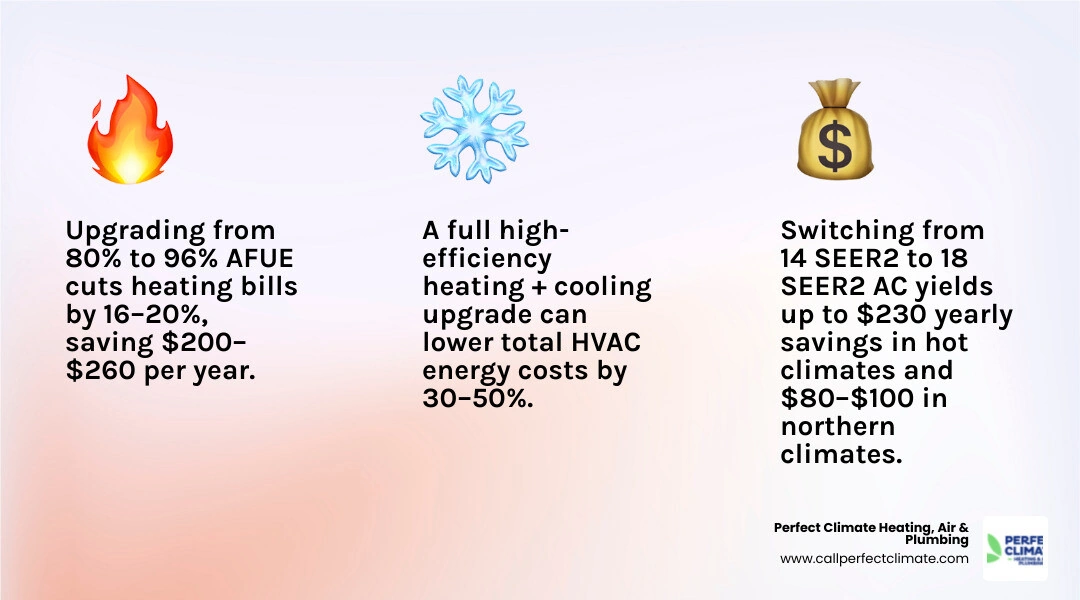
How much does a high efficiency system save is one of the most practical questions a homeowner can ask before committing to an HVAC upgrade — and the answer is: quite a bit. Here is a quick breakdown of what you can realistically expect:
| Upgrade | Annual Savings | Total Savings Over 10 Years |
|---|---|---|
| 80% to 96% AFUE furnace | $200–$260/year (16–20%) | $2,000–$2,600 |
| 14 SEER2 to 18 SEER2 AC (hot climate) | ~$230/year | ~$2,300 |
| 14 SEER2 to 18 SEER2 AC (northern climate) | ~$80–$100/year | ~$800–$1,000 |
| Full system upgrade (heating + cooling) | 30–50% total HVAC bill reduction | Varies by home |
Heating and cooling account for nearly half of the average household's annual energy bill. For homeowners in the Evansville, Newburgh, and Haubstadt, Indiana area, that means your HVAC system is likely your single largest monthly energy expense — and an aging, inefficient one could be quietly draining hundreds of dollars every year without you realizing it.
The good news is that modern high-efficiency systems are designed to put that money back in your pocket. Whether you are running an old 80% AFUE furnace through a brutal Indiana winter or cooling a humid home all summer with a dated 10 SEER air conditioner, upgrading to high-efficiency equipment can deliver real, measurable savings over the life of the system.
This guide walks you through exactly how to calculate those savings for your specific home — so you can make a confident, informed decision.
Decoding HVAC Efficiency Ratings: SEER2, AFUE, and HSPF2
To understand how a high-efficiency system saves you money, you first need to understand the ratings stamped on the side of the equipment. These ratings are the "miles per gallon" of the HVAC world, and they tell you exactly how much energy the system converts into actual comfort.
To get a comprehensive view of how these numbers impact your home, you can read our guide on Efficiency Ratings Explained for Homeowners.
Here is a quick look at the three most important ratings you will encounter:
- SEER2 (Seasonal Energy Efficiency Ratio 2): This measures the cooling efficiency of your air conditioner or heat pump over an entire cooling season. The higher the SEER2 rating, the less electricity the unit uses to keep your home cool.
- AFUE (Annual Fuel Utilization Efficiency): This measures gas furnace heating efficiency. It is expressed as a percentage, representing how much of the fuel burned is converted directly into heat for your living space versus how much is wasted.
- HSPF2 (Heating Seasonal Performance Factor 2): This measures the heating efficiency of a heat pump over the winter season.
When searching for a new system, looking for the ENERGY STAR certification is a great starting point. ENERGY STAR qualified furnaces, for example, are typically 15% more efficient than conventional models and meet strict efficiency guidelines.
To see how these tiers stack up against each other, review our breakdown of the Standard Efficiency vs High Efficiency HVAC Comparison.
| System Type | Standard Efficiency Rating | High-Efficiency Rating | Expected Energy Reduction |
|---|---|---|---|
| Gas Furnace | 80% AFUE | 96% to 98% AFUE | 16% to 20% lower gas usage |
| Central Air Conditioner | 13.4 to 14.3 SEER2 | 18 to 22+ SEER2 | 28% to 44% lower electricity usage |
| Air Source Heat Pump | 7.5 HSPF2 | 9.0 to 10+ HSPF2 | 15% to 30% lower electricity usage |
How much does a high efficiency system save in heating fuel utilization?
When it comes to gas furnaces, the difference between standard and high efficiency lies in how the system handles combustion exhaust. A standard 80% AFUE furnace converts 80 cents of every dollar spent on natural gas into heat, while the remaining 20 cents is lost up the chimney flue as hot waste gas.
A high-efficiency condensing furnace (rated at 96% or 97% AFUE) uses advanced condensing technology. It features a secondary heat exchanger that captures latent heat from the water vapor in the exhaust gases before they exit the home. By pulling this extra heat out of the exhaust, a 96% AFUE furnace converts 96 cents of every gas dollar into useful heat, leaving only 4 cents of waste.
Upgrading from an 80% to a 96% AFUE furnace cuts your heating fuel consumption by 16% to 20%, saving roughly $200 to $260 per year for a typical home in our chilly Southern Indiana winters. Over the course of its lifespan, a high-efficiency furnace can save up to $1,345 in colder regions.
How much does a high efficiency system save on summer cooling bills?
On the cooling side, upgrading an old, inefficient air conditioner to a modern high-efficiency model can yield even more dramatic electrical savings. If you are replacing a dated 10 SEER air conditioner with a modern 15 SEER2 unit, you can expect an approximate 33% reduction in your annual cooling costs.
Upgrading further to a high-efficiency 18 SEER2 unit uses approximately 28% less electricity than a standard 14 SEER2 model. To learn more about how these modern cooling systems protect your wallet, check out our articles on Energy Efficient AC Solutions and the Modern AC Advantages of upgrading.
Beyond raw electricity savings, high-efficiency cooling systems provide superior comfort. Because high-efficiency units run longer, slower cycles, they are able to remove up to twice as much humidity from the air as standard single-stage units. Lower humidity makes the air feel cooler, allowing you to set your thermostat a few degrees higher in July without sacrificing comfort.
Real-World Factors: How Much Does a High Efficiency System Save in Indiana?
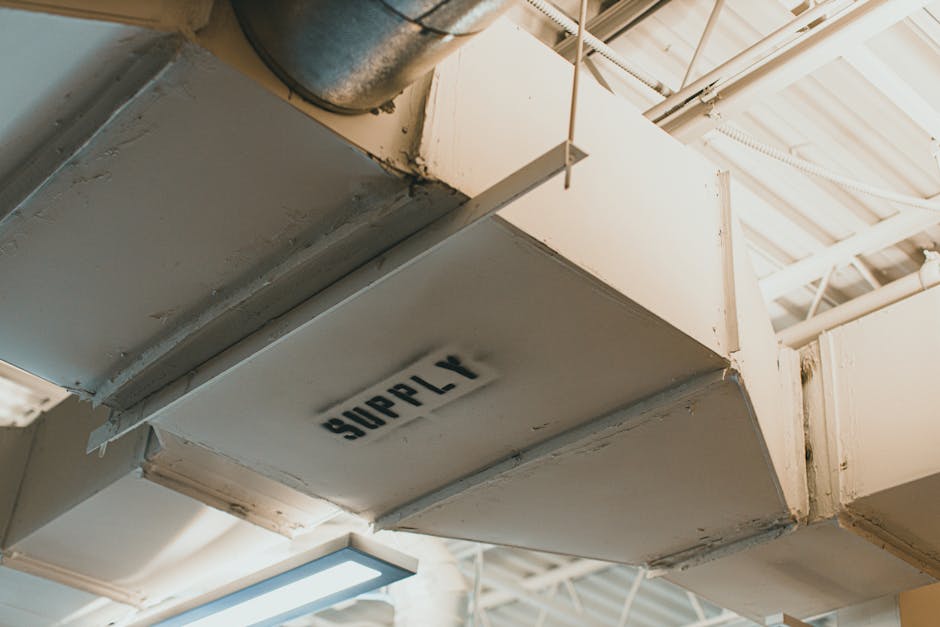
While manufacturer efficiency ratings provide a baseline, your actual monthly savings depend heavily on real-world factors unique to your property and our local climate. In Southwestern Indiana — from Evansville and Newburgh up to Princeton and Fort Branch — we experience dramatic seasonal swings. We have freezing, damp winters followed by hot, humid summers.
Because of these climate demands, several factors will influence how much does a high efficiency system save in your home:
- Ductwork Condition: Even the most efficient system will struggle if your ductwork is failing. Leaky ducts can easily waste 20% to 30% of your conditioned air into crawlspaces or attics. Sealing and insulating your ducts ensures that the energy you pay for actually reaches your living spaces.
- Home Insulation and Envelope: A well-insulated attic and tightly sealed windows keep your heated or cooled air indoors, allowing your high-efficiency system to cycle less frequently.
- System Sizing: A system that is too large will "short-cycle" (turn on and off rapidly), which wastes energy and accelerates mechanical wear. A system that is too small will run constantly, driving up utility bills.
To explore how proper installation impacts these savings, take a look at our guide on Energy Efficient AC Installation Options.
The Impact of Variable-Speed, Two-Stage, and Modulating Systems
Standard HVAC systems operate like a light switch: they are either 100% on or completely off. This constant cycling creates temperature swings and causes a surge in electrical usage every time the system starts up.
High-efficiency systems use advanced compressor and blower technologies to run more smoothly:
- Two-Stage Systems: These systems can run on a "low" setting (usually around 65% capacity) for mild days and switch to "high" only when extreme weather hits.
- Modulating and Variable-Speed Systems: These systems can adjust their output incrementally anywhere between 40% and 100% capacity. By running continuously at lower speeds, they maintain a rock-steady indoor temperature, continuously filter your indoor air, and avoid the frequent electrical surges of hard starts.
To see why these features are worth the investment, read our detailed post on Modern AC Features Worth Upgrading.
Hybrid Heating and Dual-Fuel Performance
For homeowners in communities like Boonville, Mount Carmel, and Poseyville, a hybrid or "dual-fuel" system offers an incredibly efficient heating option. This setup pairs an electric air-source heat pump with a high-efficiency gas furnace.
During mild autumn and winter days (when temperatures are above 35°F), the electric heat pump heats your home with remarkable efficiency. When temperatures drop below freezing, the system automatically switches over to the gas furnace, which is better equipped to handle extreme cold. This intelligent switchover ensures you are always using the most cost-effective fuel source throughout the year.
Calculating Your Payback Period and Maximizing ROI
When upgrading your heating and cooling equipment, you will typically pay an upfront premium for high-efficiency technology compared to a standard-efficiency system. The "payback period" is the amount of time it takes for your monthly utility savings to completely offset that initial premium.
For most homeowners in Southwestern Indiana, the payback period for a high-efficiency system upgrade ranges from 5 to 12 years. Because high-efficiency systems are built to last 15 to 20 years (for air conditioners and heat pumps) and 20 to 30 years (for well-maintained gas furnaces), you can expect many years of pure financial return after your system breaks even.
To accelerate this payback period, you can take advantage of local utility rebates and federal tax incentives. To see what is currently available for your project, check out our resource on Indiana Energy Rebates for HVAC Upgrades and learn Why HVAC Replacement is a Smart Investment.
When Standard Efficiency Makes Sense vs. High Efficiency
While high-efficiency systems offer incredible long-term benefits, they are not always the right choice for every homeowner.
A high-efficiency system is highly recommended if:
- You live in an area with harsh seasonal weather (like our freezing winters and humid summers).
- Your local utility rates are high.
- You plan to stay in your current home for at least 5 to 10 years to fully realize the return on your investment.
Conversely, a standard-efficiency system might be the more practical choice if:
- You plan to sell your home in the next year or two.
- You are installing a system in a rarely used guest house or workshop.
When to Repair vs. Replace Your Existing HVAC System
If your current heating or cooling system is acting up, you might find yourself weighing the cost of a repair against the cost of a full replacement. A good rule of thumb is the 10-year rule: if your system is more than 10 years old and a major repair is required, investing that money into a new, high-efficiency system is often the smarter financial move.
Continuously repairing an aging, inefficient unit is often "throwing good money after bad," especially when you factor in the high utility bills that come with running an older system.
To help you make this decision, read our articles on Should I Repair or Replace My HVAC System and our Ultimate Repair vs Replace HVAC Guide.
Frequently Asked Questions about High-Efficiency HVAC Savings
Do high-efficiency systems require specialized maintenance?
High-efficiency systems are advanced, precision machines. While they do not necessarily require more frequent maintenance, their annual check-ups are highly specialized.
For example, condensing furnaces produce acidic condensate water that must be safely drained from your home. During a routine maintenance visit, a technician must inspect the condensate lines, neutralizers, and secondary heat exchangers to ensure everything is draining and operating safely. Keeping your air filters clean and scheduling annual professional tune-ups will protect your system's efficiency and maintain its long-term performance.
What is the typical lifespan of a high-efficiency furnace or AC?
With regular professional maintenance, a high-efficiency central air conditioner or heat pump typically lasts 15 to 20 years, while a high-efficiency gas furnace can easily last 20 to 30 years. Most high-quality manufacturers support these systems with robust 10-year parts warranties, giving you peace of mind alongside your monthly energy savings.
Can I upgrade just my outdoor AC unit to a higher SEER2 rating?
No. To achieve the rated efficiency and performance of a high-SEER2 system, the indoor evaporator coil and the outdoor condenser must be a certified, matched set.
Trying to run a new, high-efficiency outdoor unit with an old, unmatched indoor coil will result in poor performance, inadequate humidity control, and can lead to premature compressor failure. Always ensure your system is AHRI-certified as a matched system.
Conclusion
Upgrading to a high-efficiency heating and cooling system is one of the most effective ways to lower your monthly utility bills, reduce your environmental impact, and enjoy a more comfortable home. By understanding the ratings and factoring in your home's unique layout, you can easily calculate how these long-term energy savings will pay off for years to come.
At Perfect Climate Heating, Air & Plumbing, we are proud to serve our neighbors throughout Southwestern Indiana and Southern Illinois — including Haubstadt, Evansville, Newburgh, Princeton, Boonville, and Mount Carmel. Our team of certified technicians specializes in advanced home comfort solutions, including comprehensive energy audits, preventive maintenance, geothermal systems, and solar integration.
Ready to stop burning cash and start saving? Schedule your high-efficiency system consultation today and let our team help you find the perfect system for your home and budget.
Need Help?
Contact us today to discuss your needs. Our team is ready to help.
About the Author
Perfect Climate Heating, Air & Plumbing
Recent Posts
- Why We Install Whole-Home Surge Protectors on Modern HVAC Equipment
- The Anatomy of a Frost-Free Sillcock and Why It Matters in Mount Carmel
- Why We Don't Recommend DIY Freon Recharging for Residential AC Units
- Identifying the Source of Sewer Gas Smells in Your Basement Floor Drain
- How Hard Water Scale Destroys Tankless Water Heater Heat Exchangers
Related Articles

Why We Install Whole-Home Surge Protectors on Modern HVAC Equipment
Modern variable-speed furnaces are essentially large computers. Leaving them vulnerable to grid fluctuations can destroy a brand-new circuit board in seconds during a minor storm.
Read Article
The Anatomy of a Frost-Free Sillcock and Why It Matters in Mount Carmel
Standard outdoor spigots trap water against exterior walls, risking burst pipes during deep freezes. A frost-free fixture moves the shut-off valve safely inside your heated home.
Read Article
Why We Don't Recommend DIY Freon Recharging for Residential AC Units
A sudden late-season AC breakdown can make a quick DIY refrigerant kit tempting. Understand the mechanical dangers of overcharging before you accidentally ruin your compressor.
Read Article
Identifying the Source of Sewer Gas Smells in Your Basement Floor Drain
A sudden rotten egg odor in your basement is alarming, but the fix is often simple. We explain how dried p-traps let municipal gases inside and when you actually need to call a licensed plumber.
Read Article
How Hard Water Scale Destroys Tankless Water Heater Heat Exchangers
Mineral buildup creates a physical barrier inside your tankless water heater, leading to severe overheating and cracked components. See why a professional fall flush is a strict mechanical necessity.
Read Article
The Role of a PRV (Pressure Reducing Valve) in Protecting Your Plumbing
Banging pipes and running toilets are often symptoms of high municipal water pressure. Discover how a pressure reducing valve acts as a shock absorber to save your fixtures from hidden damage.
Read ArticleReady to Get Started?
Whether you need a repair, maintenance, or a new installation, our expert team is here to help.