
Water Filtration Benefits for Your Family: Essential Health
The Ultimate Guide to Water Filtration Benefits for Family Health - Learn about water filtration benefits for your family
Perfect Climate Heating, Air & Plumbing

Why Water Filtration Benefits for Your Family Matter More Than You Think
Water filtration benefits for your family go far beyond better-tasting water. Here is a quick look at what a home filtration system can do:
- Protect your health — removes lead, PFAS, chlorine byproducts, and microbial pathogens like Giardia and Cryptosporidium
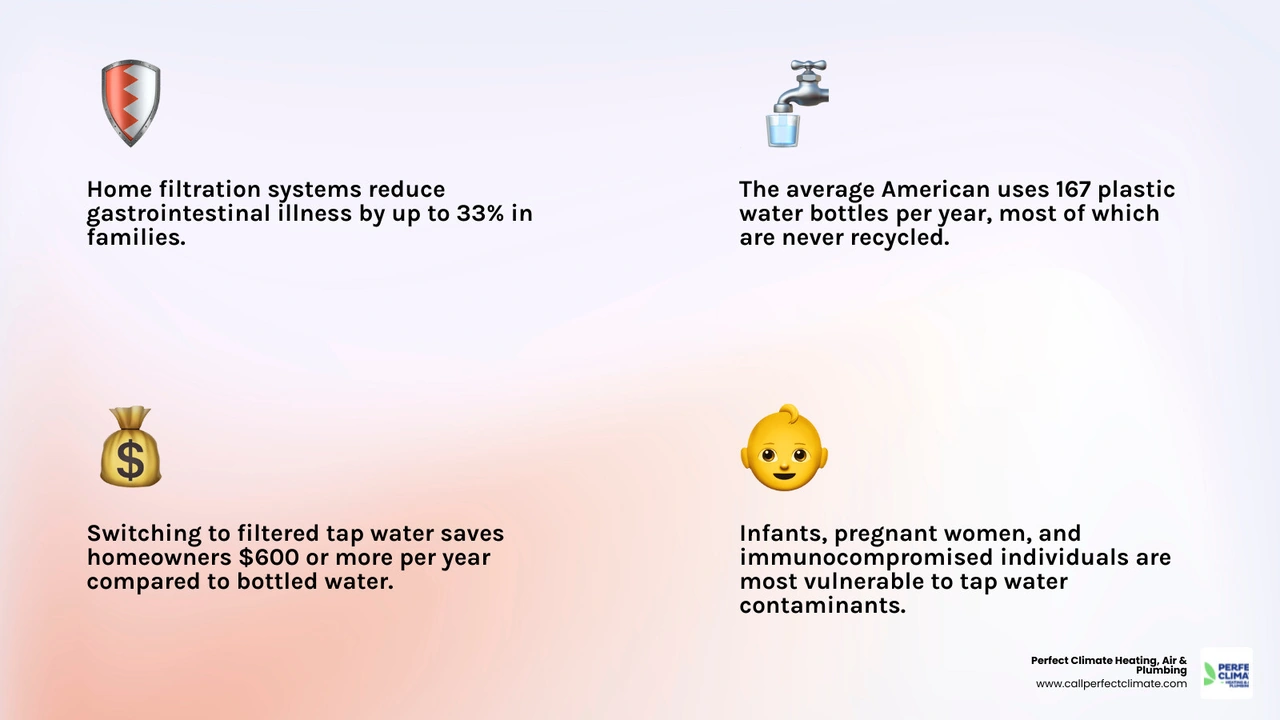
- Reduce illness — whole-house systems are linked to roughly a 33% reduction in gastrointestinal illness
- Shield vulnerable family members — especially infants, pregnant women, and anyone with a weakened immune system
- Protect your plumbing and appliances — reduces scale buildup that shortens the life of water heaters and dishwashers
- Save money — homeowners can save $600 or more per year by replacing bottled water with filtered tap water
- Help the environment — the average American uses about 167 plastic water bottles per year, most of which are never recycled
Most people grow up drinking tap water without a second thought. But the truth is, even water that leaves a municipal treatment plant in good shape can pick up contaminants on its way through aging pipes to your faucet. And for families on private wells, the picture is even less predictable — water quality can shift with the seasons, heavy rainfall, and nearby land use.
That is not meant to alarm you. U.S. tap water is generally held to high standards under the EPA's Safe Drinking Water Act, which covers more than 90 contaminants. But "generally safe" is not the same as "perfect for every home," especially when your household includes young children, pregnant women, or anyone with health sensitivities. Understanding what is actually in your water — and whether a filtration system makes sense for your situation — is the first step toward real peace of mind.
This guide walks you through everything you need to know, from health benefits and appliance protection to choosing the right system and knowing what certifications actually matter.
Key water filtration benefits for your family vocabulary:
- plumbing tips for midwest homeowners
- signs your plumbing needs professional attention
- drain and sewer line maintenance tips
Health and Wellness: Key Water Filtration Benefits for Your Family

When we think about our family's health, we often focus on nutrition, exercise, and sleep. But the water flowing through our taps is just as critical. Installing a home water filtration system is one of the most effective, quiet upgrades you can make to protect your household's long-term wellness.
One of the most immediate health benefits is the reduction of waterborne pathogens. Research indicates that whole-house filtration systems can reduce gastrointestinal illnesses by approximately 33% by physically removing microscopic microbes such as Giardia and Cryptosporidium. These chlorine-resistant parasites are notorious for slipping through standard municipal treatment processes and causing severe stomach issues.
Beyond biological pathogens, modern chemical contaminants present a growing concern. Per- and polyfluoroalkyl substances (PFAS), often called "forever chemicals," are synthetic compounds linked to immune system disruption, thyroid disease, and other serious health issues. These chemicals do not break down naturally in the environment or the human body. Fortunately, home water systems certified to NSF/ANSI Standard 53 can reduce total PFAS concentrations by up to 99.9%, keeping these persistent toxins out of your drinking glass.
Heavy metals like lead also pose severe risks. Lead almost never originates from public water sources; instead, it leaches directly into your water from older service lines, lead-soldered copper pipes, and brass fixtures on its way to your faucet. Because there is no safe level of lead exposure, filtering your water at home acts as a vital safety net.
Finally, clean water is essential for your skin and hair. Unfiltered tap water often contains high levels of chlorine and hard minerals like calcium and magnesium. When you bathe, these elements strip away your skin's natural oils, leaving it dry, itchy, and irritated. For family members struggling with sensitive skin conditions like eczema or psoriasis, showering in filtered water can provide dramatic relief. If you are ready to protect your home's water quality, exploring Water Filtration Evansville IN is a great place to start.
Protecting Vulnerable Members with Water Filtration Benefits for Your Family
While clean water is important for everyone, it is absolutely vital for the most vulnerable members of your household: pregnant women, developing fetuses, and infants.
During pregnancy, a mother’s body shares everything with the developing baby. Toxic contaminants like lead and PFAS are capable of crossing the placenta, meaning that water filtration benefits for your child actually begin before they are even born. Minimizing exposure to these substances during pregnancy is a simple, high-impact way to support healthy fetal development.
Once your baby arrives, their water needs change dramatically. Infants between 6 and 12 months of age have the highest per-pound water intake of their entire lives, consuming three to four times more water per pound of body weight than adults. Because their organs and immune systems are still rapidly developing, they are far more susceptible to the toxic effects of heavy metals and chemical residues.
If you use tap water to reconstitute infant formula, pediatric health authorities like the CDC and the American Academy of Pediatrics (AAP) recommend using cold tap water run through a filter certified for lead reduction. Never use hot tap water to mix formula, as heat encourages lead to leach more rapidly from plumbing.
It is also worth noting that boiling water does not make it safe from chemical contaminants. While boiling kills living bacteria and viruses, it does not remove lead, PFAS, microplastics, or trihalomethanes (disinfection byproducts). In fact, as water evaporates during boiling, these non-volatile contaminants actually become more concentrated. To ensure your home's water is safe for formula preparation and cooking, consider consulting with professionals in Water Filtration Newburgh IN.
Enhancing Hydration and Taste with Water Filtration Benefits for Your Family
Let’s face it: if your tap water smells like a swimming pool or tastes metallic, your family is going to avoid drinking it. One of the simplest yet most rewarding water filtration benefits for your family is a dramatic improvement in the taste, smell, and appearance of your water.
Municipal water systems rely on chlorine or chloramines to disinfect water and keep it safe from bacteria during its journey through underground mains. However, this chemical disinfectant often leaves behind a strong, unpleasant chemical odor and taste by the time it reaches your kitchen sink. Well water, on the other hand, can suffer from a distinct "rotten egg" smell caused by hydrogen sulfide, or a bitter metallic tang due to excess iron and manganese.
By running your water through an activated carbon filter, you can easily neutralize these off-putting tastes and odors. When your water tastes crisp, clean, and refreshing, everyone in the household naturally drinks more of it, making healthy hydration effortless.
This aesthetic upgrade also transforms your kitchen. Filtered water makes your morning coffee and tea taste brighter and more balanced, as there are no chemical residues to mask the natural flavors. Your home-cooked soups, broths, and boiled foods will taste better, and even your ice cubes will freeze crystal-clear instead of cloudy. For homeowners looking to elevate their daily drinking and dining experience, professional services in Water Filtration Princeton IN can help you find the perfect system.
Protecting Your Home's Plumbing, Appliances, and Budget
While the health benefits of water filtration are paramount, the financial and physical protection it offers your home is equally compelling. Unfiltered water—particularly hard water containing high concentrations of calcium and magnesium—can quietly wreak havoc on your plumbing network and expensive appliances.
As hard water heats up inside your water heater, these minerals crystallize and settle to the bottom of the tank as a thick layer of rock-like scale. This sediment accumulation acts as an insulating barrier, forcing the heating element to work much harder to warm the water. This extra strain significantly increases your monthly energy consumption and shortens the lifespan of the unit. Considering that water heaters typically cost $800 to $1,500 to replace, and dishwashers or washing machines can cost $500 to $1,200, protecting these appliances from premature mechanical failure is a major financial win.
Unfiltered water can also damage your pipes. Aggressive chemical compounds and heavy minerals can act as electrolytes in your water supply. This sets off a process called electrolysis or galvanic corrosion, which gradually eats away at copper plumbing, eventually causing pinhole leaks behind your walls.
Fortunately, installing a home water filtration system paired with a water softener creates a compounding benefit. You simultaneously protect your family’s physical health and your home's infrastructure.
The financial advantages extend to your wallet in other ways, too. By switching from single-use plastic bottles to high-quality filtered tap water, the average household can save $600 or more annually. It also makes a massive environmental impact: you will help eliminate the waste generated by the average American’s consumption of 167 plastic water bottles per year.
To safeguard your plumbing and start saving, check out Whole House Filtration Haubstadt IN or explore your options with Water Filtration Chandler IN.
Choosing the Right Water Filtration System for Your Household
Selecting the ideal water filtration system depends entirely on your water source, household size, and specific water quality concerns. The first step is always to test your water. If you are on a municipal supply, you can review your city’s annual water quality report, but a localized home test is still highly recommended to see what your home's internal plumbing might be adding to the mix. If you rely on a private well, you should test your water at least once a year for harmful bacteria, nitrates, and heavy metals.
To help you understand your options, here is a comparison of point-of-entry (whole-house) systems versus point-of-use (under-sink or pitcher) filters:
| Feature | Whole-House Filtration (Point-of-Entry) | Point-of-Use Filters (Pitchers, Under-Sink) |
|---|---|---|
| Coverage | Treats all water entering the home (showers, sinks, appliances) | Treats water at a single designated faucet or pitcher |
| Primary Benefit | Protects plumbing, skin, hair, and all household appliances | Provides high-quality drinking and cooking water at low upfront cost |
| Contaminants Removed | Chlorine, sediment, rust, PFAS, and heavy metals (system dependent) | Chlorine, lead, VOCs, and microplastics (filter dependent) |
| Maintenance | Low maintenance (filter changes every 6 to 12 months) | Frequent maintenance (cartridge changes every 2 to 3 months) |
| Water Pressure | Can experience minor pressure drops if incorrectly sized | Does not affect overall home water pressure |
When evaluating systems, always look for independent testing and certifications. The gold standard is certification by the NSF (National Sanitation Foundation) or ANSI (American National Standards Institute):
- NSF/ANSI Standard 42: Covers aesthetic effects, ensuring the system successfully reduces chlorine, taste, and odor.
- NSF/ANSI Standard 53: Certifies the reduction of health-related contaminants, including lead, PFAS, VOCs, and microbial cysts.
- NSF/ANSI Standard 58: Specifically applies to reverse osmosis systems, verifying their ability to remove total dissolved solids (TDS), lead, copper, chromium, and sodium.
- NSF/ANSI Standard P231: Certifies microbiological water purifiers capable of removing bacteria, viruses, and parasites.
Understanding filter pore sizes is also crucial. Filters act like microscopic colanders:
- An absolute pore size of 1 micron is required to trap parasites and amebas like Giardia and Cryptosporidium.
- An absolute pore size of 0.3 micron or smaller is needed to filter out bacteria such as Salmonella or E. coli.
- Advanced membrane ultrafilters feature an absolute pore size of 0.02 micron, which is small enough to block viruses, microplastics, and nanoplastics (which are small enough to otherwise cross into the human bloodstream).
Activated carbon filters are highly effective at grabbing chemical impurities, while reverse osmosis (RO) systems use pressure to push water through a semi-permeable membrane, stripping away almost all dissolved solids. For expert guidance on finding the perfect setup for your home, consider learning more about Whole House Filtration New Harmony IN.
Frequently Asked Questions About Home Water Filtration
Navigating water treatment can feel overwhelming. Here are clear answers to some of the most common questions homeowners ask when considering a home water filtration system.
Do home water filters remove germs and bacteria?
It depends entirely on the type of filter and its pore size. Standard carbon pitcher filters and refrigerator filters are designed to improve taste and remove heavy metals, but they do not remove harmful germs, bacteria, or viruses.
To reliably remove biological pathogens, you need a system designed for purification. This includes ultrafiltration systems with an absolute pore size of 0.02 microns, reverse osmosis systems, or ultraviolet (UV) disinfection systems that neutralize the DNA of living organisms.
Additionally, it is important to understand how whole-house chlorine filtration interacts with your plumbing. Chlorine is a disinfectant that prevents bacterial growth. If a whole-house system removes all chlorine at the point where water enters your home, there will be no residual disinfectant left in your pipes. This can allow harmless but slimy bacterial biofilms to grow on faucet aerators, showerheads, and toilet bowls, requiring you to clean these fixtures a bit more frequently. You can learn more about local water characteristics by reading about Haubstadts Water Quality.
What is the difference between a water filter and a water softener?
This is one of the most common points of confusion for homeowners. While both improve your water quality, they target completely different issues:
- Water Filters: Designed to remove chemical contaminants, heavy metals, sediment, chlorine, and pathogens. They focus on making your water safer, healthier, and better-tasting.
- Water Softeners: Designed specifically to address "hard water" by removing calcium and magnesium ions. Most softeners use a salt-based ion-exchange process (which accounts for roughly 74% of the water softener market) to swap hard minerals with sodium or potassium ions. This prevents scale buildup, helps soap lather, and protects your plumbing.
For the ultimate home protection, many families choose to pair a carbon filtration system with an ion-exchange water softener. To find the right balance for your household, explore Water Filtration Poseyville IN.
How often do home water filtration systems require maintenance?
To keep your water safe and flowing freely, regular maintenance is essential. Over time, filters trap contaminants and gradually become clogged, which can reduce water pressure and eventually allow trapped impurities to bypass the filter media.
Generally, point-of-use filter cartridges (like those in pitchers or under-sink units) need to be replaced every 2 to 3 months. Whole-house filter cartridges are larger and typically last between 6 and 12 months, depending on your household's water usage and source water quality. Reverse osmosis membranes usually need to be replaced every 2 to 4 years, though their pre-filters require annual replacement.
When changing filters, always wear clean gloves, wash your hands thoroughly afterward, and follow the manufacturer's sanitization guidelines to prevent introducing new bacteria into the system. For professional maintenance support and filter replacements, you can count on the team at Water Filtration Fort Branch IN.
Conclusion
Investing in a home water filtration system is one of the most impactful decisions you can make for your family's health, your home’s plumbing, and your household budget. From reducing exposure to harmful "forever chemicals" and lead to extending the lifespan of your water heater, the daily benefits of clean, filtered water are undeniable.
Every home is unique, and there is no one-size-fits-all solution when it comes to water quality. Whether you need a simple under-sink reverse osmosis system for pure drinking water or a comprehensive whole-house filtration and softening system, getting professional guidance ensures you get the right technology for your specific needs.
At Perfect Climate Heating, Air & Plumbing, we are dedicated to keeping your home safe, comfortable, and efficient. Our team of experienced, licensed plumbers can help you test your water quality, select the perfect NSF-certified filtration system, and provide professional, hassle-free installation.
Ready to enjoy the peace of mind that comes with pristine water from every tap? Schedule a professional water filtration consultation with Perfect Climate Heating, Air & Plumbing today!
Need Help?
Contact us today to discuss your needs. Our team is ready to help.
About the Author
Perfect Climate Heating, Air & Plumbing
Recent Posts
- Diagnosing a Banging Noise When Your Furnace Kicks On
- Is It Normal for My Furnace to Run Constantly on Colder October Nights?
- Navigating Evansville's Fall Leaves and Your Outdoor Heat Pump Unit
- HVAC Options Comparisons for Homeowners: Navigating Fall System Failures
- Why Does My Furnace Smell Like Burning? The 15-Minute Rule for Homeowners
Related Articles

Diagnosing a Banging Noise When Your Furnace Kicks On
That startling boom when you first turn on your heat this fall isn't just settling ductwork. It's a miniature gas explosion called delayed ignition that requires immediate action.
Read Article
Is It Normal for My Furnace to Run Constantly on Colder October Nights?
Hearing your furnace run non-stop during the first fall chill can feel like a major red flag. Find out how to tell if your system is running efficiently by design or struggling to keep up.
Read Article
Navigating Evansville's Fall Leaves and Your Outdoor Heat Pump Unit
That suffocating mat of wet autumn foliage packed against your condenser coil is a hidden hazard. Find out exactly where to draw the line between safe yard clearing and calling a pro.
Read Article
HVAC Options Comparisons for Homeowners: Navigating Fall System Failures
Read Article
Why Does My Furnace Smell Like Burning? The 15-Minute Rule for Homeowners
Read Article
October HVAC Maintenance: Identifying Freon Leaks vs. Furnace Startup Smells
Read ArticleReady to Get Started?
Whether you need a repair, maintenance, or a new installation, our expert team is here to help.