How to Maintain Your Heating and Cooling System: 7 Essential Tips
Learn how to maintain your heating and cooling system with seasonal checklists, DIY tips, and professional tune-ups for efficiency and comfort.
Perfect Climate Heating, Air & Plumbing

Why Knowing How to Maintain Your Heating and Cooling System Saves You Money and Stress
Knowing how to maintain your heating and cooling system is one of the most valuable things you can do as a homeowner. Nearly half of the average home's annual energy bill goes toward heating and cooling — and without regular upkeep, that cost climbs even higher. Worse, neglected systems break down at the worst possible times, like on the hottest day of summer or the coldest night of winter.
The good news? Most of the damage is preventable. Research shows that 85% of HVAC repairs are linked to a lack of proper maintenance, and systems that receive consistent care last 18 to 22 years on average — compared to just 11 to 14 years for systems that are ignored.
Here is a quick overview of the core steps to maintain your heating and cooling system:
How to Maintain Your Heating and Cooling System — Quick Answer
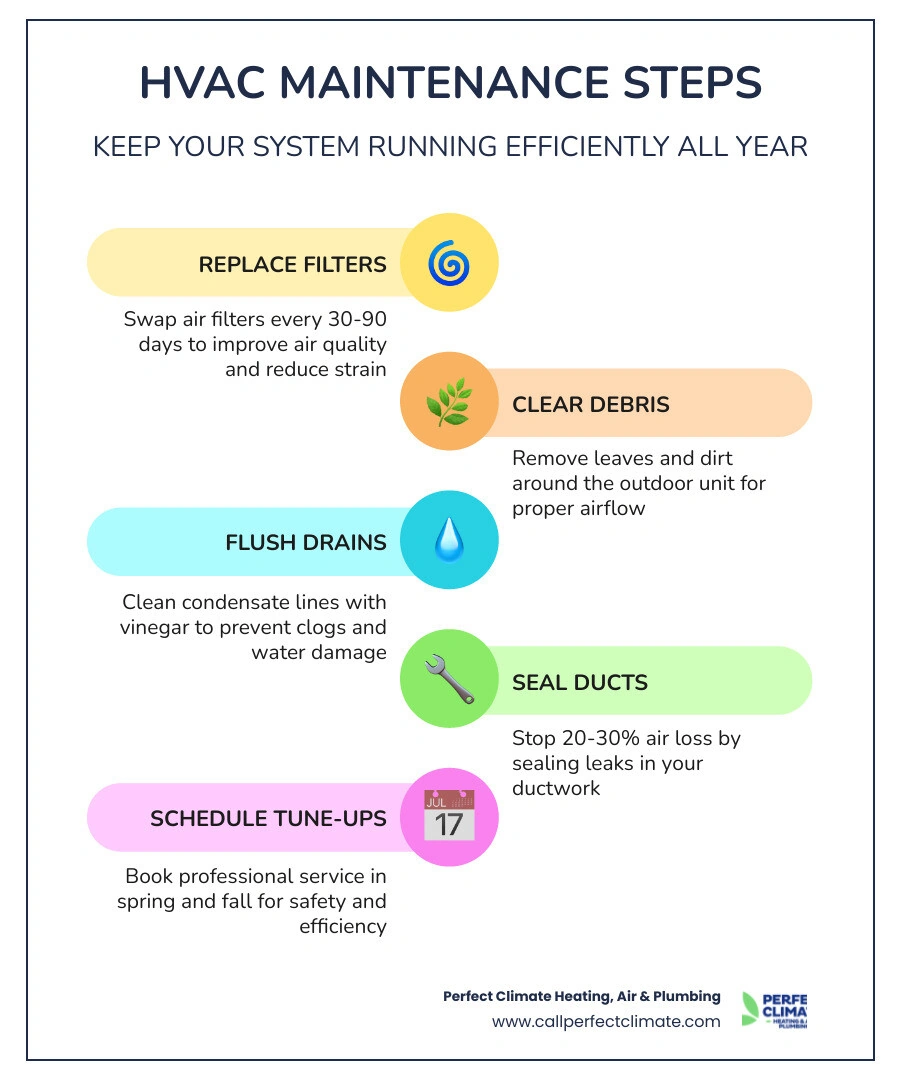
- Replace air filters every 30 to 90 days depending on your household conditions
- Schedule professional tune-ups twice a year — spring for cooling, fall for heating
- Clear debris from around your outdoor unit and maintain at least 2 feet of clearance
- Flush the condensate drain line every few months to prevent clogs and water damage
- Seal duct leaks to stop the 20 to 30 percent of conditioned air that escapes in a typical home
- Test carbon monoxide detectors and check thermostat settings each season
- Keep a maintenance log to protect your warranty and track system performance
This guide walks you through every one of those steps — from simple DIY tasks you can do in under 30 minutes to the professional checks that keep your system safe and efficient for the long haul.
Why Learning How to Maintain Your Heating and Cooling System Matters

Taking a proactive approach to your home comfort system pays massive dividends. Think of your heating and cooling equipment like a car: you wouldn't dream of driving a vehicle for 100,000 miles without changing the oil, rotating the tires, or checking the brakes. Yet, many homeowners treat their HVAC systems like a refrigerator—expecting them to run flawlessly behind the scenes for years without a single glance.
When you skip regular maintenance, the consequences accumulate quickly:
- Skyrocketing Energy Bills: A neglected air conditioner or furnace has to work much harder to push air through dirty filters and clogged coils. This extra strain can easily increase your monthly utility bills. On the flip side, a well-tuned system uses 10% to 30% less energy than a neglected one.
- Halved System Lifespan: Systems that receive regular tune-ups typically last 15 to 25 years (averaging 18 to 22 years with documentation). Neglected units often fail prematurely between years 11 and 14.
- Voided Warranties: Many homeowners do not realize that major manufacturers like Daikin, Mitsubishi, and Carrier require documented professional maintenance to keep their 10-year parts warranties valid. If your compressor fails in year seven and you cannot provide service records, your warranty claim may be denied.
- Costly Emergency Repairs: Emergency calls during a mid-summer heatwave or a freezing winter night can cost three to five times more than scheduled preventative maintenance.
By keeping a structured maintenance log and knowing when to tackle tasks yourself versus when to call in the professionals, you protect your family's comfort and your financial investment. To learn more about the financial returns of proactive care, check out our article on Annual HVAC Maintenance Is It Worth It and explore the 5 Ways an HVAC Maintenance Plan Can Benefit You.
Seasonal HVAC Service Frequency and Timing
To keep your home comfortable year-round in Southwestern Indiana and Illinois—from the humid summers of Evansville to the freezing winter winds of Princeton—timing your maintenance is everything.
We recommend scheduling professional maintenance twice a year: once in the spring (typically March to May) before the cooling season peaks, and once in the fall (September to November) before your heating system has to work overtime. If you rely on a heat pump, which handles both heating and cooling duties, bi-annual servicing is absolutely essential.
To keep yourself organized, you can refer to our HVAC Service Frequency Complete Guide and download our handy Seasonal HVAC Maintenance Checklist.
How to Maintain Your Heating and Cooling System in the Spring and Summer
As we transition out of winter, your air conditioner needs some dedicated attention before the first 85°F day arrives. Winter winds often blow leaves, twigs, and dirt into your outdoor condenser unit, which can clog the delicate coil fins and restrict heat transfer.
For a deep dive into local seasonal prep, read our guide on HVAC Maintenance Tips for Haubstadt IN Homeowners in 2023. The primary spring steps include:
- Clearing the Condenser Area: Remove any weeds, grass, or shrubs growing within two feet of the outdoor unit.
- Rinsing the Coils: Gently spray down the outdoor condenser coils with a garden hose (never use a pressure washer, as it will bend the delicate aluminum fins).
- Testing the Cooling Mode: Turn on your air conditioner on a warm spring afternoon to ensure it is blowing crisp, cool air before summer demand peaks.
How to Maintain Your Heating and Cooling System in the Fall and Winter
When autumn leaves start to fall in Newburgh and Boonville, it is time to pivot your attention to heating safety and efficiency. A furnace that sits dormant all summer can accumulate dust, which poses a minor fire risk and can spread unpleasant odors when first fired up.
Your winter prep should include:
- Sealing Home Drafts: Apply weatherstripping to exterior doors and caulk around drafty windows to keep your expensive heated air inside.
- Inspecting the Furnace Burner: Ensure the furnace flame burns a crisp, stable blue.
- Testing Safety Detectors: Test your carbon monoxide and smoke detectors to ensure they are fully operational before the heating season begins.
Essential DIY Maintenance Tasks for Homeowners
While complex mechanical testing should always be left to licensed professionals, there are several highly effective DIY tasks you can perform to keep your system happy. In fact, performing just two 30-minute homeowner maintenance sessions a year can prevent up to 90% of early equipment failures.
However, it is also easy to make simple mistakes that lead to system issues. Be sure to review these 6 HVAC Maintenance Mistakes to Avoid for Homeowners and learn How Proper HVAC Maintenance Prevents Mold Growth inside your ductwork.
Choosing and Replacing Your Air Filters
Your air filter is the unsung hero of your HVAC system. Its primary job is not actually to clean the air you breathe (though it does help with that), but to protect the internal components of your system from dust and debris buildup. A clogged filter restricts airflow, which can freeze your indoor evaporator coils, cause your system to short-cycle, and eventually lead to complete compressor failure.
- MERV Ratings: Minimum Efficiency Reporting Value (MERV) ratings range from 1 to 16. For most residential systems, MERV 8 to 11 is the absolute sweet spot. It provides excellent filtration for dust, pet dander, and pollen without restricting your system’s airflow. Avoid MERV 13+ filters unless your system has been specifically modified to handle them, as their dense material can choke your system's airflow.
- Replacement Frequency:
- No pets / single occupant: Every 90 days.
- Average suburban home with pets: Every 60 days.
- Homes with severe allergies or asthma: Every 30 to 45 days.
- Peak seasons (July & January): Check monthly. If you hold the filter up to a light and cannot see through it, it is time for a swap.
For a detailed breakdown of filter types, check out our guide on How Often to Replace Your Air Filter.
Clearing Condensate Drains and Outdoor Debris
Your air conditioner does more than cool your home—it also dehumidifies it. In fact, a single central air conditioner can pull several gallons of water out of your indoor air every single hour during a humid Indiana summer. All that moisture collects in a drain pan and flows out of your home through a narrow PVC condensate drain line.
Over time, algae, mold, and dust can create a thick slime inside this tube. If the line clogs, the water will back up, causing expensive water damage to your drywall or triggering your system's safety switch to shut the unit down entirely.
To prevent this:
- Locate your condensate drain line access point (usually a T-shaped pipe near your indoor unit).
- Pour one cup of distilled white vinegar down the line every three months to kill any developing algae.
- Keep the outdoor exit point of the drain clear of dirt, mulch, and pests.
Maintaining proper humidity control is essential for your comfort and health; read more about how to Optimize Humidity with HVAC.
The Professional HVAC Tune-Up: What is Included?
While DIY care is incredibly valuable, there are certain highly technical tasks that require specialized tools, training, and EPA certifications. When a professional technician visits your home for a seasonal tune-up, they are performing a comprehensive health check on your system.
A thorough professional tune-up should always include:
- Electrical Diagnostics: Tightening all electrical connections and measuring the voltage and current on motors. Technicians test your system's capacitors—the tiny "batteries" that jumpstart your compressor and fan motors. Capacitors degrade over time, and catching a weak one in spring prevents your AC from dying on a 95°F afternoon.
- Refrigerant Charge Verification: Checking refrigerant levels to ensure there are no leaks. Under EPA Section 608, handling refrigerant without a license is a federal violation. Too much or too little refrigerant can drop your system's efficiency by 10% to 20% and eventually destroy the compressor.
- Combustion Analysis (for Gas Furnaces): Inspecting the heat exchanger for microscopic cracks, testing gas pressure, and checking burner combustion. A cracked heat exchanger can leak deadly carbon monoxide into your home's air supply.
- Ductwork Inspection: Checking accessible ducts for leaks, holes, and poor connections. In a typical home, 20% to 30% of conditioned air is lost to duct leaks, costing you money and forcing your system to run longer.
Investing in a professional service agreement takes the guesswork out of scheduling. Read our analysis on whether Is an HVAC Maintenance Plan Worth It to see how these programs pay for themselves over time.
When to Call a Professional vs. DIY Maintenance
Knowing your limits as a DIYer is crucial for both your personal safety and the health of your HVAC system.
As a general rule of thumb: If a task requires opening a sealed electrical panel, handling gas lines, or touching refrigerant tubes, call a professional.
You should also bypass DIY steps and call for immediate service if you notice any of these system warning signs:
- Frequent Short Cycling: If your system turns on and off every few minutes without actually cooling or heating your home, it could indicate an oversized unit, a failing thermostat, or a failing compressor.
- Unusual Noises: Squealing, grinding, banging, or metal-on-metal scraping noises indicate worn-out bearings, loose belts, or broken blower components.
- Burning or Sulfur Smells: A burning electrical smell indicates overheating wires or a failing motor. If you smell rotten eggs (sulfur), this indicates a natural gas leak—evacuate your home immediately and call your utility provider and an HVAC expert.
- Water Pooling Around the Indoor Unit: This is a clear sign of a severely clogged condensate line or a frozen evaporator coil. Turn the system off immediately to prevent water damage and call for service.
Frequently Asked Questions About HVAC Maintenance
What are the warning signs that my heating and cooling system needs immediate repair?
If your system is blowing warm air in cooling mode (or cold air in heating mode), making loud grinding or squealing noises, short cycling constantly, or if you notice water pooling around the indoor air handler, you need to call a professional. Additionally, if your utility bills spike suddenly without a change in usage, your system is likely suffering from a mechanical failure.
How does regular maintenance protect my manufacturer warranty?
Most major HVAC brands require annual professional maintenance to keep their 10-year parts warranties active. If you need to make a warranty claim for a major component like a compressor or heat exchanger, the manufacturer will often require you to provide written service records from a licensed technician proving the system was maintained annually.
Can I clean my own indoor evaporator coils?
We highly recommend leaving indoor evaporator coil cleaning to the pros. These coils are located deep inside your indoor unit, are difficult to access, and feature incredibly sharp, delicate aluminum fins that are easily damaged. A professional technician has the specialized self-rinsing chemical sprays and fin combs required to clean them safely without causing system leaks.
Conclusion
Learning how to maintain your heating and cooling system is the single best way to protect your home’s comfort, slash your monthly energy bills, and ensure your system lasts for decades. By pairing simple DIY habits—like regular air filter replacements and outdoor debris clearing—with professional seasonal tune-ups, you can enjoy total peace of mind in every season.
At Perfect Climate Heating, Air & Plumbing, we are proud to serve our neighbors throughout Haubstadt, Evansville, Newburgh, Princeton, Boonville, and the surrounding communities. Whether you need a simple seasonal tune-up, a comprehensive energy audit, or are interested in advanced options like geothermal systems, our licensed team is here to help.
Keep your home comfortable year-round. Contact us today to sign up for a comprehensive Perfect Climate Maintenance Plan and let our family take care of yours!
Need Help?
Contact us today to discuss your needs. Our team is ready to help.
About the Author
Perfect Climate Heating, Air & Plumbing
Recent Posts
- The Anatomy of a Frost-Free Sillcock and Why It Matters in Mount Carmel
- Why We Don't Recommend DIY Freon Recharging for Residential AC Units
- Identifying the Source of Sewer Gas Smells in Your Basement Floor Drain
- How Hard Water Scale Destroys Tankless Water Heater Heat Exchangers
- The Role of a PRV (Pressure Reducing Valve) in Protecting Your Plumbing
Related Articles

The Anatomy of a Frost-Free Sillcock and Why It Matters in Mount Carmel
Standard outdoor spigots trap water against exterior walls, risking burst pipes during deep freezes. A frost-free fixture moves the shut-off valve safely inside your heated home.
Read Article
Why We Don't Recommend DIY Freon Recharging for Residential AC Units
A sudden late-season AC breakdown can make a quick DIY refrigerant kit tempting. Understand the mechanical dangers of overcharging before you accidentally ruin your compressor.
Read Article
Identifying the Source of Sewer Gas Smells in Your Basement Floor Drain
A sudden rotten egg odor in your basement is alarming, but the fix is often simple. We explain how dried p-traps let municipal gases inside and when you actually need to call a licensed plumber.
Read Article
How Hard Water Scale Destroys Tankless Water Heater Heat Exchangers
Mineral buildup creates a physical barrier inside your tankless water heater, leading to severe overheating and cracked components. See why a professional fall flush is a strict mechanical necessity.
Read Article
The Role of a PRV (Pressure Reducing Valve) in Protecting Your Plumbing
Banging pipes and running toilets are often symptoms of high municipal water pressure. Discover how a pressure reducing valve acts as a shock absorber to save your fixtures from hidden damage.
Read Article
Navigating Federal Tax Credits for High-Efficiency Heat Pump Upgrades
Read ArticleReady to Get Started?
Whether you need a repair, maintenance, or a new installation, our expert team is here to help.