
Whole House Air Filtration Benefits for Your Home: 5 Essential Tips
Discover whole house air filtration benefits for your home with whole-home systems that reduce allergens, protect HVAC equipment, and improve indoor air quality.
Perfect Climate Heating, Air & Plumbing

Why Whole House Air Filtration Benefits for Your Home Matter More Than You Think
The whole house air filtration benefits for your home go far beyond just cleaner-smelling air — they can directly affect your health, your comfort, and even how long your HVAC system lasts. According to the EPA, indoor air can be two to five times more polluted than outdoor air. And since most of us spend the majority of our time inside, that's not a small concern.
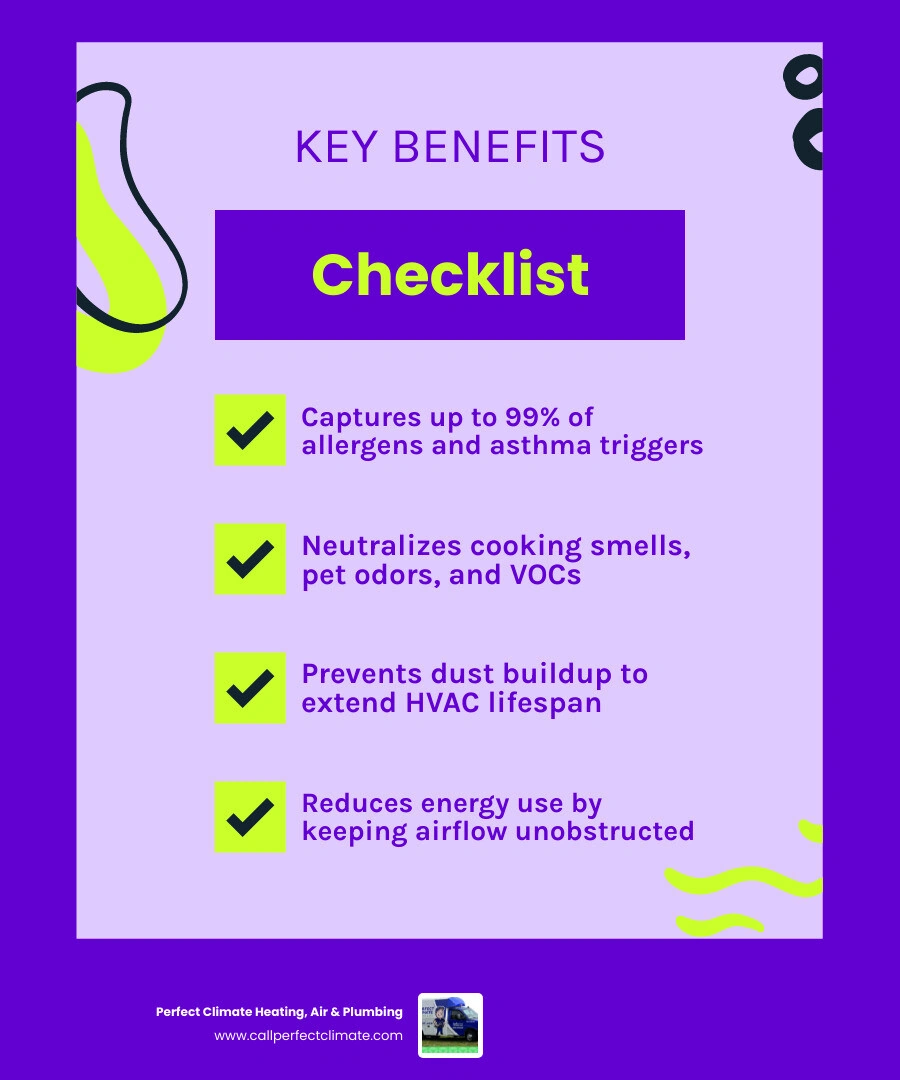
Here's a quick look at the key benefits:
- Removes allergens and dust — captures pollen, pet dander, and fine particles throughout every room
- Reduces asthma and allergy triggers — whole-house systems can capture up to 99% of allergens and asthma-inducing particulates
- Eliminates odors — activated carbon filtration neutralizes cooking smells, pet odors, and VOCs
- Protects your HVAC system — less dust buildup means cleaner coils, better airflow, and a longer system lifespan
- Improves energy efficiency — a cleaner system runs more efficiently and uses less energy
- Prevents mold growth — reduces airborne mold spores before they can settle and spread
- Better sleep and daily comfort — cleaner air supports better rest and overall well-being
Most homes in Indiana rely on a basic 1-inch furnace filter that was designed to protect the HVAC equipment — not to purify the air you breathe. A whole-house air filtration system integrates directly into your existing HVAC ductwork and filters all the air circulating through your home, continuously, every time the system runs.
The difference is significant. Standard filters miss fine particles. Whole-house systems — whether media filters, electronic air cleaners, or UV systems — are built to catch what standard filters let through.
Understanding Whole-House Air Filtration vs. Standard HVAC Filters

A whole-house air filtration system is an indoor air quality upgrade that works with your central heating and cooling system. Instead of cleaning air in one room at a time, it filters air as it moves through your return ductwork, air handler, furnace, or HVAC system.
That means the air from bedrooms, living areas, hallways, and other conditioned spaces is pulled back through the system, filtered, and redistributed through the supply vents. When properly selected and installed, this creates cleaner air throughout the home without adding bulky equipment to each room.
A standard 1-inch filter is different. Its main job is to keep large dust and debris away from HVAC components. That matters, but it is not the same as whole-home air purification.
| Feature | Standard 1-Inch HVAC Filter | Whole-House Air Filtration System |
|---|---|---|
| Primary purpose | Basic HVAC equipment protection | Whole-home indoor air quality improvement |
| Coverage | Air passing through HVAC only, with limited filtration capacity | Air circulating through the home’s duct system |
| Particle capture | Larger dust and debris | Dust, pollen, dander, fine particles, and more depending on system type |
| Filter surface area | Small | Larger media surface or advanced collection technology |
| Airflow impact | Can clog quickly if too restrictive | Designed for better filtration with proper airflow when professionally matched |
| Odor control | Minimal | Available with activated carbon options |
| Microorganism control | Minimal | UV options can help reduce biological contaminants inside the system |
| Best use | Minimum filtration | Cleaner, healthier whole-home air |
The biggest takeaway is this: whole-house filtration is not just a “better filter.” It is a system-level solution that must match your HVAC equipment, ductwork, airflow needs, and indoor air quality goals.
Coverage and Efficiency of Whole-House Systems
Whole-house systems are effective because they use your HVAC system as the delivery network. Every time your heating or cooling system runs, air cycles through the return side, passes through filtration, and returns to the home cleaner than before.
The key factors that affect performance include:
- Air circulation: The more often air moves through the system, the more opportunities the filter has to capture particles.
- Return duct design: Good return airflow helps the system pull air evenly from the home.
- Filter efficiency: MERV ratings help describe how well a filter captures particles of different sizes.
- System compatibility: A filter that is too restrictive can reduce airflow and strain equipment.
- Duct condition: Leaky ducts can pull dust, insulation fibers, attic air, or crawlspace air into the system.
MERV stands for Minimum Efficiency Reporting Value. In simple terms, a higher MERV rating captures smaller particles, but higher is not always automatically better. If your HVAC system is not designed for a very restrictive filter, airflow can drop. Some research notes that filters exceeding a system’s capacity may reduce airflow and increase energy use.
That is why we look at the whole system before recommending an upgrade. Cleaner air should not come at the expense of comfort, efficiency, or equipment life.
If you are starting your research, our Indoor Air Quality services can help you understand which options fit your home.
Why Standard 1-Inch Filters Fall Short for Entire Homes
A 1-inch filter has a tough job. It sits in the airflow path, catches large particles, and protects the blower motor, coil, and other HVAC components. But it has limited surface area, which means it can load up with dust quickly.
When that happens, several problems can show up:
- Reduced airflow from clogged filter material
- More dust bypassing the filter or settling around the home
- Hot and cold spots due to restricted circulation
- Extra strain on the blower motor
- Less effective humidity control
- More frequent filter changes
- More particles staying airborne in living spaces
A standard filter may catch visible lint and larger dust, but it often misses fine particles like pollen fragments, smoke particles, smaller pet dander, and other irritants. Those are the particles many homeowners are actually trying to reduce when they say, “Why is my house so dusty?” or “Why do my allergies flare up indoors?”
For stronger home air quality improvement, a whole-house filtration system gives your HVAC system more filtration capacity and better particle control while still preserving the airflow your equipment needs.
Key Whole House Air Filtration Benefits for Your Home
The biggest whole house air filtration benefits for your home come from consistency. Portable units can help in a single room, but a central system works with the air already moving through your home. That makes it especially useful for families dealing with dust, pet dander, seasonal pollen, musty odors, or respiratory sensitivities.
Here are the benefits homeowners usually notice most.
- Cleaner air in more rooms
A whole-house system treats the air moving through your ductwork, not just the air near a plug-in unit. This is especially helpful in multi-room homes where family members spend time in bedrooms, kitchens, living rooms, and home offices throughout the day.
- Less dust on surfaces
No system eliminates dust completely. We wish it did — nobody loves dusting ceiling fan blades. But stronger filtration captures more airborne dust before it settles on furniture, floors, electronics, and vents.
- Reduced pollen and pet dander
In southwest Indiana and nearby Illinois communities, pollen can find its way indoors through open doors, clothing, shoes, pets, and ventilation. Whole-house filtration helps capture these particles as air recirculates.
- Better odor control
Activated carbon filtration can help reduce odors from cooking, pets, smoke residue, cleaning products, and some chemical vapors. Particle filters alone do not handle odors well, so carbon is an important option when smell is a concern.
- Support for asthma and allergy management
Filtration does not replace medical care, cleaning, humidity control, or ventilation, but it can reduce airborne triggers. Research shows efficient filtration can reduce particulate matter and allergens, which may support better respiratory comfort.
- Cleaner HVAC components
Dust does not just settle on coffee tables. It can also build up inside the HVAC system. Better filtration helps keep coils, blower parts, and duct surfaces cleaner.
- More comfortable sleep
Cleaner bedroom air may help reduce nighttime irritation from dust, dander, and pollen. Many families first notice the difference in the morning: less stuffiness, less sneezing, and fewer “why did I wake up congested?” moments.
- A more complete indoor air strategy
Filtration works best alongside source control, ventilation, humidity management, duct sealing, and routine HVAC maintenance. In other words, it is part of a healthy home system — not a magic wand. A very helpful wand, but still not magic.
Maximizing Whole House Air Filtration Benefits for Your Home and Health
To get the most from a whole-house system, it helps to match the technology to the pollutants you want to reduce.
Common indoor air pollutants include:
- Dust
- Pollen
- Pet dander
- Mold spores
- Dust mite particles
- Smoke particles
- Cooking particles
- Bacteria and some airborne biological contaminants
- Volatile organic compounds, often called VOCs
- Household odors
Different filtration technologies handle different problems.
Mechanical media filters use dense pleated filter material to physically capture particles. These are common, reliable, and available in different MERV ratings.
High-efficiency filtration captures smaller particles than standard filters. True HEPA filtration is known for capturing 99.97% of particles at 0.3 microns in properly designed systems, but whole-home HEPA setups must be carefully matched because dense filtration can affect airflow.
Electronic air cleaners use an electrical charge to attract and collect particles. They can be effective, but they require proper maintenance so collection surfaces stay clean.
UV germicidal lights use ultraviolet light inside the HVAC system to help reduce biological growth on coils and other surfaces. UV does not trap dust, so it is typically paired with filtration.
Activated carbon filters adsorb odors and certain gases. They are especially useful when the concern is smell rather than just dust.
For homes with asthma, allergies, pets, or recurring respiratory irritation, filtration can be an important comfort upgrade. Fine particles can reach deeper into the lungs, and biological particles like pollen, dander, and mold spores can trigger symptoms for sensitive people.
You can learn more about this connection in our guide on how air filtration improves respiratory health.
Protecting Your HVAC System and Lowering Energy Bills
Cleaner air is the headline benefit, but your HVAC system benefits too.
Dust buildup can collect on:
- Evaporator coils
- Blower wheels
- Motors
- Heat exchangers
- Duct interiors
- Supply and return registers
When dust coats critical components, the system may have to work harder to move air and transfer heat. That can affect comfort, efficiency, and equipment wear over time.
A properly selected whole-house filtration system helps reduce that buildup. The important phrase is “properly selected.” If the filter is too restrictive for the system, it can increase static pressure and reduce airflow. That is why we do not recommend simply grabbing the highest-rated filter on the shelf and hoping for the best.
A balanced filtration setup can support:
- Better airflow
- Cleaner HVAC components
- More consistent heating and cooling
- Reduced dust inside ductwork
- Less strain on the blower
- Longer equipment life
- Better energy performance
If energy efficiency is one of your goals, filtration should be considered alongside duct condition, insulation, HVAC maintenance, thermostat settings, and equipment performance. Our team can help identify practical ways to reduce energy bills while improving comfort.
How Whole-House Systems Integrate with Your HVAC
Whole-house air filtration is installed into the central HVAC air path, usually near the return air duct, furnace, air handler, or indoor coil. Placement matters because the system needs to filter air before it reaches sensitive HVAC components and before it is redistributed through your home.
A typical process may involve:
- Evaluating the HVAC system and ductwork
- Checking available space near the return or air handler
- Reviewing airflow and static pressure needs
- Selecting the right filtration technology
- Installing the filter cabinet, electronic cleaner, UV light, carbon component, or combined solution
- Testing system operation after installation
- Reviewing maintenance steps with the homeowner
Whole-house systems can be simple or layered. For example, a home may use a high-efficiency media filter for particles, activated carbon for odors, and UV light to help keep the indoor coil cleaner. The right combination depends on the home.
A few HVAC-integrated options include:
- Media air cleaners: Larger pleated filters with more surface area than standard 1-inch filters.
- High-efficiency filter cabinets: Designed to hold deeper filters that capture more particles while supporting airflow.
- Electronic air cleaners: Use charged plates or collection cells to attract particles.
- UV germicidal lights: Installed inside the HVAC system to help control biological growth on surfaces.
- Activated carbon filtration: Added for odor and gas reduction.
- Hybrid systems: Combine multiple technologies for broader air quality improvement.
Whole-house filtration is not a one-size-fits-all product. Your home’s layout, duct design, HVAC capacity, humidity levels, pets, allergies, and comfort concerns all matter.
Choosing the Right Whole House Air Filtration Benefits for Your Home Setup
Choosing the right system starts with asking the right questions.
Consider these factors:
- What problem are you trying to solve? Dust, allergies, pet odor, musty smells, smoke particles, and mold concerns may require different solutions.
- How large is the home? Larger homes need adequate airflow and filtration capacity.
- What type of HVAC system do you have? Furnace, heat pump, air handler, ductless zones, and hybrid systems may require different approaches.
- What is the condition of the ductwork? Leaks can pull dirty air into the system before filtration ever has a chance.
- What MERV rating can your system handle? Higher efficiency is helpful only if airflow remains healthy.
- Are odors part of the concern? If yes, activated carbon may be needed.
- Are biological contaminants a concern? UV may be useful inside the HVAC cabinet or near the coil.
- How easy will maintenance be? A great filter that never gets changed will not stay great for long.
For many residential systems, a moderate-to-high efficiency media filter provides a strong balance of air cleaning and airflow. However, some homes need more advanced filtration, especially if family members have allergies, asthma, pets, or sensitivity to fine particles.
We always recommend choosing based on the whole home, not just a filter label. Our guides on selecting the right air filtration system and the best air filter for your home are helpful starting points.
Essential Maintenance for Long-Term Performance
A whole-house filtration system works best when it is maintained consistently. Maintenance is not complicated, but it is important.
Key maintenance tasks include:
- Replacing media filters on schedule
- Cleaning electronic air cleaner cells or collector plates if applicable
- Replacing UV lamps as recommended
- Checking for airflow restrictions
- Inspecting the filter cabinet for air bypass
- Keeping return grilles clean
- Checking ductwork for leaks or gaps
- Scheduling routine HVAC maintenance
Filter replacement frequency depends on the system type, filter size, home conditions, and how often the HVAC runs. Homes with pets, heavy dust, nearby construction, frequent open windows, or allergy concerns may need more frequent replacement.
Signs your filtration system needs attention include:
- More dust than usual
- Weak airflow at vents
- Higher humidity or stuffy rooms
- Musty odors
- A filter that looks heavily loaded
- Increased allergy symptoms indoors
- HVAC system short cycling or struggling
Do not ignore ductwork, either. A good filter cannot solve a major duct leak. Research has shown that gaps in return ductwork can pull insulation fibers, dust, and unconditioned air into the HVAC system. In real life, that means your system may be circulating attic or crawlspace contaminants through the home.
If you are dealing with persistent dust or odor, air duct cleaning and duct sealing may be part of the answer. We explain more in our articles on how air filter replacement improves air quality and how proper HVAC maintenance helps prevent mold growth.
Frequently Asked Questions About Home Air Quality
Indoor air quality can feel confusing because everything is connected: filters, ducts, airflow, humidity, ventilation, cleaning habits, pets, and even how often doors open and close.
Here are the questions we hear most often from homeowners.
How does a whole-house air filtration system differ from a standard 1-inch furnace filter?
A standard 1-inch furnace filter is mainly designed to protect HVAC equipment from large dust and debris. It provides basic filtration, but it usually has limited surface area and limited ability to capture fine particles.
A whole-house air filtration system is designed to improve air quality throughout the home. It usually has more filter media, a deeper cabinet, or advanced technology that captures smaller particles more effectively.
The biggest differences are:
- Filter thickness: Whole-house media filters are often deeper than 1-inch filters.
- Surface area: More surface area can capture more particles with less restriction when properly matched.
- Efficiency: Whole-house systems can use higher-performing filtration.
- Coverage: They filter air moving through the entire ducted HVAC system.
- Air quality focus: They are designed for cleaner breathing air, not just equipment protection.
That said, bigger or higher-rated is not automatically better. The filter must match the HVAC system’s airflow capacity.
Can a whole-house air purifier help reduce dust and musty odors throughout the home?
Yes, a properly selected system can help reduce dust and musty odors, but the solution depends on the cause.
For dust, media filtration or high-efficiency filtration can capture airborne particles before they settle. If dust returns quickly after cleaning, we also recommend checking duct leaks, return gaps, filter fit, and HVAC maintenance history.
For musty odors, filtration may help, but you also need to address moisture. Musty smells often point to humidity problems, microbial growth, dirty coils, clogged drains, or contaminated ductwork. Activated carbon can reduce some odors, while UV lights can help control biological growth inside the HVAC system.
If odors seem to come from vents, duct cleaning may also be worth considering. Our guide to eliminating musty odors with air duct cleaning explains what may be happening inside the duct system.
How often do whole-house air filters need to be replaced?
Replacement timing depends on the filter type and home conditions. Some filters need attention more often, while larger media filters may last longer between changes. The best schedule is the one recommended for your specific system, adjusted for real-life conditions in your home.
You may need more frequent filter replacement if you have:
- Pets
- Allergy or asthma concerns
- Heavy household dust
- Recent remodeling
- Frequent HVAC use
- Smoky or high-pollen conditions
- Return duct leaks
- Multiple occupants
- A home near fields, gravel roads, or active construction
The safest habit is to check the filter regularly and replace it before it becomes heavily clogged. A dirty filter can restrict airflow, reduce comfort, strain equipment, and lower filtration performance.
Conclusion
Whole-house air filtration is one of the most practical ways to improve comfort, support healthier indoor air, and protect your HVAC system at the same time. It helps reduce dust, allergens, pet dander, odors, and airborne particles throughout the home — not just in one room.
The best system for your home depends on your HVAC equipment, ductwork, air quality concerns, and comfort goals. That is where professional guidance makes a difference.
At Perfect Climate Heating, Air & Plumbing, we help homeowners throughout Haubstadt, Evansville, Newburgh, Princeton, Fort Branch, Poseyville, Mount Carmel, Oakland City, Owensville, Chandler, Elberfeld, Hazleton, New Harmony, and surrounding communities choose indoor air quality solutions that fit their homes. As a locally owned HVAC and plumbing company, we focus on reliable comfort, energy-efficient solutions, and practical recommendations that make sense for your household.
If you are ready to breathe easier, start with our local whole-house filtration services in Evansville, IN or Princeton, IN. We are here to help you build a cleaner, healthier, more comfortable home.
Need Help?
Contact us today to discuss your needs. Our team is ready to help.
About the Author
Perfect Climate Heating, Air & Plumbing
Recent Posts
- Why We Don't Recommend DIY Freon Recharging for Residential AC Units
- Identifying the Source of Sewer Gas Smells in Your Basement Floor Drain
- How Hard Water Scale Destroys Tankless Water Heater Heat Exchangers
- The Role of a PRV (Pressure Reducing Valve) in Protecting Your Plumbing
- Navigating Federal Tax Credits for High-Efficiency Heat Pump Upgrades
Related Articles

Why We Don't Recommend DIY Freon Recharging for Residential AC Units
A sudden late-season AC breakdown can make a quick DIY refrigerant kit tempting. Understand the mechanical dangers of overcharging before you accidentally ruin your compressor.
Read Article
Identifying the Source of Sewer Gas Smells in Your Basement Floor Drain
A sudden rotten egg odor in your basement is alarming, but the fix is often simple. We explain how dried p-traps let municipal gases inside and when you actually need to call a licensed plumber.
Read Article
How Hard Water Scale Destroys Tankless Water Heater Heat Exchangers
Mineral buildup creates a physical barrier inside your tankless water heater, leading to severe overheating and cracked components. See why a professional fall flush is a strict mechanical necessity.
Read Article
The Role of a PRV (Pressure Reducing Valve) in Protecting Your Plumbing
Banging pipes and running toilets are often symptoms of high municipal water pressure. Discover how a pressure reducing valve acts as a shock absorber to save your fixtures from hidden damage.
Read Article
Navigating Federal Tax Credits for High-Efficiency Heat Pump Upgrades
Read Article
Bypass vs. Fan-Powered Whole-House Humidifiers: A Design Choice for Evansville Homes
Preparing your home for the dry winter ahead means choosing the right humidifier. Discover how your square footage and duct layout determine whether a bypass or fan-powered unit is the best fit.
Read ArticleReady to Get Started?
Whether you need a repair, maintenance, or a new installation, our expert team is here to help.