
Post Winter HVAC Inspection What to Check: 5 Essential Steps
Prepare your system with this post winter hvac inspection what to check checklist to boost efficiency and avoid summer breakdowns.
Perfect Climate Heating, Air & Plumbing

What to Check During a Post-Winter HVAC Inspection
Knowing post winter HVAC inspection what to check can mean the difference between a cool, comfortable summer and a system breakdown on the hottest day of the year. For homeowners in Indiana and Illinois — where winters are long and summers get genuinely hot — skipping this step is a gamble that rarely pays off. Heating and cooling account for roughly 52% of a household's annual energy use, so a system that's dragging from winter wear will cost you more every single month.
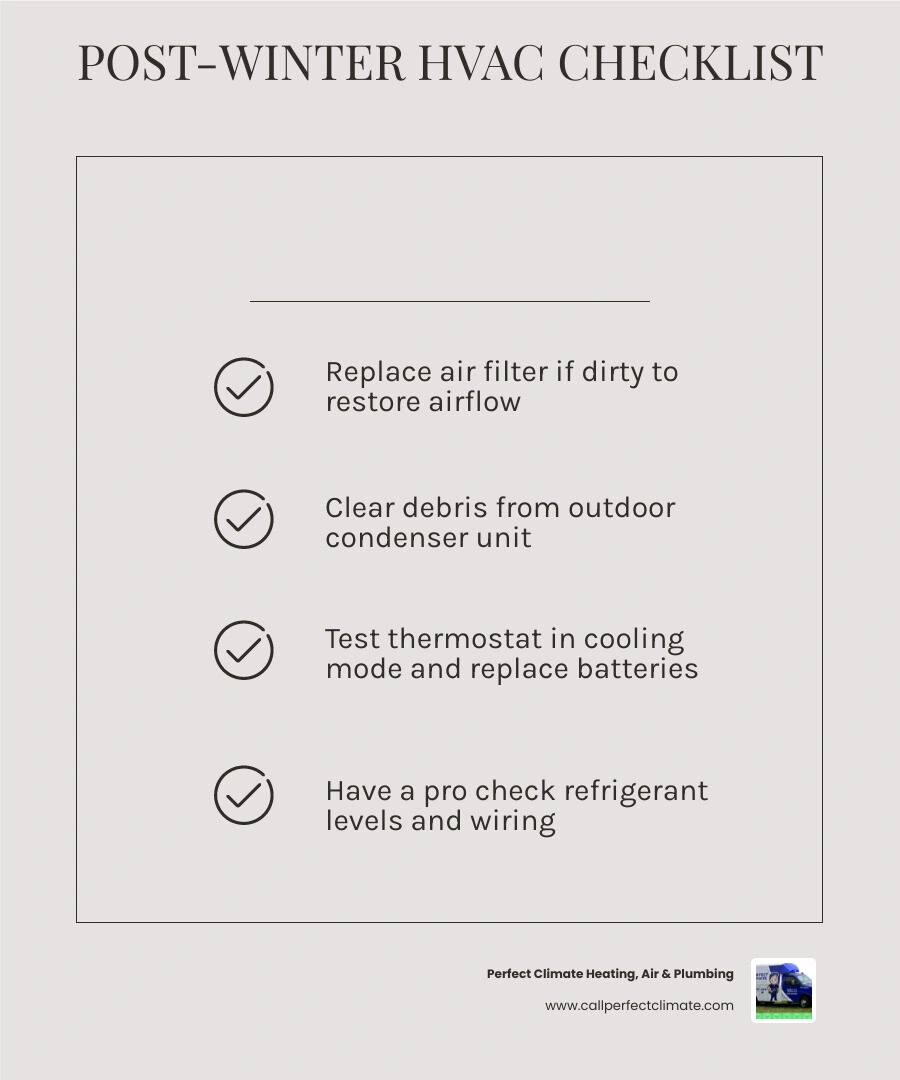
Here's a quick overview of what to inspect after winter before switching to cooling mode:
- Air filter - Replace if dirty or clogged
- Outdoor condenser unit - Clear debris and clean coils
- Thermostat - Test in cooling mode and replace batteries
- Vents and registers - Check for blockages and ensure all are open
- Condensate drain line - Clear algae or clogs
- Ductwork - Look for visible leaks, gaps, or dust buildup
- Refrigerant line insulation - Inspect for cracks or wear
- Electrical connections - Have a pro check for loose or corroded wiring
- Evaporator and condenser coils - Clean for efficient heat transfer
- Carbon monoxide detector - Test and replace batteries
- Refrigerant levels - Have a certified technician verify
The good news is that many of these checks are straightforward. Some you can handle yourself on a Saturday morning. Others — like refrigerant levels and electrical diagnostics — need a licensed technician with the right tools. This guide walks you through both, so you know exactly what to tackle and when to call in the pros.
Why a Post Winter HVAC Inspection What to Check Checklist Saves Your Summer
Think of your HVAC system like a marathon runner. During our freezing Midwest winters, your furnace or heat pump runs almost continuously to keep your home warm. By the time May 2026 rolls around, those mechanical parts have endured thousands of heating cycles. If you transition straight into the heavy cooling demand of summer without an inspection, you are asking a tired system to run another marathon without a water break.
Skipping this transition check is the primary reason why systems fail on the very first hot day of the summer. During the shoulder months of spring, the system sits relatively idle. When the first heatwave hits, homeowners crank the thermostat down, creating a sudden "peak load" situation. If your outdoor coils are caked with winter dirt or your air filter is clogged, the compressor works up to 15% harder than necessary, often leading to a sudden, costly motor burnout.
Investing a little time in a spring transition check directly impacts system longevity. On average, systems with documented annual maintenance last 18 to 22 years. Without regular maintenance, that lifespan drops to just 11 to 14 years. That means a few simple checks can add 6 to 8 years of life to your equipment—saving you from premature replacement.
Additionally, keeping your system clean keeps your utility bills manageable. Properly maintained HVAC systems use 15% to 25% less energy than neglected ones. By taking preventative action in the spring, you also keep small issues from escalating into emergency service calls. To learn more about how a little proactive care keeps your system running smoothly, check out our guide on How to Prevent HVAC Emergencies with Maintenance. For a broader look at year-round system care, you can also review our comprehensive Seasonal HVAC Maintenance Checklist.
The Ultimate Post-Winter HVAC Checklist: DIY Tasks for Homeowners

Before you call in the professionals, there are several vital maintenance tasks you can easily handle yourself. Taking care of these basic items not only saves you money but also ensures that when a technician does arrive for a professional tune-up, they can focus on advanced diagnostics rather than simple cleaning.
Safety should always be your top priority. Before performing any physical checks on your HVAC system—especially when dealing with the outdoor condenser or opening cabinet doors—make sure to turn off the power. You can shut off the power at the main electrical panel or use the outdoor disconnect switch located near your condenser unit.
Taking a proactive approach to these tasks is the first step toward lower energy bills and fewer repair headaches. If you want to make home maintenance even simpler, joining a seasonal plan is a great option. Discover the benefits of regular care in our article on 5 Ways an HVAC Maintenance Plan Can Benefit You.
Air Filter Replacement: The First Post Winter HVAC Inspection What to Check Step
If you only do one thing for your HVAC system this spring, make it replacing the air filter. During the winter, your heating system recirculates indoor air constantly. Because Americans spend about 90% of their time indoors—where pollutant concentrations can be 2 to 5 times higher than outdoor levels—your filter works overtime catching dust, pet dander, lint, and soot.
A dirty, clogged air filter acts like a wall in your ductwork, causing severe airflow restriction. This forces your blower motor to work harder to push air through the home, which can increase your energy usage by 5% to 15% and cause the system to overheat. In the summer, this restricted airflow can actually cause your indoor evaporator coils to freeze over, turning your air conditioner into a solid block of ice.
When choosing a replacement filter, pay attention to the Minimum Efficiency Reporting Value (MERV) rating:
- MERV 1–4: Basic fiberglass filters. They protect the system from large dust particles but do very little for indoor air quality.
- MERV 8–11: High-quality pleated filters. These are the sweet spot for most residential homes, capturing pollen, mold spores, and dust mites without restricting airflow.
- MERV 13+: High-efficiency filters. While excellent for allergies, they can sometimes restrict airflow in older systems, so check your manufacturer's recommendations first.
Be sure to match the exact dimensions stamped on the side of your old filter. If you have noticed issues with airflow or uneven heating during the winter, resolving filter issues is a great place to start. For more details on troubleshooting common heating issues, check out our guide on Common Furnace Problems and Solutions.
Clearing the Outdoor Condenser Unit and Coils
Your outdoor condenser unit is responsible for releasing the heat captured from inside your home. Over the winter, winds blow leaves, twigs, grass clippings, and mulch against the unit. Snow and ice can pack debris into the delicate metal fins.
To clear the unit:
- Turn off the power at the outdoor disconnect box.
- Clear the perimeter: Remove any weeds, bushes, or vines to maintain at least a two-foot clearance around the entire unit. This ensures unobstructed airflow.
- Remove loose debris: Clear away leaves and twigs from the top and base of the unit.
- Rinse the coils: Grab your garden hose and gently spray the metal fins from the inside out to wash away accumulated dirt and pollen.
Warning: Never use a pressure washer! The high-pressure stream will instantly bend the soft aluminum fins, permanently restricting airflow and forcing a costly repair. If you spot bent fins, you can use a specialized fin comb to gently straighten them. Dirty condenser coils can increase your system's energy usage by up to 15%, so keeping this area clean is critical.
Testing and Calibrating Your Thermostat
Your thermostat is the brain of your HVAC system. If it is miscalibrated or has dying batteries, your entire system will run inefficiently.
Start by replacing the batteries, even if the low-battery indicator isn't on yet. Fresh batteries prevent your system from shutting down unexpectedly during a summer heatwave. Next, switch the thermostat from "Heat" to "Cool" and set the temperature a few degrees below the current room temperature. Listen closely: you should hear the indoor blower fan turn on, followed shortly by the outdoor condenser unit.
Let the system run for about 10 minutes. Feel the air coming from your supply registers—it should feel distinctly cool. If the air remains lukewarm, or if the system constantly cycles on and off rapidly, your thermostat may need recalibration or replacement. Utilizing programmable or smart settings to automatically adjust temperatures when you are away can save you up to 10% annually on cooling costs.
Professional Maintenance vs. DIY: What to Leave to the Experts
While DIY tasks are fantastic for keeping your system clean, there are limits to what a homeowner can safely do. Modern HVAC systems are complex machines that combine high-voltage electricity, pressurized chemical refrigerants, and delicate electronic controls.
Working on these components without specialized training and diagnostic tools is dangerous and can void your manufacturer's warranty. Brands like Daikin, Carrier, and Mitsubishi often require documented, professional annual maintenance to keep their parts warranties valid. To help you decide when to pick up a tool and when to pick up the phone, refer to this quick guide:
| Maintenance Task | DIY (Homeowner) | Professional Technician | Why It Requires a Pro |
|---|---|---|---|
| Replace Air Filters | Yes | No | Straightforward, no safety risk. |
| Clear Outdoor Debris | Yes | No | Simple physical cleaning. |
| Clean Condenser Coils | Yes (Surface) | Yes (Deep Clean) | Deep cleaning requires chemical washes and electrical safety. |
| Test Thermostat Settings | Yes | No | Basic programming and battery swaps. |
| Check Electrical Wiring | No | Yes | High voltage risk; requires multimeters. |
| Measure Refrigerant Levels | No | Yes | Regulated by the EPA; requires pressure gauges. |
| Inspect Heat Exchanger | No | Yes | Crucial for identifying carbon monoxide leaks. |
| Clear Condensate Drain | Yes (Flush) | Yes (Clog Removal) | Severe clogs require professional vacuuming. |
If you are wondering whether investing in professional service is the right choice for your home, take a look at our article: Is an HVAC Maintenance Plan Worth It.
What a Professional Post Winter HVAC Inspection What to Check Includes
When our licensed technicians perform a professional spring tune-up, they conduct a comprehensive multi-point inspection that goes far deeper than surface cleaning. We inspect the blower motor and fan blades to ensure they are clean and balanced. A dusty blower wheel restricts airflow and causes the motor to run hot, shortening its lifespan.
We also evaluate overall system performance by measuring temperature splits—the difference in temperature between the air entering your return vents and the air leaving your supply registers. This tells us exactly how efficiently your system is transferring heat.
If you are located in our Indiana service areas, you can learn more about local heating and cooling care in our Heating Maintenance Princeton IN Guide. For our Illinois neighbors, we have put together a specialized Heating Maintenance Mount Carmel Guide to address local climate needs.
Electrical Connections and Safety Controls
Loose electrical connections are one of the leading causes of component failure in HVAC systems. During winter operation, the constant vibration of the system can slowly loosen electrical terminals.
During a professional inspection, a technician will:
- Tighten connections: Secure all electrical terminals at the contactor, capacitor, and disconnect switch.
- Test capacitors: Capacitors act like temporary batteries that give your motors the extra boost they need to start up. We test them with a multimeter and recommend replacing them if they fall more than 5% to 10% below their rated value. A weak capacitor is the number-one cause of early-summer "AC won't turn on" service calls.
- Inspect contactors: We check for pitting, burn marks, or worn contacts that can cause the outdoor unit to run continuously or fail to start.
- Verify safety controls: We test safety limit switches and carbon monoxide detectors. Carbon monoxide detectors should be tested monthly, and the units themselves must be replaced every 7 years to ensure your family's safety.
Catching these issues early prevents major breakdowns and helps you avoid unexpected system failures. If your system is getting older and showing signs of wear, it helps to know what to watch out for. Read up on the key indicators in our guide to Furnace Replacement Warning Signs.
Refrigerant Levels and Line Insulation
Your air conditioner does not actually "create" cold air; it uses chemical refrigerant to absorb heat from inside your home and release it outdoors. If your system has a refrigerant leak, its cooling capacity will plunge, causing the compressor to run constantly, overheat, and eventually fail.
A professional technician will attach specialized manifold gauges to measure the exact pressure and temperature of the refrigerant. If levels are low, we don't just add more refrigerant—we locate and repair the leak to protect your system and the environment.
We also inspect the thick foam insulation wrapping the copper refrigerant lines. If this insulation is cracked, water-damaged, or stripped away by weather and pests, the line will absorb heat from the outdoors, drastically reducing cooling efficiency. Replacing damaged insulation is a quick fix that makes a noticeable difference. To see how these lines and other components transition between seasons, check out our tips on Preparing Your Furnace for Winter.
Adapting Your Post-Winter HVAC Checklist for Indiana and Illinois Climates
Homeowners in places like Evansville, Newburgh, and Mount Carmel, IL face unique climate challenges. Unlike regions with mild, dry weather, the tristate area experiences extreme seasonal swings. We go from sub-zero winter wind chills to sweltering, humid summer days.
This high humidity means your air conditioner has to work twice as hard. It doesn't just lower the air temperature; it also has to pull moisture out of the air. This makes checking your condensate drain line incredibly important. If the drain line is clogged with dust or algae, that extracted moisture has nowhere to go. It will back up, causing water damage to your ceiling or triggering a safety switch that shuts down your entire system.
Additionally, our springs bring heavy pollen, cottonwood seeds, and agricultural dust. This airborne debris quickly coats outdoor condenser coils, acting like an insulating blanket that traps heat inside the unit. If you have a geothermal system—which we specialize in at Perfect Climate—spring is the perfect time to check loop pressures and verify pump operation to ensure maximum efficiency before summer.
Understanding how to care for your system during these extreme seasonal shifts is the key to avoiding breakdowns. For specialized tips on keeping your system running smoothly through our region's toughest weather, read our Furnace Maintenance Tips to Avoid Breakdowns During the Coldest Days in Mount Carmel IL.
Frequently Asked Questions about Post-Winter HVAC Care
How does skipping a post-winter inspection affect energy bills?
Skipping your post-winter inspection directly impacts your wallet. When your system has dirty coils, clogged filters, or slightly low refrigerant, it has to work up to 15% harder and run much longer to cool your home. This extra runtime shows up immediately as a spike on your monthly utility bills.
When is the best time to perform a post-winter HVAC check?
The ideal time is during the spring transition, typically between March and May. During this period, the weather is mild, meaning your system isn't under heavy demand. This low-stress window gives you plenty of time to identify and repair any issues before the first major summer heatwave. It is also the easiest time to schedule a professional technician before our busy summer rush begins.
Can I use a pressure washer to clean my outdoor condenser coils?
No, never use a pressure washer on your outdoor unit. The high-pressure water stream will instantly bend and crush the delicate aluminum fins on the coils. This restricts airflow and can cause permanent damage to your system. A gentle rinse with a standard garden hose is all you need for basic DIY cleaning. For deep, stubborn grime, always call a professional to apply safe chemical coil cleaners.
Conclusion
Taking the time to understand post winter HVAC inspection what to check is one of the smartest investments you can make in your home's comfort and efficiency. By tackling basic DIY tasks like filter replacement and outdoor clearing, and partnering with licensed professionals for electrical and refrigerant checks, you ensure your system is ready to handle whatever summer throws our way.
At Perfect Climate Heating, Air & Plumbing, we are dedicated to keeping your home comfortable all year long. Whether you live in Haubstadt, Evansville, Newburgh, Princeton, Boonville, or Mount Carmel, IL, our team of experienced technicians is here to help.
Don't wait for the first sweltering day of summer to find out if your air conditioner is up to the task. Sign up for a Perfect Climate Maintenance Plan today and enjoy complete peace of mind all season long!
Need Help?
Contact us today to discuss your needs. Our team is ready to help.
About the Author
Perfect Climate Heating, Air & Plumbing
Recent Posts
- How Hard Water Scale Destroys Tankless Water Heater Heat Exchangers
- The Role of a PRV (Pressure Reducing Valve) in Protecting Your Plumbing
- Navigating Federal Tax Credits for High-Efficiency Heat Pump Upgrades
- Bypass vs. Fan-Powered Whole-House Humidifiers: A Design Choice for Evansville Homes
- Why Your Gas Furnace Short-Cycles When You First Turn It On in Autumn
Related Articles

How Hard Water Scale Destroys Tankless Water Heater Heat Exchangers
Mineral buildup creates a physical barrier inside your tankless water heater, leading to severe overheating and cracked components. See why a professional fall flush is a strict mechanical necessity.
Read Article
The Role of a PRV (Pressure Reducing Valve) in Protecting Your Plumbing
Banging pipes and running toilets are often symptoms of high municipal water pressure. Discover how a pressure reducing valve acts as a shock absorber to save your fixtures from hidden damage.
Read Article
Navigating Federal Tax Credits for High-Efficiency Heat Pump Upgrades
Read Article
Bypass vs. Fan-Powered Whole-House Humidifiers: A Design Choice for Evansville Homes
Preparing your home for the dry winter ahead means choosing the right humidifier. Discover how your square footage and duct layout determine whether a bypass or fan-powered unit is the best fit.
Read Article
Why Your Gas Furnace Short-Cycles When You First Turn It On in Autumn
That frustrating three-minute shutdown cycle on the first chilly morning is usually a built-in safety response. Find out if it is a simple airflow issue or a dirty flame sensor.
Read Article
Upgrading Your Electrical Panel to Handle a New High-Efficiency HVAC System
Surprised by a quote to overhaul your breaker box before a heat pump installation? This electrical upgrade is a mandatory safety requirement to support modern heating systems.
Read ArticleReady to Get Started?
Whether you need a repair, maintenance, or a new installation, our expert team is here to help.