Whole House Filtration in Fort Branch, IN
Whole-House filtration installation in Fort Branch, IN improves indoor air quality. Learn options and steps, and maintenance—schedule today.

Whole House Filtration in Fort Branch, IN
For ultimate comfort and health in Fort Branch, IN, improving your indoor air quality is a top priority. With our hot, humid summers, unpredictable pollen seasons, and the dust and particulates from nearby agricultural activity, homes in this region truly benefit from a system designed for their unique challenges. Perfect Climate Heating and Air specializes in expertly designed whole-house filtration systems that significantly improve the air you breathe. Trust Perfect Climate Heating and Air to help you find the perfect solution for your home.
.jpeg)
Why whole-house filtration matters in Fort Branch, IN
Fort Branch homeowners commonly contend with:
- Seasonal tree and grass pollen that spikes in spring and early summer
- Agricultural dust and fine soil particulates during planting and harvest
- Higher indoor humidity that encourages mold spores and dust mite proliferation
- Winter indoor combustion byproducts from furnaces and occasional wood burning
A whole-house filtration system treats the air that circulates through your HVAC system, reducing allergens, fine particles (PM2.5), pet dander, and airborne irritants throughout every room rather than just in a single portable unit.
Common whole-house filtration types
Understanding the differences helps match the system to your health needs and HVAC system capabilities.
- Media filters with MERV ratings
- MERV 8 to 11: Effective for larger particles like dust, lint, and pollen.
- MERV 11 to 13: Better for smaller particles including fine dust, some smoke, mold spores, and pet dander; commonly recommended for allergy and asthma concerns.
- Higher MERV filters capture more small particles but may increase static pressure—professional assessment is essential.
- HEPA-compatible setups
- True HEPA in-duct systems or dedicated whole-house HEPA cabinets can remove 99.97% of particles at 0.3 microns.
- Many standard home HVAC blowers cannot handle high static pressure associated with HEPA; HEPA installations often require a separate blower or an engineered bypass cabinet.
- Electronic and polarized filters
- Electronic air cleaners and polarized media remove fine particles by charging and collecting them on plates or fibers.
- These systems can be highly effective for ultrafine particles but require regular cleaning of collection cells and may produce trace ozone in some designs.
- Activated carbon stages (optional)
- For homes concerned with odors, VOCs, or smoke, adding activated carbon media can reduce gaseous contaminants when paired with particle filtration.
Integration with ductwork and HVAC systems
Proper installation is about more than dropping a filter in the return. Key considerations include:
- Filter cabinet location and sizing to fit a higher-efficiency filter or a HEPA module
- Static pressure and airflow: technicians measure existing system fan capacity and pressure to avoid reducing system performance
- Sealing and duct integrity: filtration works best with well-sealed ducts; coordination with duct cleaning or sealing is common
- Compatibility with furnaces, air handlers, and zoning systems to ensure even airflow and avoid noise or cycling issues
A professional assessment establishes whether a simple filter upgrade, a media cabinet, or a HEPA-compatible retrofit is the right solution for your home.
Expected improvements in allergen and particulate removal
- Upgrading from a basic 1-inch fiberglass filter to a MERV 11–13 media filter commonly reduces household airborne allergens, pollen, and many fine particulates by a large margin.
- True HEPA installations capture the smallest respirable particles, including many bacteria-sized and smoke particles.
- Electronic air cleaners tend to reduce ultrafine particles that some mechanical filters miss but require routine maintenance to remain effective.
- Realistic outcomes depend on system selection, duct sealing, and maintenance; note that filtration reduces airborne particulates but does not remove settled dust or eliminate all VOCs without a carbon stage.
Installation and replacement procedures
Installation typically follows these steps:
- Site assessment and airflow measurement to determine the right filter type and cabinet size.
- Installation of a media filter cabinet, retrofit HEPA module, or electronic cleaner into the return plenum or duct run.
- Static pressure test and blower adjustment if needed to ensure the system continues to deliver required CFM.
- System balancing and verification checks (noise, cycling, and overall operation).
Replacement and routine care:
- Media filters: replacement intervals depend on MERV rating, load, and indoor sources—commonly every 3 to 12 months.
- HEPA modules: pre-filters require regular replacement; HEPA elements last longer but must be monitored for pressure drop.
- Electronic cleaners: collection cells should be cleaned per manufacturer guidance, usually every 1–3 months.
Technicians will show how to safely access and replace filters and document baseline performance for future comparisons.
Performance specifications and testing
Professional installations include measurable performance checks:
- Airflow (CFM) readings before and after installation to confirm proper circulation
- Static pressure (inches w.c.) to ensure the filter does not excessively restrict the blower
- Particle count testing or visual inspections to demonstrate pre/post improvements when requested
- Verification of electrical and mechanical integrity for electronic cleaners and HEPA modules
These tests provide objective data on filtration effectiveness and ensure the system meets the home’s air quality goals.
Maintenance plans, service agreements, and financing
Long-term performance requires scheduled maintenance. Service agreements can include:
- Regular filter replacement or delivery schedules
- Annual inspections and static pressure checks
- Cleaning of electronic cells and verification testing
- Coordination with duct cleaning and sealing for best results
Financing options are commonly available for higher-investment solutions such as HEPA retrofits or whole-house systems, and service agreements can be structured to match replacement and maintenance needs.
Health and indoor air quality benefits
- Fewer allergy and asthma triggers by reducing pollen, dust mite allergens, and pet dander circulating through the home
- Lower indoor PM2.5 and particulate exposure during agricultural fieldwork, seasonal smoke, or high-pollen days
- Reduced dust accumulation on surfaces and HVAC components, helping systems run more efficiently and last longer
- Improved comfort and perceived air freshness, especially in tightly sealed homes common in modern construction
Compatibility and practical considerations
- Higher-efficiency filters are valuable, but they must match your HVAC system capacity; oversized pressure drop can reduce heating and cooling performance.
- Layered approaches—pre-filter + MERV/HEPA + activated carbon—often deliver the best balance of particle and gas removal.
- Integrating filtration upgrades with existing duct cleaning and maintenance maximizes result and value.
For Fort Branch, IN homes, whole-house filtration is a practical, effective way to reduce allergens, fine dust, and indoor pollutants that vary with Midwestern seasons and local agricultural activity. A professional evaluation that considers your current HVAC capacity, indoor health priorities, and lifecycle maintenance will identify the filtration type and installation approach that delivers measurable improvements in indoor air quality and long-term system reliability.
What Our Clients
Say About Us
Our clients consistently praise our dedication and expertise. They appreciate our commitment to meeting their needs and providing sound advice, which has fostered long-lasting relationships.

SERVICE AREAS
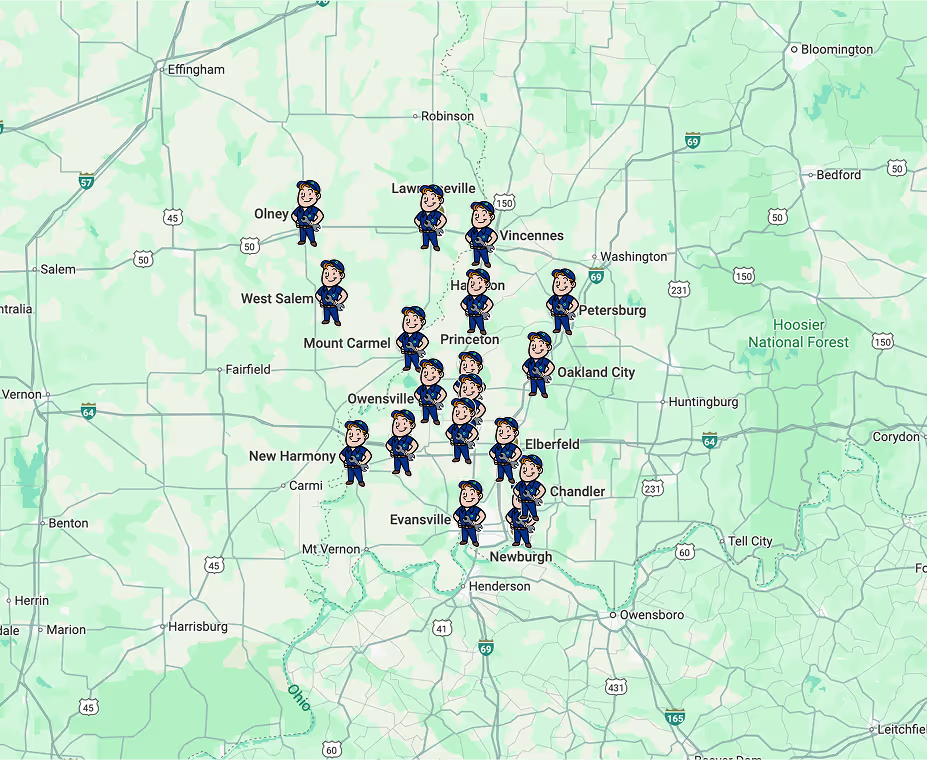
We proudly serve clients throughout our surrounding communities, delivering reliable service wherever you need us. No matter the location, our team is committed to the same high-quality results and responsive support.