Whole House Filtration in West Salem, IL
Whole-house filtration in West Salem, IL improves indoor air with high-MERV filters and UV; learn more about implementation and benefits.

Whole House Filtration in West Salem, IL
West Salem, IL homeowners know the struggle: seasonal pollen, agricultural dust, winter wood smoke, and the constant threat of humidity-driven mold. Improving indoor air quality isn't just a luxury, it's essential for comfort and health. Whole-house filtration offers comprehensive protection by treating all the air that circulates through your HVAC system, effectively reducing allergens, particulates, and biological contaminants throughout your entire home, not just a single room. At Perfect Climate Heating and Air, we understand these local challenges and are here to help you breathe easier indoors.
.jpeg)
Why whole-house filtration matters in West Salem, IL
- Seasonal pollen and grass pollens are high in spring and summer, impacting allergy sufferers.
- Nearby agricultural activity can increase fine dust and airborne particulates during planting and harvest.
- Cold-season wood burning and furnace use can raise indoor particulate levels.
- Older homes with leaky ducts or aging HVAC equipment are more likely to trap dust, mold spores, and pet dander inside living spaces.
A properly designed whole-house filtration system lowers particle counts across the home, improves HVAC efficiency by keeping coils and ducts cleaner, and reduces allergy and asthma triggers for occupants.
Whole-house filtration technologies explained
Understanding the main options helps match technology to home needs and budget.
- Media filters (standard and high-MERV)
- Standard pleated filters (MERV 6-8) capture larger particles like dust and lint.
- High-MERV media (MERV 11-13) capture finer particles such as pollen, pet dander, and some mold spores while remaining compatible with many systems.
- Thicker filters (2-inch to 4-inch) reduce pressure drop compared to thin 1-inch filters at the same MERV rating.
- HEPA and high-performance filtration
- True HEPA filters remove 99.97% of particles 0.3 micron in size. Whole-house HEPA requires a special bypass housing or a dedicated air cleaner sized to your system to avoid excessive pressure drop.
- High-efficiency filters nearing HEPA performance are available with lower pressure penalties for some HVAC systems.
- Electronic air cleaners
- Electrostatic precipitators charge and collect particles on plates that must be cleaned regularly. They are effective on fine and ultrafine particles.
- Ionizing cleaners can reduce airborne particles but may produce ozone; models should meet safe ozone emission standards.
- UV additives
- UV-C lamps installed near the coil and drain pan reduce microbial growth on the evaporator coil and help control mold and bacteria.
- UV does not remove particulates but complements filtration by limiting biological contamination and improving coil efficiency.
- Combination systems
- The most effective whole-house solutions often combine mechanical filtration (high-MERV or HEPA) with UV and/or electronic cleaners to address particulates and biologicals comprehensively.
How filtration improves allergen and particulate removal
- Particle capture: Mechanical filters and HEPA physically trap particles; MERV rating indicates the size range captured.
- Biological control: UV reduces microbial loads on HVAC components and in the airstream when positioned properly.
- Source reduction: Better filtration limits the recirculation of indoor contaminants, reducing buildup in carpets and on surfaces.
- Health outcomes: Proper filtration lowers triggers for allergies and asthma by significantly reducing pollen, pet dander, dust mite debris, and fine particulate matter (PM2.5), which is associated with respiratory irritation.
System selection and sizing
Selecting the right system requires matching filtration performance to HVAC capacity and home characteristics.
- Assess airflow and CFM: Filters create pressure drop. Ensure the chosen filter or whole-house unit does not exceed the blower and duct design limits.
- Consider filter thickness: 2-inch and 4-inch media offer higher efficiency with lower pressure drop than 1-inch options.
- Account for home size and occupancy: Larger homes or homes with pets and smokers will benefit from higher-efficiency options.
- Evaluate blower type: Variable speed blowers tolerate higher-efficiency filters better than single-speed units.
- Placement: Most whole-house filters are installed at the return plenum or in a dedicated filter cabinet; some electronic or HEPA units require separate housings or bypass ducts.
Professional assessment typically includes measuring existing static pressure, determining system compatibility, and sizing units to maintain adequate airflow while achieving targeted filtration levels.
Installation and integration with HVAC systems
- Typical locations: return grille, return trunk, or dedicated filter cabinet near the air handler.
- Electrical needs: Electronic air cleaners and UV lamps require power and safe mounting near the coil; wiring should follow local codes.
- Coil and duct considerations: Installing filtration often pairs with duct cleaning or coil cleaning to maximize performance and prevent initial contamination.
- Safety and compliance: Avoid ozone-producing devices and ensure UV installations do not expose occupants or service personnel to direct UV light.
Proper installation balances filtration efficiency with HVAC performance to avoid reduced comfort or increased energy use.
Maintenance and filter replacement schedules
Regular maintenance keeps the system effective and protects HVAC equipment.
- 1-inch pleated filters: check monthly; replace every 1 to 3 months depending on use and dust load.
- 2-inch to 4-inch media filters: inspect every 3 months; typical replacement every 6 to 12 months.
- HEPA housings: prefilters require more frequent replacement; HEPA modules may last several years with proper prefiltration.
- Electronic cleaners: wash collection cells every 3 to 6 months; inspect power supply annually.
- UV-C lamps: replace bulbs annually, as output decreases over time even if the lamp still lights.
- Annual system check: static pressure and airflow test, verify seals and housings, and confirm UV and electronic components are functioning.
Create a maintenance plan that matches local seasonal changes in West Salem, such as increased pollen season inspections.
Performance expectations and testing
- Expected reductions: Upgrading from a basic MERV 4-6 to a MERV 11-13 filter typically reduces household particle loads substantially; HEPA can remove most particles down to 0.3 micron.
- Measurable results: Particle counters can provide before-and-after PM2.5 and particle size data; HVAC professionals may also test static pressure and airflow to ensure system health.
- Realistic outcomes: Filtration improves the air you breathe indoors but cannot remove all contaminants (for example, gases and VOCs require activated carbon or other sorbents).
Purchasing, financing, and ongoing costs
- Purchase options: Whole-house filters and units are available as retrofit housings, integrated factory solutions, or standalone air handlers. Choose based on compatibility and long-term maintenance expectations.
- Financing approaches: Many homeowners use financing plans, equipment loans, or manufacturer financing to spread installation costs. Check for available local energy rebates or incentives for high-efficiency upgrades.
- Ongoing costs: Factor in filter replacements, cell cleanings, UV lamp replacements, and annual inspections. Subscribing to a scheduled replacement service simplifies upkeep and ensures performance.
Whole-house filtration in West Salem, IL, provides meaningful reductions in pollen, dust, smoke, and biological contaminants when matched correctly to your HVAC system and maintained regularly. Consider a combined approach—high-MERV media or HEPA plus UV and proper duct care—to address both particulates and microbial growth. Professional assessment, proper sizing, and an agreed maintenance schedule will deliver the best long-term indoor air quality and system reliability for West Salem homes.
What Our Clients
Say About Us
Our clients consistently praise our dedication and expertise. They appreciate our commitment to meeting their needs and providing sound advice, which has fostered long-lasting relationships.

SERVICE AREAS
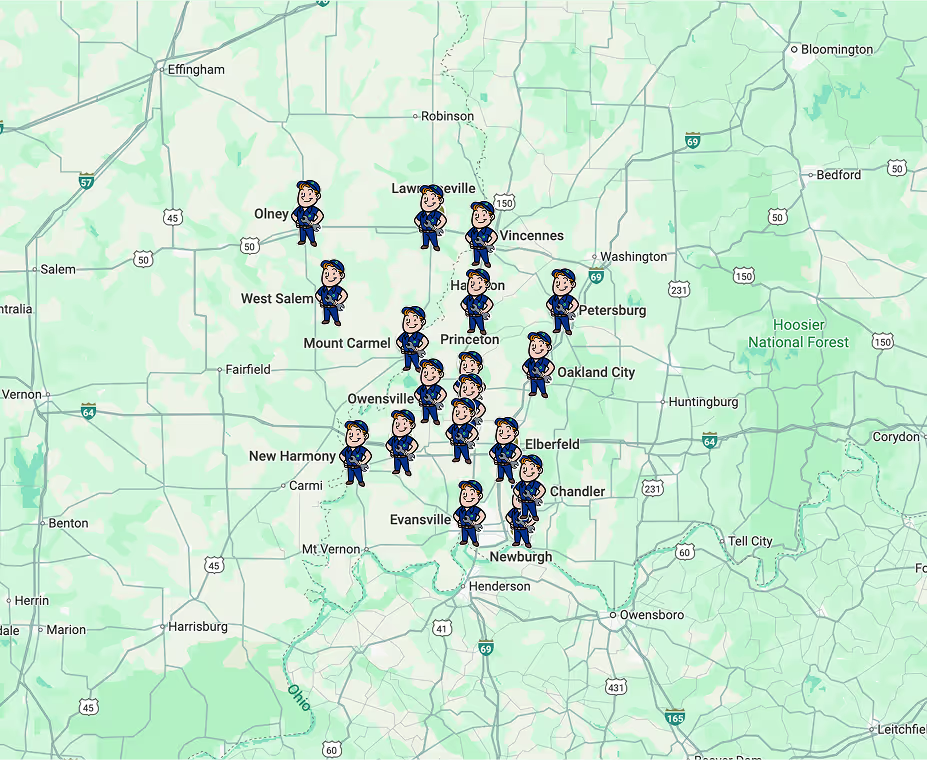
We proudly serve clients throughout our surrounding communities, delivering reliable service wherever you need us. No matter the location, our team is committed to the same high-quality results and responsive support.