
How Often Should You Change Your HVAC Air Filter: 2026 Essential Guide
Learn how often should you change your hvac air filter with our 4-step guide to boost air quality and HVAC efficiency.
Perfect Climate Heating, Air & Plumbing

The Quick Answer: How Often Should You Change Your HVAC Air Filter?
Knowing how often should you change your HVAC air filter is one of the simplest — and most impactful — things you can do to keep your home comfortable and your system running efficiently. Most homeowners don't think about their air filter until something goes wrong: energy bills creep up, the air feels stale, or worse, the system breaks down entirely.
Here's a quick-reference guide based on filter type and household conditions:
| Filter Type | Standard Home | Pets or Allergies | Heavy Use / Large Family |
|---|---|---|---|
| 1-inch fiberglass | Every 30 days | Every 20-30 days | Every 20 days or less |
| 1-inch pleated | Every 60-90 days | Every 30-60 days | Every 30-45 days |
| 2-inch pleated | Every 60-90 days | Every 30-60 days | Every 30 days |
| 4-inch media filter | Every 6-9 months | Every 4-6 months | Every 3-4 months |
| 5-inch media filter | Every 9-12 months | Every 6-9 months | Every 4-6 months |
The bottom line: most homes should check their filter at least once a month and replace it somewhere between every 30 and 90 days — though thicker media filters can stretch that to six months or longer. Your specific schedule depends on factors like pets, allergies, home size, and how hard your system works throughout Indiana's hot summers and cold winters.
According to the U.S. Department of Energy, simply replacing a clogged filter can improve your HVAC system's energy efficiency by 5 to 15%. That's a meaningful difference — and it costs next to nothing compared to an avoidable repair.
In this guide, we'll walk you through everything you need to know: which filter type is right for your home, the signs that your filter needs replacing sooner than expected, how to change it in four simple steps, and what happens if you let it go too long.
How often should you change your hvac air filter definitions:
How Often Should You Change Your HVAC Air Filter?
When it comes to maintaining your home's comfort, there is rarely a universal, one-size-fits-all schedule. However, establishing a reliable baseline is the first step toward keeping your heating and cooling system in peak condition. For most standard households in Haubstadt, Evansville, and surrounding Tri-State areas, the general rule of thumb is to replace standard pleated filters every 90 days.
But why is this baseline so critical, and what exactly does "standard" mean? A standard home is typically defined as a moderate-sized house with average occupancy (two to four people), no indoor pets, and no residents who suffer from severe allergies or chronic respiratory conditions. If your household fits this description, a high-quality 1-inch pleated filter will comfortably last about three months before it gathers enough dust and debris to restrict airflow.
However, your HVAC system does not operate in a vacuum. It is constantly circulating the air inside your living spaces, trapping airborne particles with every cycle. As the filter captures dust, pollen, and lint, its fibers gradually fill up. While a partially dirty filter actually becomes slightly more efficient at trapping smaller particles because the existing debris helps block incoming dust, there is a tipping point. Once the filter becomes overloaded, the system has to work twice as hard to pull air through the clogged barrier.
Regularly scheduling your replacements ensures you protect your equipment from unnecessary wear and tear. If you are unsure whether your current schedule is matching your home’s actual needs, reading our guide on How Often Should You Replace Your Air Filter can help you dial in the perfect cadence. Staying on top of this simple chore pays massive dividends, because consistent Air Filter Replacement Improves Air Quality while keeping your monthly utility costs as low as possible.
How Often Should You Change Your HVAC Air Filter with Pets and Allergies?
If you share your home with furry companions, your filter replacement schedule changes dramatically. Dogs and cats are wonderful additions to the family, but they are also walking, playing dust-and-dander factories. Every time your pet runs across the living room carpet, shakes off after an outdoor play session, or sheds their seasonal coat, they release hair and microscopic dander into the air.
This airborne debris is quickly pulled into your return vents. If you have a single pet, we recommend checking your filter every 60 days. If you have multiple pets, or breeds that are prone to heavy shedding, that window shrinks to every 30 to 45 days.
For households dealing with asthma, seasonal allergies, or other respiratory vulnerabilities, the air filter serves as the primary line of defense. Standard filters can capture large dust bunnies, but they let microscopic allergens slip right through. If anyone in your family struggles with breathing issues, we highly recommend upgrading to high-quality, electrostatic pleated filters and changing them every 30 to 60 days.
When you have young children in the home, their developing lungs are naturally more sensitive to indoor air pollutants. Keeping a strict 60-day replacement schedule using high-efficiency filters is a simple way to protect them. Clean filters prevent trapped pollen, mold spores, and pet dander from being constantly re-circulated through your vents. To explore the deep connection between your HVAC filtration and your family's health, read about How Air Filtration Improves Respiratory Health.

How Often Should You Change Your HVAC Air Filter Based on Filter Type and Thickness?
Not all air filters are created equal. The material, design, and physical dimensions of your filter play a massive role in how often it needs to be swapped out.
- Fiberglass Filters (1-inch): These are the thin, spun-glass filters you often see sold in inexpensive multi-packs. They are designed primarily to protect your HVAC equipment from large dust particles, rather than to clean your indoor air. Because they have very little surface area, they clog incredibly fast and must be replaced every 30 days or less.
- Pleated Filters (1-inch to 2-inch): Made from folded polyester or cotton fibers, pleated filters have significantly more surface area than flat fiberglass models. This design allows them to capture much smaller particles (like pollen and pet dander) without immediately choking your system's airflow. These typically last 60 to 90 days in standard homes.
- Media Filters (4-inch to 5-inch): These thick, accordion-style filters are housed in a dedicated media cabinet attached to your furnace or air handler. Because they are packed with feet of folded filtering material, they have an immense surface area. A 4-inch filter typically lasts around six months, while a robust 5-inch filter can easily last nine to twelve months before needing a replacement.
To help you choose the ideal match for your specific system and lifestyle, check out our comprehensive breakdown of the Best Air Filter for Your Home.
Key Factors and Signs That Your Filter Needs Replacing
While calendar guidelines are incredibly helpful, your actual home environment will always dictate the true lifespan of your filter. Several key factors can accelerate how quickly a filter fills up:
- Home Size: Smaller homes have less volume of air, which means the air circulates through the filter more frequently, often loading it with dust faster than in a sprawling multi-story house. Conversely, very large homes circulate massive volumes of air, which can also load filters quickly if the system runs continuously.
- System Usage: During mild spring and autumn months in Southern Indiana, your HVAC system might barely run. If the fan isn't blowing, the filter isn't catching dust, which extends its lifespan. However, during freezing January nights or humid July afternoons, your system runs almost constantly, meaning the filter will clog much faster.
- Local Environment and Outdoor Air Quality: If you live near working farms in Poseyville, IN, or near active construction zones in Newburgh, IN, your home is naturally exposed to higher levels of outdoor dust and agricultural particulates. Similarly, seasonal events like high pollen counts or drifting wildfire smoke can overwhelm a filter in a matter of days.
Fortunately, you don't have to guess when it's time for a change. There are several unmistakable signs that your air filter has reached the end of its useful life:
- The Light Test: This is the most reliable DIY inspection method. Turn off your HVAC system, slide the filter out, and hold it up to a bright light source (like a window or a flashlight). If the light cannot pass through the fabric because it is matted with a gray, fuzzy layer of dust, your filter is clogged and needs to be replaced immediately.
- Excessive Dust Around the House: If you notice a thin layer of grey dust settling on your tables, countertops, and television screens just a day or two after deep cleaning, your filter is likely full and can no longer trap incoming particles.
- Musty Odors: A dirty filter can trap moisture and organic material, leading to musty, stale smells whenever the air conditioner or furnace kicks on.
- Longer System Cycles: If your air conditioner or heater seems to run endlessly without ever quite reaching the temperature set on your thermostat, restricted airflow from a dirty filter is often the culprit.
For residents looking to optimize their home environment, exploring our Indoor Air Quality Tips Poseyville IN can provide excellent regional advice. Keeping your filter clean is a vital first step, and learning how to Improve Indoor Airflow with HVAC Care will keep your home feeling fresh and comfortable all year long.
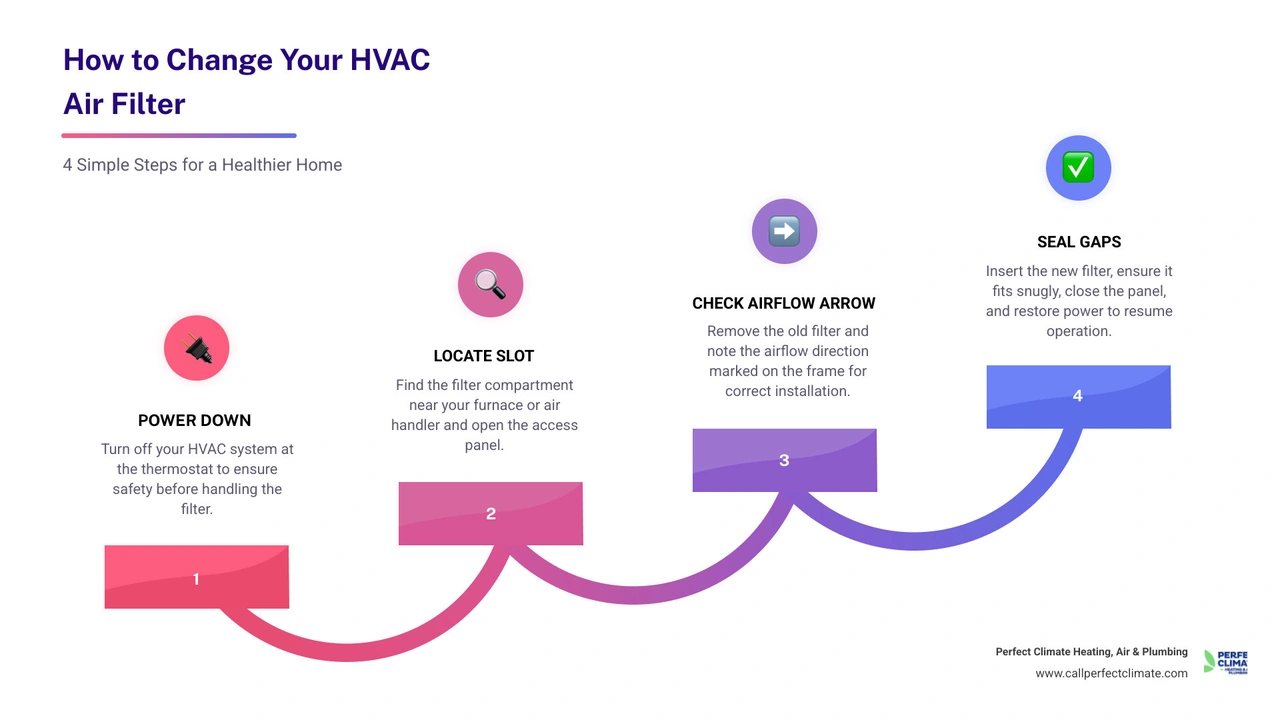
How to Change Your HVAC Air Filter in 4 Simple Steps
Changing your air filter is a quick, straightforward task that requires absolutely no specialized tools. By following these four simple steps, you can safely complete this essential maintenance chore in under five minutes.
Step 1: Power Down Your System
Before you touch the filter, always turn your HVAC system completely off. You can do this by switching your thermostat to the "Off" position or by using the electrical shutoff switch located near your furnace or indoor air handler.
Why this matters: If the system is running while you pull the old filter out, the powerful suction from the blower fan can pull loose dust, hair, and debris directly into the unprotected internal components of your furnace. It can also make sliding the new filter in incredibly difficult because of the strong air pressure.
Step 2: Locate and Remove the Old Filter
Locate your system's filter slot. Depending on how your home was built, this slot might be located inside a metal cabinet next to your indoor furnace/air handler, or it may be hidden behind a return air grille mounted on a hallway wall or ceiling. Gently slide the old filter out of its housing. Take a moment to look at the frame of the filter—the physical dimensions (such as 16x25x1) will be clearly printed on the side.
Step 3: Check the Airflow Arrow and Insert the New Filter
Every high-quality air filter has a small arrow printed on its outer cardboard frame. This arrow represents the direction that air must flow through the media. Air always flows from your living spaces, through the return ductwork, through the filter, and finally into the HVAC unit.
Ensure the arrow on your new filter points toward the furnace or blower motor. Gently slide the new filter into the slot, making sure it fits snugly without forcing or bending the cardboard frame. If there are visible gaps around the edges, you can use a small strip of foam weatherstripping to seal the edges and prevent air bypass.
Step 4: Record the Date and Power Back On
Using a dark marker, write the current date (for example, June 2026) directly on the visible edge of your new filter's cardboard frame. This simple trick takes the guesswork out of your next inspection because you will know exactly how long the filter has been in service. Once the filter is securely in place, turn your thermostat or system switch back to "On" or "Auto."
Regularly performing this quick routine is an excellent habit, but it is also important to recognize common pitfalls. To ensure you aren't accidentally hurting your system, take a moment to review these 6 HVAC Maintenance Mistakes to Avoid for Homeowners.
Consequences of Neglecting Filter Maintenance
It is easy to let filter maintenance slide. Life gets busy, and because your air filter is usually tucked away out of sight in a basement, closet, or attic, it is easily forgotten. However, neglecting this simple chore can trigger a chain reaction of expensive, frustrating problems throughout your home.
When a filter becomes completely clogged with dirt, hair, and dust, it acts like a wall inside your ductwork. The immediate consequence is a severe drop in airflow. Without a steady stream of warm air flowing over your air conditioner’s indoor evaporator coil during the summer, the refrigerant inside the coil drops below freezing.
Moisture in the air rapidly condenses on the cold metal and freezes solid, turning your AC unit into a block of ice. Once your coils freeze, your system will blow warm air, and the ice can eventually melt, causing severe water damage to your ceilings and floors.
Furthermore, restricted airflow forces your blower motor to work significantly harder to push air through the home. This constant strain causes the motor to overheat, drastically shortening its lifespan and eventually leading to complete blower motor failure.
Because the system has to run much longer cycles to heat or cool your home, your monthly energy bills will spike dramatically. What could have been a simple, inexpensive filter swap can quickly escalate into a catastrophic system breakdown requiring emergency repairs.
To protect yourself from these costly headaches, many homeowners choose to invest in a structured protection plan. If you've ever wondered how to safeguard your system year-round, reading about whether Is an HVAC Maintenance Plan Worth It can help you make an informed decision for your home.
Frequently Asked Questions About HVAC Filters
Can I use washable or reusable filters instead of disposable ones?
While washable electrostatic filters sound like an environmentally friendly and cost-effective option, they come with significant trade-offs. Washable filters require meticulous monthly cleaning. You must spray them down with a hose, wash them with mild detergent, and—most importantly—let them dry completely before reinstalling them.
If you put a damp washable filter back into your HVAC system, it becomes a perfect breeding ground for mold, mildew, and bacteria, which can quickly spread through your ductwork. Additionally, washable filters generally have lower filtration efficiency than high-quality disposable pleated filters.
Does a higher MERV rating always mean better filtration?
Not necessarily. MERV stands for Minimum Efficiency Reporting Value, and ratings range from 1 to 16 for residential systems. While higher MERV ratings (like MERV 13) are incredibly effective at trapping tiny microscopic particles, they are also much denser.
If your specific heating and cooling system was not designed to handle a highly restrictive filter, upgrading to a high MERV rating can choke your system's airflow, causing the exact same strain and freezing issues as a dirty filter. For most standard residential systems, a MERV 8 to MERV 11 filter offers the perfect balance of excellent air filtration and safe, unrestricted airflow.
How should I store my replacement air filters?
To keep your backup filters in pristine condition, always store them flat in their original plastic packaging. Keep them in a clean, dry, climate-controlled environment. Avoid storing filters in damp basements, humid crawlspaces, or dusty garages, as the cardboard frames can warp from moisture, and the filtering material can absorb ambient odors and dust before they are ever installed in your system.
Conclusion
Keeping your HVAC air filter clean is one of the easiest, most cost-effective ways to protect your home's comfort, preserve your indoor air quality, and keep your energy bills low. By understanding your home’s unique needs—whether you are managing a busy household filled with pets in Evansville or enjoying a quiet home in Princeton—you can establish a perfect replacement schedule that keeps your system running flawlessly.
At Perfect Climate Heating, Air & Plumbing, we are dedicated to helping our neighbors throughout Haubstadt, IN, and the surrounding communities enjoy safe, efficient, and comfortable homes. Whether you need a professional system tune-up, an indoor air quality assessment, or a comprehensive maintenance plan to keep your equipment in peak condition, our friendly, licensed technicians are always here to help.
Don't wait for your system to struggle. Protect your comfort and your wallet by exploring our Perfect Climate Preventive Maintenance Plan today, or reach out to our team to schedule your next seasonal service!
Need Help?
Contact us today to discuss your needs. Our team is ready to help.
About the Author
Perfect Climate Heating, Air & Plumbing
Recent Posts
- Why Does My Furnace Smell Like Burning? Fall HVAC Troubleshooting
- Why We Install Whole-Home Surge Protectors on Modern HVAC Equipment
- The Anatomy of a Frost-Free Sillcock and Why It Matters in Mount Carmel
- Why We Don't Recommend DIY Freon Recharging for Residential AC Units
- Identifying the Source of Sewer Gas Smells in Your Basement Floor Drain
Related Articles

Why Does My Furnace Smell Like Burning? Fall HVAC Troubleshooting
Read Article
Why We Install Whole-Home Surge Protectors on Modern HVAC Equipment
Modern variable-speed furnaces are essentially large computers. Leaving them vulnerable to grid fluctuations can destroy a brand-new circuit board in seconds during a minor storm.
Read Article
The Anatomy of a Frost-Free Sillcock and Why It Matters in Mount Carmel
Standard outdoor spigots trap water against exterior walls, risking burst pipes during deep freezes. A frost-free fixture moves the shut-off valve safely inside your heated home.
Read Article
Why We Don't Recommend DIY Freon Recharging for Residential AC Units
A sudden late-season AC breakdown can make a quick DIY refrigerant kit tempting. Understand the mechanical dangers of overcharging before you accidentally ruin your compressor.
Read Article
Identifying the Source of Sewer Gas Smells in Your Basement Floor Drain
A sudden rotten egg odor in your basement is alarming, but the fix is often simple. We explain how dried p-traps let municipal gases inside and when you actually need to call a licensed plumber.
Read Article
How Hard Water Scale Destroys Tankless Water Heater Heat Exchangers
Mineral buildup creates a physical barrier inside your tankless water heater, leading to severe overheating and cracked components. See why a professional fall flush is a strict mechanical necessity.
Read ArticleReady to Get Started?
Whether you need a repair, maintenance, or a new installation, our expert team is here to help.