
Ductless Mini Split Options for Older Homes: Smart Comfort
Discover how ductless mini split options for older homes deliver efficient comfort without damaging historic architecture or requiring extensive renovations.
Perfect Climate Heating, Air & Plumbing

Ductless Mini Split Options for Older Homes: What Indiana Homeowners Need to Know
If you're exploring ductless mini split options for older homes, here's the short answer: these systems are one of the most practical ways to add modern heating and cooling to a pre-1970s house without tearing into plaster walls, adding bulky ductwork, or compromising the architectural character that makes your home special.
Quick Overview: Best Ductless Mini Split Options for Older Homes
- Single-zone wall-mounted unit - Ideal for one problem room, addition, or converted space
- Multi-zone wall-mounted system - Best for compartmentalized older layouts needing whole-home comfort
- Floor console units - Great for replacing under-window radiators in Victorian or Craftsman homes
- Ceiling cassette units - Works well where walls are limited but ceiling access exists
- Recessed ceiling units - Nearly invisible; suits historic interiors where aesthetics are a priority
- Concealed ducted mini splits - Hidden inside a shallow ceiling chase; no visible indoor unit at all
Owning an older home in southwestern Indiana comes with real charm — the solid hardwood floors, the tall ceilings, the plaster moldings — and real comfort challenges. When summer humidity rolls in or a winter freeze hits, a pre-1970s house without modern HVAC can feel like a different era in all the wrong ways. Drafty windows, uneven temperatures from room to room, sky-high energy bills, and heating systems that were never designed to cool — these are problems that thousands of older homeowners face every season.
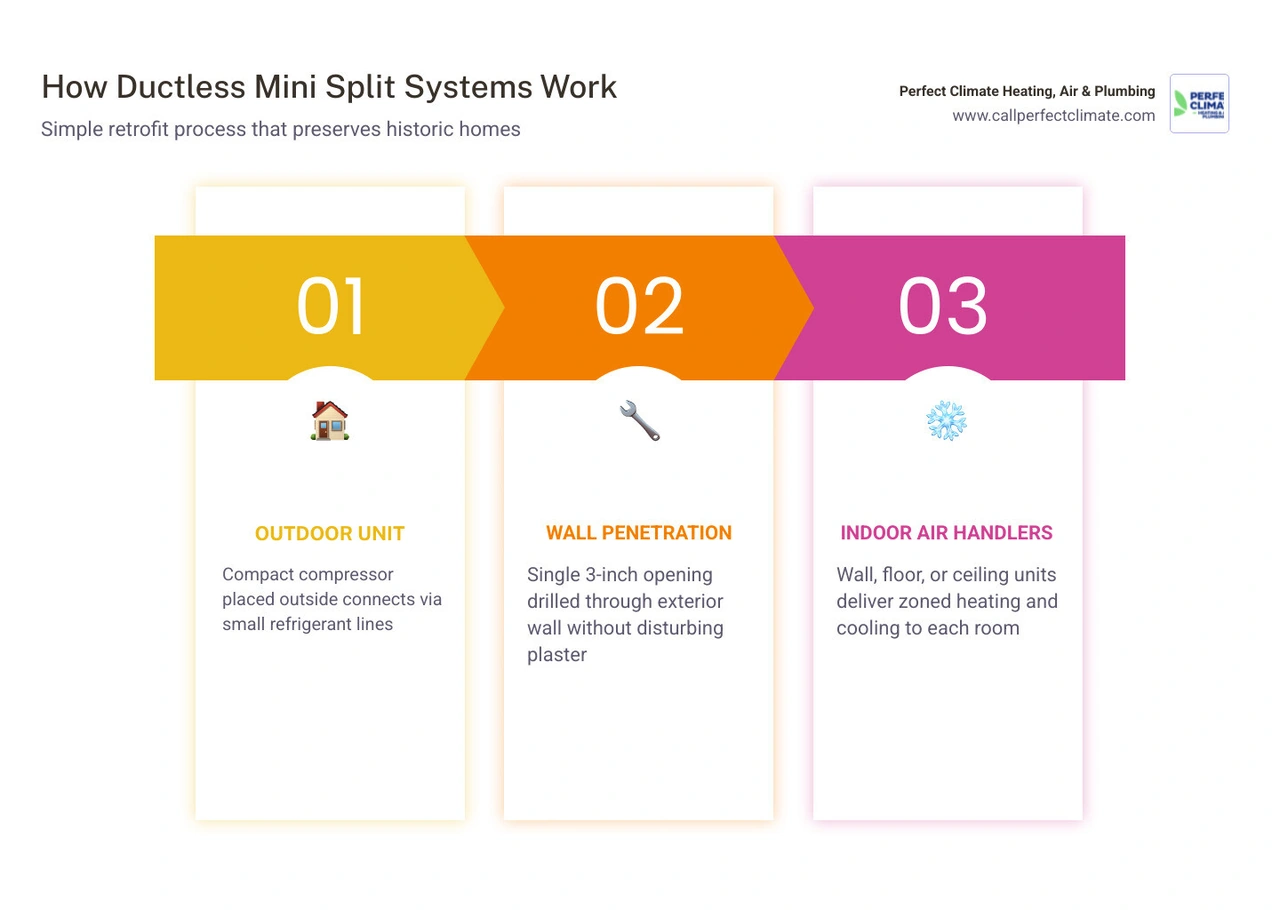
The good news is that ductless mini-split systems were practically built for this situation. They connect an outdoor compressor to indoor air handlers through a single small opening in your wall — no ductwork required, minimal disruption to your home's structure, and precise comfort control in every room you choose. According to industry data, ductless systems can reduce energy consumption by up to 40% compared to conventional systems, in large part because there's no ductwork losing conditioned air before it ever reaches you.
At Perfect Climate Heating, Air & Plumbing, we help homeowners across Haubstadt, Evansville, Newburgh, Princeton, Boonville, and surrounding communities find the right fit for their older homes — without sacrificing what makes those homes worth preserving.
Ductless mini split options for older homes basics:
Why Traditional HVAC Fails in Historic Properties

When many of the classic homes in Evansville, New Harmony, or Princeton were built, residential air conditioning didn't exist. Heating was handled by cast-iron radiators, coal-burning fireplaces, or gravity furnaces. Because of this, these properties were constructed without the wall cavities, drop ceilings, or chases required to run modern, bulky metal ductwork.
Trying to retrofit a traditional ducted central air system into a vintage home often feels like trying to fit a square peg into a round hole. It routinely forces homeowners to make heartbreaking architectural compromises. To run ductwork through a multi-story historic home, contractors often have to build artificial soffits, drop beautiful plaster ceilings, or sacrifice precious closet space.
Furthermore, older building techniques present unique structural challenges:
- Plaster and Lath Walls: Unlike modern drywall, historic plaster is fragile and supported by hundreds of wooden laths. Tearing into these walls to run ducts causes extensive vibration, which can lead to spider-web cracks across vintage wallpaper and original plaster details.
- Balloon-Frame Construction: Common in pre-1930s homes, balloon framing features wall cavities that run continuously from the foundation to the roof without fire stops. Cutting large openings in these floors and walls for ductwork is structurally invasive and can create fire-safety hazards if not carefully sealed.
- Severe Energy Loss: Traditional ductwork is notorious for leaking. In fact, standard central systems can lose 20% to 30% of their conditioned air through duct leaks and poor insulation in unconditioned spaces like attics or crawlspaces. When you route ducts through drafty, uninsulated attics in an older home, those efficiency losses skyrocket.
By opting for a ductless setup, you bypass the ductwork nightmare entirely. For a detailed breakdown of how these two approaches compare, you can read our Central AC vs Ductless Mini Split Comparison.
| Feature | Traditional Ducted Systems | Ductless Mini-Splits |
|---|---|---|
| Space Required | High (Requires attic, basement, or closet space for ducts) | Minimal (Requires only a small 3-inch wall penetration) |
| Installation Disruption | High (Weeks of demolition, framing, and drywall repair) | Low (Typically completed in 1 to 3 days with no structural demolition) |
| Noise Levels | Moderate (Rushing air noise, duct expansion creaks) | Whisper-Quiet (Indoor units operate as low as 19 dBA) |
| Energy Efficiency | Lower (20-30% energy loss through duct leaks) | Extremely High (Inverter technology; zero duct loss) |
| Zoned Comfort | Difficult/Expensive (Requires complex motorized dampers) | Built-In (Every indoor head operates independently) |
Evaluating Ductless Mini Split Options for Older Homes
Ductless mini splits operate on a simple but highly sophisticated principle. Instead of using a massive, single-speed central compressor to push air through a network of ducts, a mini split uses an outdoor condenser connected to one or more indoor air handlers via small refrigerant lines.
The secret to their incredible efficiency is inverter technology. Traditional heating and cooling systems operate like a light switch — they are either 100% on or completely off. This constant cycling on and off wastes immense amounts of energy and causes annoying temperature swings. In contrast, inverter-driven compressors operate more like a cruise control system. They ramp up and down gradually, adjusting their speed to match the exact heating or cooling load of the room. This steady operation can cut monthly energy bills by 30% to 50% compared to older systems, while providing superior dehumidification — a massive benefit during humid southwestern Indiana summers.
To learn more about how this technology keeps your home perfectly balanced, check out our guide on Mini Split Heat Pump Benefits for Homeowners.
Single-Zone vs. Multi-Zone Ductless Mini Split Options for Older Homes
When planning your system, one of the first decisions you'll make is choosing between single-zone and multi-zone configurations.
- Single-Zone Systems: These consist of one outdoor condenser connected to a single indoor air handler. They are the perfect solution for targeting a single problem area in your home, such as a drafty attic bedroom, a newly added sunroom, or a kitchen extension that always runs hot.
- Multi-Zone Systems: For whole-home comfort, a multi-zone setup is the gold standard. A single, powerful outdoor condenser can connect to up to eight independent indoor air handlers.
Because older homes are typically highly compartmentalized — featuring distinct rooms with solid plaster walls and heavy doors rather than the wide-open floor plans of modern builds — air does not circulate easily from room to room. Multi-zone systems allow you to customize the temperature in each individual room. You can keep your upstairs bedrooms cool at night while turning off the climate control in the downstairs parlor or dining room, saving a significant amount of energy.
For a closer look at how zoning solves temperature imbalances in local properties, read our article on Central Air vs Mini Split for Southwestern Indiana Homes.
Wall, Floor, and Ceiling Ductless Mini Split Options for Older Homes
One of the greatest advantages of modern ductless technology is the variety of indoor air handlers available. You are no longer limited to a white plastic box high on the wall. Today's ductless mini split options for older homes include several low-profile designs:
- High-Wall Units: The most common and cost-effective option. They are mounted high on the wall, keeping them out of your main line of sight, and are excellent at distributing air evenly across a room.
- Floor Consoles: A absolute favorite for historic preservation. These units mount low on the wall, sitting just above the floorboard. They look remarkably similar to traditional cast-iron radiators or decorative grilles, making them fit seamlessly beneath windows in Victorian, Craftsman, or Tudor-style homes.
- Ceiling Cassettes: If you have access to an attic space above the room, ceiling cassettes can be recessed directly into the ceiling. The only visible portion is a slim, flush-mounted grille that distributes air in four directions.
- Concealed Ducted Units: For a completely invisible solution, these compact air handlers can be hidden inside a closet, a crawlspace, or a shallow ceiling chase. They use short, localized duct runs to deliver air through discreet, historic-style register grilles, giving you the benefit of ductless zoning with zero visual impact on your room's design.
To explore which style matches your home's unique layout, see our Ductless HVAC Complete Guide Princeton IN.
Key Preservation and Aesthetic Considerations for Vintage Properties
If you own a registered historic home or live in a protected historic district — such as those in Newburgh or Evansville — keeping the exterior and interior of your home historically accurate is not just a preference; it may be a legal requirement. Obtaining a Certificate of Appropriateness (COA) requires careful planning before any HVAC work begins.
Fortunately, mini splits are highly reversible and non-invasive. Unlike central air installation, which permanently alters the structural framing of a house, a mini split requires only a single 2.5- to 3-inch hole through an exterior wall to connect the indoor and outdoor components. If the system is ever removed in the future, that small hole can be easily patched, leaving the original historic fabric of the home completely intact.
To keep your home looking its best, we utilize several preservation-first installation strategies:
- Discreet Line Routing: Rather than running refrigerant lines directly across the front facade of your home, we route them through closets, along interior corners, down the back of the house, or alongside existing gutter downspouts.
- Paintable Line Set Covers: All exterior lines are enclosed in durable, decorative covers. These slim covers can be painted to match your home's siding, trim, or brickwork, making them virtually invisible from the street.
- Strategic Condenser Placement: Outdoor units can be mounted on low-profile ground stands or tucked away on secondary elevations (such as the back or side yard) and screened with historic-approved landscaping or lattice.
If you are planning a preservation-friendly project in Warrick County, read more about our localized approach in Mini Split Installation Newburgh IN.
Overcoming Installation and Electrical Challenges in Pre-1970s Houses
Retrofitting modern technology into a century-old house requires specialized craftsmanship. Standard construction techniques do not apply to vintage properties, and an inexperienced installer can easily cause permanent damage.
One of the most delicate tasks is drilling the wall penetration for the refrigerant lines. Standard drywall hole saws will shatter historic horse-hair plaster, causing large cracks to spider-web across your walls and ruin vintage wallpaper. Our experienced technicians use specialized diamond core drills at low speeds with gentle pressure to cleanly cut through plaster, lath, and solid brick without causing structural vibrations. Additionally, because balloon-frame construction features open, chimney-like wall cavities, we ensure that every wall penetration is sealed with fire-blocking foam to maintain the home’s structural integrity and meet local building codes.
Another common hurdle is the home's electrical infrastructure:
- 60-Amp or Fuse Panels: Very old electrical systems are completely inadequate for modern HVAC equipment. If your home still uses a fuse box or has a limited 60-amp main service, a panel upgrade to 100 or 200 amps will be necessary.
- Maxed-Out 100-Amp Panels: Many mid-century homes have 100-amp panels that are physically full. In these cases, we can often install a dedicated subpanel to power your new mini split without requiring a full service upgrade.
- 115V Mini Split Options: For smaller retrofits — such as cooling a single master bedroom or attic office — we can utilize advanced high-efficiency 115V mini split systems. These units can run on a standard household voltage circuit, potentially saving you from the need for extensive electrical panel modifications.
For professional assistance with these technical retrofits, explore our services in Mini Split Heat Pumps Boonville IN and Mini Split Installation Mount Carmel IL.
Frequently Asked Questions About Retrofitting Vintage Properties
How do mini-splits perform in extreme cold weather?
A common concern for homeowners in southwestern Indiana and southeastern Illinois is whether a ductless system can handle our freezing winter temperatures.
Modern cold-climate heat pumps are incredibly advanced. Using hyper-heating technology and flash-injection compressors, these systems can maintain 100% of their heating capacity even when outdoor temperatures drop to 5°F, and they continue to operate efficiently down to -13°F and below.
For older, drafty homes with poor insulation, we carefully evaluate whether your mini split can serve as the primary heat source or if it should be paired with a backup heating system. If your home has an existing boiler or radiator system, we can design a hybrid setup where the mini split handles all of your summer cooling and spring/fall heating, while your radiators kick in only during the absolute coldest winter stretches.
How do you size a mini-split for a drafty older home?
Sizing a mini-split for an older home is not as simple as matching square footage to a chart. Older homes have unique thermal dynamics due to drafty, single-pane wood windows, a lack of wall insulation, and high ceilings that trap heat.
If you install an undersized unit, it will run constantly, driving up your energy bills and wearing out prematurely. If you install an oversized unit, it will cool the room too quickly without running long enough to remove moisture from the air, leaving you with a cold, clammy, and uncomfortable space.
To get it right, we perform a comprehensive room-by-room Manual J load calculation. This scientific assessment takes into account your home's specific insulation levels, window types, sun exposure, ceiling heights, and local climate data to determine the precise BTU capacity needed for every single zone.
What maintenance is required for ductless systems?
Ductless mini splits are highly reliable, but they do require regular maintenance to keep running at peak efficiency:
- Monthly Filter Cleaning: Because mini splits move air through compact indoor units, their mesh filters must be kept clean. Fortunately, this is a simple DIY task. Every few weeks, you simply pop open the front panel, slide out the mesh filters, rinse them in your sink, let them dry, and slide them back in.
- Keeping the Outdoor Unit Clear: Ensure that leaves, snow, grass clippings, and debris are kept clear of your outdoor condenser. We recommend maintaining at least 18 inches of clear space around the unit for proper airflow.
- Annual Professional Maintenance: Once a year, it is crucial to have a licensed technician perform a deep clean. This includes sanitizing the indoor evaporator coils, checking the condensate drain lines to prevent water leaks, testing the electrical connections, and verifying the system's refrigerant charge.
To ensure your system remains covered under its manufacturer warranty and runs flawlessly for decades, visit our page on Mini Split Installation Evansville IN.
Conclusion
Preserving the architectural soul of an older home shouldn't mean sacrificing modern comfort. With the right ductless mini split options for older homes, you can enjoy whisper-quiet cooling, powerful winter heating, and incredible energy savings — all without a single foot of invasive ductwork.
Every historic property has its own story, its own structural quirks, and its own unique comfort challenges. Successfully retrofitting these homes requires a team that understands both the delicate nature of vintage craftsmanship and the technical precision of modern HVAC design.
If you are ready to transform your older home into a comfortable, energy-efficient sanctuary, we are here to help. Schedule a professional consultation with Perfect Climate Heating, Air & Plumbing today, and let our local experts design a custom, low-profile ductless solution tailored to your home and lifestyle.
Need Help?
Contact us today to discuss your needs. Our team is ready to help.
About the Author
Perfect Climate Heating, Air & Plumbing
Recent Posts
- HVAC Options Comparisons for Homeowners: Navigating Fall System Failures
- Why Does My Furnace Smell Like Burning? The 15-Minute Rule for Homeowners
- October HVAC Maintenance: Identifying Freon Leaks vs. Furnace Startup Smells
- Heating Options Comparisons for Homeowners: Heat Pumps vs. Gas Furnaces Before Indiana's Winter Hits
- Indiana Fall HVAC Checklist: Handling Furnace Startup Smells and Late-Season AC Repair
Related Articles

HVAC Options Comparisons for Homeowners: Navigating Fall System Failures
Read Article
Why Does My Furnace Smell Like Burning? The 15-Minute Rule for Homeowners
Read Article
October HVAC Maintenance: Identifying Freon Leaks vs. Furnace Startup Smells
Read Article
Heating Options Comparisons for Homeowners: Heat Pumps vs. Gas Furnaces Before Indiana's Winter Hits
Read Article
Indiana Fall HVAC Checklist: Handling Furnace Startup Smells and Late-Season AC Repair
Read Article
Why Does My Furnace Smell Like Burning Dust? Fall Heating Startup Guide
Read ArticleReady to Get Started?
Whether you need a repair, maintenance, or a new installation, our expert team is here to help.