
How HVAC Condition Affects Home Appraisals: The Essential 2026 Guide
Learn how HVAC condition affects home appraisals in Evansville and maximize your property value with our expert guide.
Perfect Climate Heating, Air & Plumbing

Why HVAC Condition Affects Home Appraisals More Than Most Homeowners Realize
How HVAC condition affects home appraisals is one of the most financially significant factors homeowners overlook when preparing to sell, refinance, or apply for a home equity line of credit. A failing, outdated, or missing system can quietly erase thousands of dollars from your appraised value — sometimes before you even know there's a problem.
Here's a quick summary of how your HVAC system can impact your appraisal:
| HVAC System Status | Typical Appraisal Impact |
|---|---|
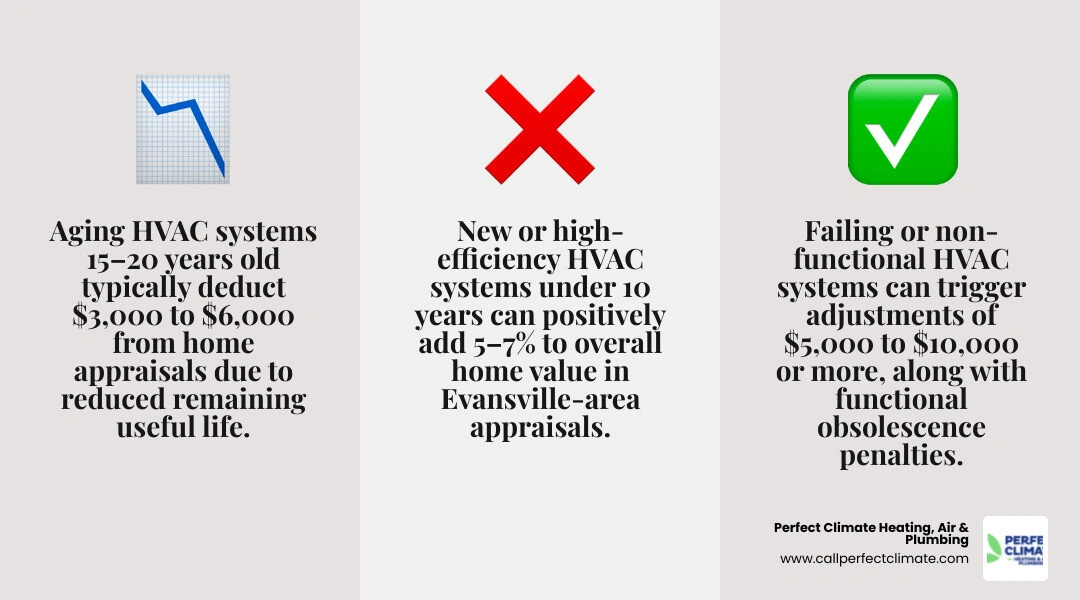
| New or high-efficiency system (under 10 years) | Positive or neutral; may add 5–7% to home value |
| Well-maintained older system (10–15 years) | Neutral with good documentation |
| Aging system (15–20 years, showing wear) | -$3,000 to -$6,000 adjustment |
| Failing or non-functional system | -$5,000 to -$10,000 or more |
| Missing central air (where expected by market) | -$5,000 to -$8,000 functional obsolescence penalty |
| R-22 refrigerant system | Treated as zero remaining useful life |
Appraisers don't run technical diagnostics on your HVAC. Instead, they perform a visual inspection and basic functional test, then estimate the system's remaining useful life based on age, visible condition, and maintenance history. That assessment gets factored directly into your home's overall condition rating — which drives your appraised value.
For homeowners in Evansville, Haubstadt, Newburgh, and across Indiana's Tri-State region, where summers are hot and winters are genuinely cold, a reliable heating and cooling system isn't a luxury — it's a baseline expectation. Appraisers in this market know it, and they'll flag anything that falls short.
Whether you're planning to sell, tap your home equity, or refinance, understanding what appraisers are looking for gives you a real advantage. The sections below break down exactly how the evaluation works, what it costs you when things go wrong, and what you can do to protect — or even increase — your home's appraised value.
How HVAC Condition Affects Home Appraisals: The Appraiser's Checklist
When an appraiser steps onto your property, they are not looking at your home through the eyes of a buyer who is imagining where to place the sofa. They are looking at your home through the lens of risk, functionality, and market standards. Because heating and cooling systems represent one of the most expensive mechanical components of a home, they receive significant attention during the walkthrough.

An appraiser’s evaluation of your HVAC system is primarily visual and functional. Under Uniform Standards of Professional Appraisal Practice (USPAP) guidelines, they are not required to perform deep, invasive diagnostic testing. Instead, they use a straightforward checklist to determine how your climate control system impacts the property's overall valuation.
First, they will perform a visual inspection. They look at the physical condition of both the indoor unit (furnace or air handler) and the outdoor condenser. They check for obvious signs of neglect, such as heavy rust, corrosion, dented cabinets, loose wiring, or pooled water.
Second, they conduct a functional test. This is as simple as turning on the system via the thermostat to ensure it actually blows warm air in the winter and cool air in the summer. If the system fails to turn on, makes alarming screeching noises, or blows lukewarm air, it is immediately flagged.
Third, they assess the system's remaining useful life (RUL) and effective age. These two concepts are critical to understanding How Old is Too Old for an HVAC System. Chronological age is simply the number of years since the unit was manufactured. Effective age, however, is how old the unit behaves and looks. A 15-year-old system that has been meticulously maintained, cleaned, and serviced annually might have an effective age of only 8 years. Conversely, a neglected 7-year-old system with clogged coils, rusted panels, and a struggling compressor might have an effective age of 15.
Assessing System Age and Functionality
To determine the chronological age of your equipment, the appraiser will locate the manufacturer's data plate on the indoor and outdoor units. This plate contains the serial number, model number, and manufacture date. If the date isn't clearly printed, appraisers can easily decode the serial number using industry databases.
If the data plate is missing, painted over, or completely worn away, appraisers must make conservative, cautious estimates. This usually works against the homeowner, as they will assume the system is closer to the end of its lifespan.
During the functional test, the appraiser is looking for immediate red flags. If you notice any Time for AC Replacement Signs—such as uneven cooling, short-cycling, or a compressor that struggles to kick on—you can guarantee the appraiser will notice them too. If the system cannot maintain a comfortable, safe indoor temperature during the walkthrough, it will be classified as non-functional, leading to direct value deductions.
Regional Climate Expectations and Local Market Standards
Appraisal standards are highly regional. What is acceptable in a mild coastal climate is often a major deficiency in the Midwest. Here in Southern Indiana—from Poseyville and Fort Branch to Boonville and Evansville—we experience a full range of dramatic four-season weather. Our summers are notoriously hot and humid, while our winters bring freezing temperatures, ice, and snow.
Because of these local climate realities, central air conditioning and robust, reliable heating are considered standard, baseline expectations. If a home in Newburgh or Princeton lacks a central cooling system and relies entirely on window units, the appraiser will compare it negatively to nearby homes that have central air. Because window units are considered personal property (since you can take them with you when you move), they do not count toward the real estate's appraised value.
In our region, a home without a permanent, fully functional central heating and cooling system suffers from what appraisers call "functional obsolescence." This means the home's design or physical features are inadequate for the local market, triggering a automatic value penalty. To ensure your system is prepared to meet these local demands year-round, following a structured Hvac Maintenance Checklist for Four Season Midwest is highly recommended before the appraiser schedules their visit.
The Financial Impact of Heating and Cooling Systems on Property Valuation
The condition of your HVAC system directly influences the final dollar figure on your appraisal report. While a beautifully updated kitchen creates visual appeal, a functioning, efficient HVAC system provides the foundational security that lenders require. If the core mechanical systems of a home are failing, the rest of the home's aesthetic upgrades lose their value in the eyes of an appraiser.
| HVAC System Condition | Typical Appraisal Adjustment | Impact on Home Equity |
|---|---|---|
| Excellent / High-Efficiency (0-5 years old) | +$1,000 to +$5,000 | Maximizes borrowing capacity; protects equity |
| Good / Standard (5-10 years old, well-maintained) | Neutral (Baseline) | Maintains baseline market value |
| Fair / Aging (12-18 years old, fully functional) | Neutral to -$3,000 | Minor risk; may prompt closer lender scrutiny |
| Poor / Failing (15+ years old, visible wear or issues) | -$5,000 to -$10,000+ | Reduces available equity; can stall loan approvals |
| Non-Functional or Missing Central HVAC | -$5,000 to -$10,000+ | Direct equity loss; potential loan denial |
When an appraiser finds a failing or outdated system, they apply a downward adjustment to your home's value relative to comparable properties (comps) in your area that have modern, working systems. This is why understanding Why HVAC Replacement is a Smart Investment is so important; it is often less about creating a massive premium and more about aggressively defending your home's existing equity from steep deductions.
How hvac condition affects home appraisals for HELOC limits and refinancing
If you are applying for a Home Equity Line of Credit (HELOC) or refinancing your mortgage, the appraised value of your home is the single most important factor. Lenders use this value to calculate your Loan-to-Value (LTV) ratio, which determines exactly how much money you can borrow.
A lower appraisal caused by a neglected HVAC system directly shrinks your borrowing power. For example, if an appraiser applies a value deduction because your furnace is on its last legs, your available equity drops. This can push your LTV ratio past the lender's strict approval threshold, resulting in a lower credit limit, higher interest rates, or a complete denial of your loan application. In this context, maintaining or upgrading your HVAC system serves as an essential equity safeguard, ensuring you can access the maximum amount of your home's wealth when you need it.
Value penalties for failing, outdated, or missing systems
The financial penalties for a substandard HVAC system can be severe. If your home has a system that is actively failing or has completely stopped working, appraisers will typically deduct the cost of a full replacement from the home's valuation.
Furthermore, systems that use R-22 refrigerant are treated with extreme caution. Because the EPA has banned the production and import of R-22, repairing these older systems is incredibly expensive and often impossible. Appraisers recognize that an R-22 system has virtually zero remaining useful life, and they will adjust the valuation accordingly, viewing it as an imminent liability.
Heating systems also carry heavy weight. If you are noticing Furnace Replacement Warning Signs—such as yellow burner flames, frequent repairs, or persistent cracks in the heat exchanger—these safety hazards will be flagged immediately. For government-backed loans like FHA, VA, or USDA mortgages, a non-functional or unsafe heating system will halt the entire transaction. These lenders enforce strict "Minimum Property Standards" to ensure the home is safe, sound, and secure. If the heating system cannot safely keep the home warm, the loan will be rejected until the system is professionally repaired or replaced.
Maximizing ROI and Preparing Your System Before an Appraisal
If you know an appraiser is coming to your home, you have an opportunity to take proactive steps. Managing how your heating and cooling system is presented can prevent negative adjustments and even secure positive value adjustments.
While a standard HVAC replacement typically recovers a solid portion of its cost in direct appraised value, upgrading to a high-efficiency system can provide a much higher return on investment. Modern efficiency metrics—such as SEER2 (Seasonal Energy Efficiency Ratio 2) for cooling, AFUE (Annual Fuel Utilization Efficiency) for gas furnaces, and HSPF2 (Heating Seasonal Performance Factor 2) for heat pumps—are highly valued by appraisers who understand modern building science. To see how these ratings translate to real-world performance, review our Standard Efficiency vs High Efficiency HVAC Comparison.
How hvac condition affects home appraisals when upgrading to high-efficiency systems
Upgrading to a high-efficiency system does more than just lower your monthly utility bills; it actively boosts your home's marketability and appraisal value. Appraisers are increasingly trained to look for green, energy-efficient features. Certified high-efficiency systems can justify positive adjustments on the appraisal report, especially in higher-end neighborhoods where buyers expect modern technology.
Advanced systems, such as dual-fuel heat pumps or geothermal heating and cooling, represent the gold standard of energy efficiency. Because geothermal and solar-assisted systems dramatically slash operating costs, they are viewed as premium assets. However, to get full credit for these systems, they must be properly matched to the home. Understanding How Proper HVAC Sizing Affects Comfort and Efficiency is critical; an oversized or undersized high-efficiency system will struggle to control humidity and temperature, which an appraiser will quickly notice during their walkthrough.
When to repair vs. replace before an appraisal or sale
Deciding whether to invest in a repair or a full replacement before an appraisal depends on your system's current condition, age, and your ultimate goals. If your system is under 10 years old and simply has a minor issue, a professional repair is the smartest path to ensure it passes the appraiser's functional test.
However, if your system is over 15 years old, uses outdated refrigerant, or has a history of breakdown, replacement is often the most strategic move. A brand-new system eliminates the risk of appraisal red flags, ensures smooth transaction progress, and makes your home highly attractive to prospective buyers who want to avoid immediate mechanical expenses. To help you weigh your options, consult our Should I Repair or Replace My HVAC System guide and our Ultimate Repair vs Replace HVAC Guide.
Creating an HVAC Portfolio and Avoiding Red Flags
One of the most effective ways to influence an appraiser's evaluation is to hand them an organized HVAC Portfolio when they arrive. Do not assume they will automatically notice your system's brand-new components or its high-efficiency ratings. Instead, provide physical proof. Your portfolio should include:
- Installation Invoices: Showing the exact date of installation, equipment models, and serial numbers.
- Permit Records: Proving that the installation was done legally and met local building codes in your specific Indiana municipality.
- Warranty Documentation: Showing if the warranty is transferable to a new homeowner.
- Service Logs: Documenting annual preventative maintenance, proving the system has been cared for.
- Efficiency Labels: Highlighting SEER2, AFUE, or ENERGY STAR certifications.
Additionally, take time to clear away common visual red flags before the appraiser arrives. Clean any visible rust or dirt off the outdoor condenser cabinet. Clear away weeds, leaves, and debris from around the outdoor unit to ensure proper airflow. Most importantly, change your indoor air filters. A filthy, clogged filter is a major red flag that suggests overall home neglect, and it can cause the system to choke or fail during the appraiser's functional test.
Frequently Asked Questions about HVAC and Appraisals
Preparing for an appraisal can bring up many questions. Below are some of the most common inquiries we receive from homeowners in our Southern Indiana and Tri-State communities.
Will a new HVAC system increase my HELOC credit limit?
A new HVAC system typically will not instantly trigger a massive increase in your credit limit on its own, but it serves as an essential safeguard for your existing equity. By replacing an old, failing system with a new one, you prevent steep value deductions on your appraisal. This keeps your home's total valuation high, which keeps your Loan-to-Value (LTV) ratio favorable and ensures you can access the maximum borrowing capacity allowed by your lender.
How old does an HVAC system need to be before it hurts my appraisal?
Generally, once an HVAC system crosses the 15-year mark, appraisers begin to view it with increased scrutiny. Systems between 15 and 20 years old are often flagged as nearing the end of their useful life. However, chronological age is only part of the equation. If you have a solid paper trail of annual professional maintenance, you can prove the system's effective age is much lower, which can help prevent age-related value deductions.
Is getting my HVAC serviced before an appraisal worth it?
Absolutely. Having your system professionally serviced right before an appraisal is highly recommended. It ensures the system is running perfectly and will pass the functional test with ease. Furthermore, a fresh service sticker on the side of your furnace, accompanied by a clean technician's report, provides immediate, undeniable proof to the appraiser that the system is safe, functional, and well-maintained.
Conclusion
Your heating, cooling, and plumbing systems are the beating heart of your home. As we have seen, how HVAC condition affects home appraisals is a critical factor in protecting your hard-earned equity, securing loan approvals, and ensuring a smooth home sale.
At Perfect Climate Heating, Air & Plumbing, we are proud to be a locally owned and trusted partner for homeowners throughout Haubstadt, Evansville, Newburgh, Princeton, Boonville, and the surrounding Tri-State communities. Whether you need a simple pre-appraisal tune-up, a comprehensive energy audit, or are interested in advanced technologies like geothermal and solar, our licensed team is here to help.
Don't let an outdated or neglected system quietly drain your home's value. Explore our HVAC services or give us a call today to schedule your maintenance or upgrade consultation and ensure your home is fully prepared to stand up to any appraisal.
Need Help?
Contact us today to discuss your needs. Our team is ready to help.
About the Author
Perfect Climate Heating, Air & Plumbing
Recent Posts
- Heating Options Comparisons for Homeowners: Heat Pumps vs. Gas Furnaces Before Indiana's Winter Hits
- Indiana Fall HVAC Checklist: Handling Furnace Startup Smells and Late-Season AC Repair
- Why Does My Furnace Smell Like Burning Dust? Fall Heating Startup Guide
- Essential HVAC Maintenance Tips for the First Fall Freeze
- Comparing Heating Options for Homeowners: Navigating the 2026 Heat Pump Tax Credit
Related Articles

Heating Options Comparisons for Homeowners: Heat Pumps vs. Gas Furnaces Before Indiana's Winter Hits
Read Article
Indiana Fall HVAC Checklist: Handling Furnace Startup Smells and Late-Season AC Repair
Read Article
Why Does My Furnace Smell Like Burning Dust? Fall Heating Startup Guide
Read Article
Essential HVAC Maintenance Tips for the First Fall Freeze
Read Article
Comparing Heating Options for Homeowners: Navigating the 2026 Heat Pump Tax Credit
Read Article
Troubleshooting Mid-Fall Heating Odors Before Searching for AC Repair Near Me
Read ArticleReady to Get Started?
Whether you need a repair, maintenance, or a new installation, our expert team is here to help.